Has anyone, on the list, run across an article, advertisement or DOCUMENTED evidence as the the cost or 18th and 19th and turn of the 20th century uilleann pipes?
Pat Sky
Has anyone, on the list, run across an article, advertisement or DOCUMENTED evidence as the the cost or 18th and 19th and turn of the 20th century uilleann pipes?
Pat Sky
I recall seeing mention of vintage prices in some of the earliest issues of the Piper’s Review. I can’t remember which time period they were from. It might have been as late as Leo Rowsome and Crowley (which I guess wouldn’t help you according to your criteria) but it might be worth a quick look if you haven’t already.
O’Neill records two reported prices in Irish Minstrels and Musicians; a set made by Harrington for the Cork exhibition of c. 1850 was reportedly sold for £50, and O’Neill reports that the value/price of the Maloney brothers set, in the “early part of the 19th century” was estimated at £100 pounds. These are probably extreme examples for the mid-19th century, but there is some reason to believe that some instruments from the late 18th century and early 19th century were even more labor-intensive in construction than these later examples - I reckon a deluxe Timothy Kenna set commanded relatively more in its day than the Maloney set did in its time.
Either way, these are very substantial sums for their time - for instance the average wages of a farm laborer were about 20d per day in 1834, 240d per pound, so O’Neill’s figures represent roughly three to six years’ wages for a laborer. Of course the pipes weren’t bought by laborers…
Bill
£50 for a Harrington set. $500 USD for the Beatty Taylor set. Both hearsay. Think O’Neill has one or two other instances of a set costing such-and-such. Good luck finding any instances of pipes being described in print that Sean Donnelly hasn’t documented already. Terry McGee’s site has some old Rudall and Rose etc flute price lists, I recall one list someone drew up or reprinted that also had the price of Wheatstone concertinas on it. Those are about as close as we’ve gotten to documented prices for folk instruments, not that “folk” was the target market for these latter items.
I did a bit of searching through the Google News Archives for ‘Irish,’ ‘bagpipe,’ and other such keywords, finding a score of items perhaps, most of them originally in the New York Times, and those will be reprinted in the Pipers’ Review at some point. It’s mostly pretty dry stuff - “a crowd danced to the music of fiddles and bagpipes on St Patrick’s” etc. This was all free of charge so public domain. There are also subscription only items, especially a good few in the Chicago Tribune, including one with the tantalizing headline “Prof Touhey’s bagpipes stolen,” apparently after the Columbian Exhibition in 1893. Perhaps they mention their value; I also intend to cough up $$$$ to read a dozen of these and will let you know if a price is mentioned. Won’t be reprinting those in the Review for obvious copyright issues. Although their are obvious issues here with the copyright on a 127 year old news clipping…
PBOF. TUOHEY’S BAGPIPES STOLEN. Lots of typos with this Optical Character Recognition software.
I know its not what your looking for in that its alot later than what you asked for but it may be of some interest.
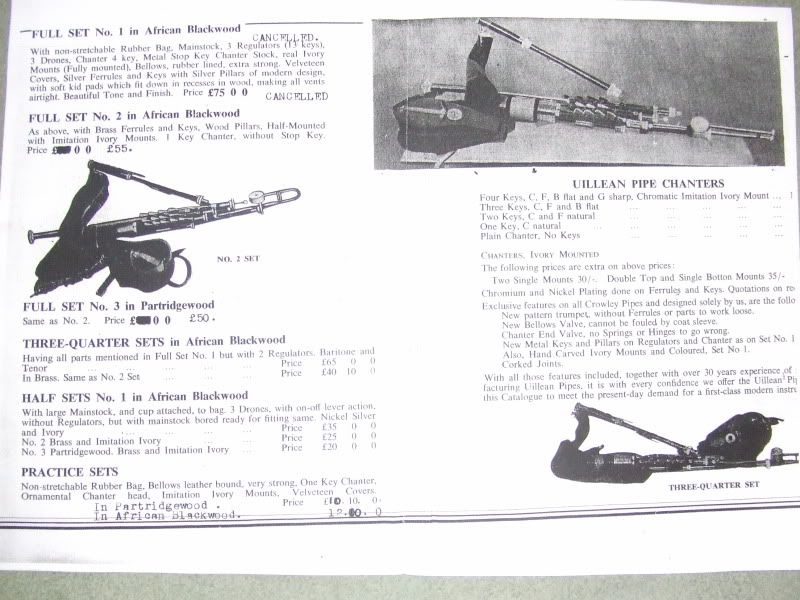
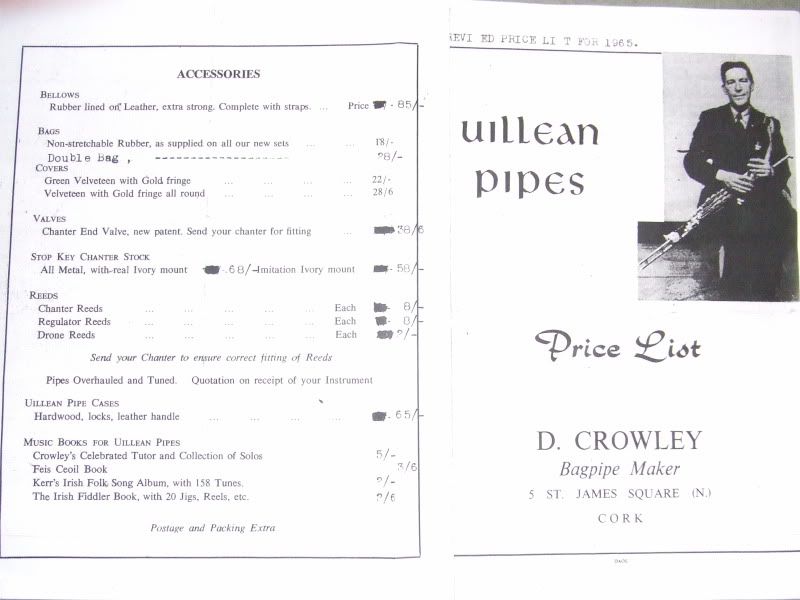
RORY
Wow, I think this gives a new meaning to the 21 years of piping – there would also be 21 years of saving up for a set. I know how honored pipers are today to have a set bequeathed to them, so I can imagine the feeling in the 19th century when pipes were worth years of take home pay. It’s no wonder there were piping families.
Considering the fact that a laborer made 8-10 pounds per year and a set of pipes cost in the neighborhood of 40 plus pounds, this gives new meaning to the pipes as a traditional instrument. Obviously only the rich could afford to play around with the pipes; Lord Fitzgerald or Walker Jackson come to mind. Most likely the pipes came to the folk when the landed gentry went bankrupt and the estates were sold off the pipes wound up in pawn shops an auctions where they were purchased for a nominal fee. Or sometimes when one of the lords heard a good player he commissioned a set of pipes to the lucky sod. As I said this brings into question whether or not Uilleann pipes are a traditional/ folk instrument, a case, as the Germans say" of Gesunkenes Kulturgut, where the food, music, fashions and culture of the rich are mimicked by the lower classes.
Seamus Ennis told me his dad paid 15 pounds for his Coyne set. Willie Clancy said that pipes were going of 10-15 pounds when he was a young boy. Out or reach of most workers.
A similar situation happened in America with the guitar. The guitar during the late 18th and 19th century was a parlor instrument for wealthy young women. There are many photographs of guitar and string orchestras featuring also other instruments such as the mandolin. These instruments wound up in pawnshops and estate sales where they were picked up by those less fortunate. Photos of early blues players showed artists such as Robert Johnson playing not the big guitars we see today but the small “Ladies” guitars made by Bruno and Martin.
Still I am looking for printed evidence of such a scenario especially the original cost by the maker. I was always hoping that Sears would put the pipes in their catalog along with the genuine Stradivarius $2.00 violins…with case.
All the best.
Pat Sky
Considering the fact that a laborer made 8-10 pounds per year and a set of pipes cost in the neighborhood of 40 plus pounds, this gives new meaning to the pipes as a traditional instrument
Wow, someone simply must write an authoritative paper on the subject, when enough reliable information is made available of course.
If these figures are true, it gives one pause to consider with what casualness we buy and sell such a wonderful instrument these days.
Or, me at least.
I recently went to hear Pat Mitchell’s talk on the Martin Reilly recording of the O’Connor Donn Reel. Pat mentioned that Martin went to England to acquire his set; I think he said it cost Martin Reilly 6 pounds. Pat may have documentation for that.
Cheers,
KAD
Here’s a couple of extracts from a long letter written by Brother Gildas - the place Bruff, 1910:
"I was now in Bruff with no pipes but a false Chanter made by W. Rowsome and pushed on to me by old Mrs. Rowsome for [pound-sign] 1. It had been rejected by somebody. I sent it to Peter Carrigan, who made reeds splendidly and the first statement in his letter back to me was: “This is a bad chanter, you should get it changed.”
“I had no chance of changing it so I tried to manage some with it till I got the 18 inch Moloney a year or two after. I learned that Pat Ward of Drogheda had the like, and I got 25/ from a friend and got it from Ward for [pound-sign]1. I sent it to W. Rowsome for a reed, and now with it playing somewhat correctly I felt moving on.”
So a new Willie Rowsome chanter, and a secondhand Moloney chanter from Pat Ward were purchased for a pound sterling each, in 1910, by Brother Gildas.
Another extract from the Gildas’ letter regarding Michael Sullivan’s Egan set which was missing the original Egan chanter:
“Where was the Egan? Why was it missing? Michael Sullivan was still alive at this time. I went to see him in the County Home near Cahirciveen. He told me he bought that set in America, and gave ‹10 and a small set for it. Being blind he was never conscious of what was missing.”
“A British Military Official, who was a friend of the Carrigan’s and was looking for Sets of Pipes for them found out Michal and got the Set from him for [pound-sign] 3. Sullivan told me that he owed a little debt, and was anxious to pay it before he died.
Hence the sale!”
So Sullivan’s secondhand Egan set, missing the original chanter, sold for for 3 pound sterling. This was in 1916.
I reckon the market for pipes changed a lot between Harrington’s time and Gildas’ time. In the early 19th century the primary customers - for deluxe, new instruments - were gentry. Post-famine, the conditions would have been very different.
There is a report - unfortunately the paperwork is not available to me now - of a surviving receipt from Timothy Kenna for a deluxe set of pipes, which reportedly was in the tens of pounds sterling (i.e. £25 or perhaps more, relying here on uncertain memories). This would fit in roughly with the O’Neill figures which were, one presumes, noteworthy for being extreme examples. One may extrapolate that an “ordinary” set of union pipes might have cost in the neighborhood of £10 or so in the early 19th century. For a skilled laborer or professional musician (as opposed to a farm laborer) this would still have represented a very serious investment.
By Brother Gildas’ day the sets in circulation would largely have been used/old sets in variable condition, almost always needing serious repair or missing key parts (such as the chanter), and the market would no longer be composed of an established gentry, but would have been the likes of the handful of serious players and reasonably-well-off acifionados, amateurs, and collectors. (For example James Ennis, and Gildas himself). Despite the scarcity of good instruments, lower prices were probably the result of the new circumstances of the market.
Bill
Here is John Egan, quoted in an article in the Clinton (New York) Courier newspaper, July 6, 1887, p. 2 column 1.
A friend of mine recently found this. The whole article worth a look:
Clinton NY Courier 1886- 1889 Grayscale - 0318.pdf
Enjoy!
Nick Whitmer

There are quite a lot of records extant of the price lists of Victorian GHB makers, which might provide at least a relative comparison. I’ve no idea if any records survive of the makers who also made other instruments, such as Donald MacDonald.
hmm, zombie thread  , BUT, in light of new evidence:
The soon to be published “Book of Brennan” , of which I own an advance copy, offers too many nuggets to list. Here’s a teaser:
Thomas Coyne’s 4 reg set (this is the one that Jeff Cullen restored a few years back) sold for $150 USD, new.
Hugh Dillon of Eureka CA’s 3 reg set was shipped for $100
John O Brien of NYC paid the same price,
Harry Tohill of SanFrancisco paid $25 for “Bag, Bellows, Chanter”
lastly, a P Healey (of 694 Haight St in SanFran) paid $10 for “1 doz reeds” 
This is the publication of JE Brennan’s order book, circa 1910-1920, with complete plans for Uilleann, Highland and Reel pipe (possibly the closest to orig Taylor plans we will get), lists of contemporary pipers, measurements of 15 chanters (incl 9 Taylor chanters), pictures, instruction method, so much that was almost lost.
One can infer that the Taylor Bros original prices were in the same ballpark, since as we all know, Brennans aprenticeship was with them
Inspired by nwhitmer here’s a clip from
Waverly NY Free Press 1886-1888 - 0053.pdf
“Watch for the street parade of the Harrigan Hibernian company, when a jaunting car with bagpipe music inside can be seen; also a brass band ef eight pieces. On that day a pair of Irish bagpipes, costing $800 each will be on exhibition. Waverly opera house, Tuesday evening, February 2.”
Possibly by the Taylor Bros.?
Didn’t the Beaty Taylor cost $500 in the 1880s?
The latest issue of An Piobaire [vol.9 no.4 pg.28] has reprinted a Chicago Daily Chronicle ad about P. Touhey’s stolen pipes pricing them at $300.
VISITORS TO THE MIDWAY PLAISANCE,
who profoundly admired the technique of Prof. J. P. Tuohey, the bagpipe player at the Irish Village, will be grieved to learn the professor was in some unknown manner relieved of his pipes while on his way home from a bag recital early Sunday morning. The set of bagpipes, the more or less dulcet tones of which caused a thrill of satisfaction that things were no worse to pervade the breasts of thousands of Midway visitors, were manufactured at a cost of $300 expressly for Mr. Tuohey, and his ardent affection for them was demonstrated by the hugging he gave them continuously during the World’s Fair. The police will spare no efforts to locate the pipes before they fall into the hands of some conscienceless amateur. Detective Rafferty has a full description of the bags and pipes, but so far is without a clew [sic] to their whereabouts.
(Chicago Daily Chronicle, 16 Oct. 1894)
Does anybody know if this is the same set that S. McKiernan now owns, or whether the set was ever found again, or lost for good?
I’d guess he got them back?
Any photo I saw of him had the same set, so before and after 1894.
Although I have heard that he owned several sets.
Tommy
I didn’t know patsy touhey was known as professor p touhey - is it the same sort of thing as ellington being called ‘duke’ and basie ‘count’,(or, more along the same lines, professor longhair)- a term denoting pre-eminence in music?
Yes, I don’t think it was that unusual for people to award themselves or be “awarded” such titles at that time. In the early 1800s, one of the MacCrimmon family was often referred to by his aristocratic patrons as “professor”.