The past couple nights after getting a batch of whistle completed, I turned to mad whistle scientist activities.
I get delrin and PVC material in these big 3" diameter shipping tubes, I have a lot of them.
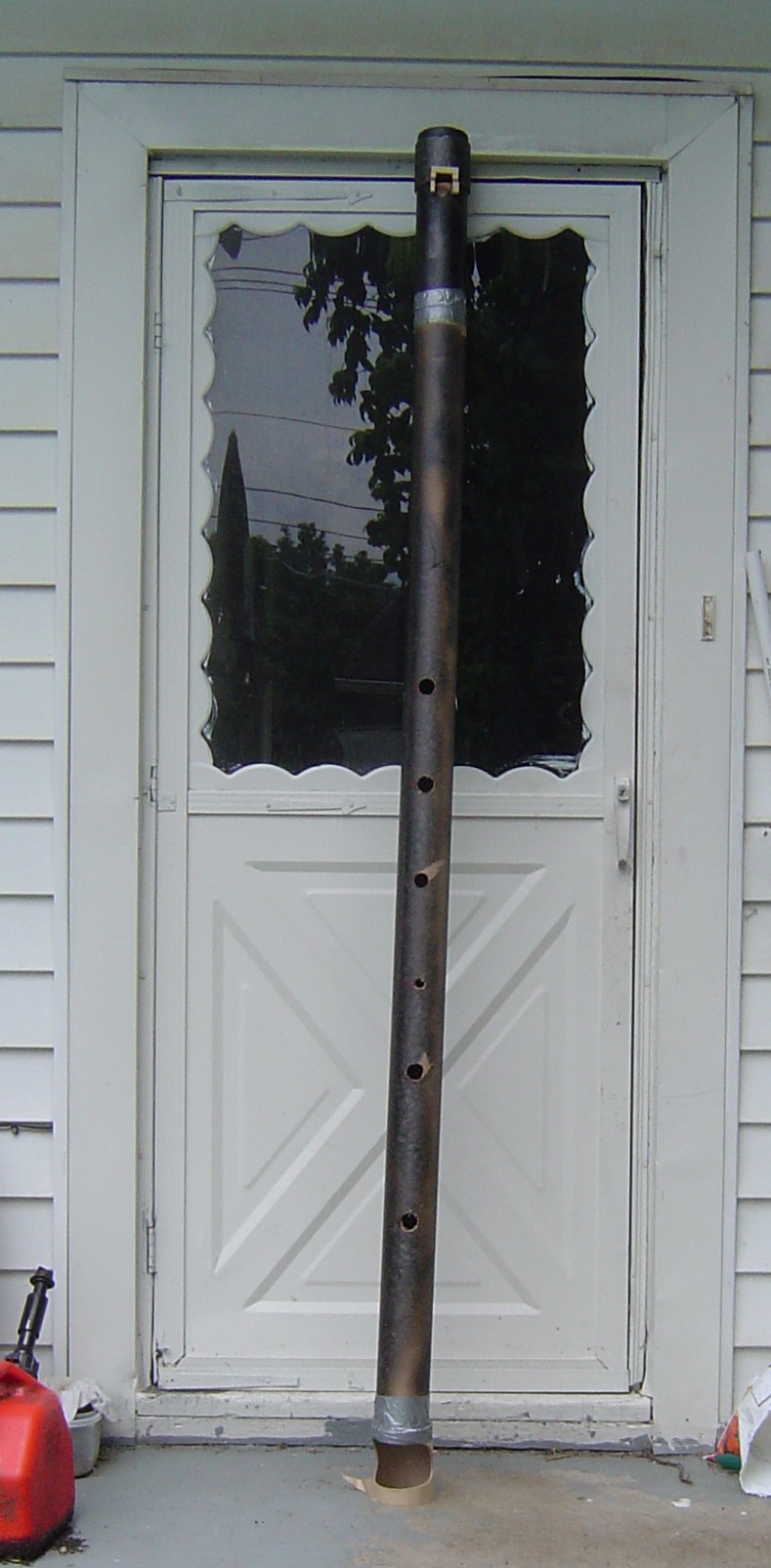
One of the extra ones is in the process of becoming a contrabass whistle.
Cutting off about a foot of the tubing for the headjoint, I cut out a 1" wide windway slot (0.25" across the window) and use CA glue to harden all the spots where the tubing was cut and also the area where the ramp is filed. (Keeps the cardboard from separating).
Painted the inside of the headjoint to help seal it and make it somewhat waterproof and less porous.
Then I cut a disk out to fit inside to channel the air up to the windway.
Another piece of tube cut to expand around the headjoint to cover the windway.
After that I duct taped a long piece of tubing to it and cut it off so that the distance from the block at the window to the end is 6 1/2 Foot long.
As a result, it’s gettting a weak 98 Hz Contrabass G note. Once I voice it a little better and seal the rest of the bore, I hope to get a little more volume.
I might just go a bit further with this duct tape thing - would made Red Green proud:
How about using Duct tape as hinges for the keys? Just for fun. The keys can be made from the same cardboard with some CA glue to stiffen. That comes later.
That will really fix those $2000-$3000 Contrabass Recorder people - a Contrabass Tinwhistle made from recycled materials. Not even $10 in it yet.
I had another thread going earlier on a Bass whistle made of copper - that’s still in the works, I’m waiting for the hobby store to get some #0-80 taps in for threading the key axles.
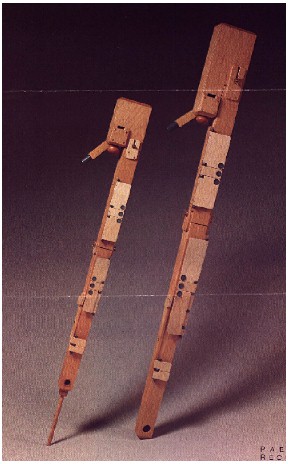
It honestly couldn’t be any uglier than the $3K + Paetzold contrabass recorder:
I like the idea of the contrabass, but the idea of bellowing out low notes like a cow, only with the flexibility of a panda on heat doesn’t quite excite
I wonder though - once you introduce a bocal design into the 1 inch labium, maybe that would really re-shape its ergonomics!
It’s now sounding a bit better.
Here’s a photo. At the moment it only plays the octave notes and harmonics.
Ears around the fipple does improve the volume. I also replaced the labium with a little wood piece that could be filed and adjusted easier.
Going to have to make a mouthpipe that is reachable.
This one is not folded, it’s straight. I think I’ll keep it that way.
Wicked cool man! I hope you make a few to sell. Shipping would probably be more than the cost of the whistle though. Maybe not, however, once you figure your time into the cost. This is just “out there” in so many ways. I love it!!!
That’s easy - put it in a bigger shipping tube. Since you’ll have extra shipping tubes lying around this will lead to a sub-contrabase whistle requiring an even bigger shpping tube leading to sub-sub…
Well, I thought my tuner was wrong when it was indicating a D and I thought it was a G.
The tube is sounding even better with a little filing and more voicing work and the tuneit! software confirms that it’s play a 72.4 Hz - slightly flat low-low-low-D.
I ran the numbers on the whistle spreadsheet and it is about the right length for that note.
This gives an L/B ratio of 28.7 it would probably do better as a low-low-low-G but I’m tempted to make it a low-low-low-D (Sub Contrabass D) because it’s working.
Well, this is even better.
Good thing I checked, I was just about to put toneholes in it to G and that would have screwed it up.
It’s like what the utility guys say, “Call before you dig”.
Ok, the correct toneholes are in.
I need to record this on something better than a PC microphone - doesn’t work good at 74 Hz!
I put extra piece on the bottom so that it rest on the floor and still let the sound out.
The hole sizes and dimensions are as follows:
Bore ID: 3"
Wall Thickness: 1/8"
Block to end length: Apx 86" (2192mm)
Holes (measured from bottom) listing top down
Hole 6:
46.55" (1182mm) 1" dia.
Hole 5:
40.59 (1031mm) 1" dia.
Hole 4:
34.4" (874mm) 7/8" dia.
Hole 3:
27.95" (710mm) 5/8" dia.
Hole 2:
22.6" (574mm) 1" dia.
Hole 1:
13.64" (346mm) 1" dia.
The cutoff ratios are about 2.48 to 3.03 which is pretty good consistency.
I would like the low end to be a bit louder though, can’t have any leaks anywhere.
Daniel, I notice there is a gas can in the lower left of your latest picture. You aren’t contemplating doing a Jimi Hendrix job on this whistle are you?
Feadoggie: No Jimmy Hendrix stuff, the gas can was for the lawnmower and rototiiller for the “linear” garden than runs along the property line. I added some more tomato plants recently.
The flaps "aka keys have been put on it. Now I must add some stops to keep them from opening too far and springs. They too are made of cardboard and just taped on with duct tape. This is continuing to be a low budget operation using items from around the workshop.
The windcap on top is fitted with a piece of 3/4" CPVC for connecting the mouthpipe and the head joint has just gain a cardboard coupler to act as a pseudo “tuning” joint. Although, it’s intention wasn’t originally for tuning but to hold the headjoint in place.


 Bravo, Daniel.