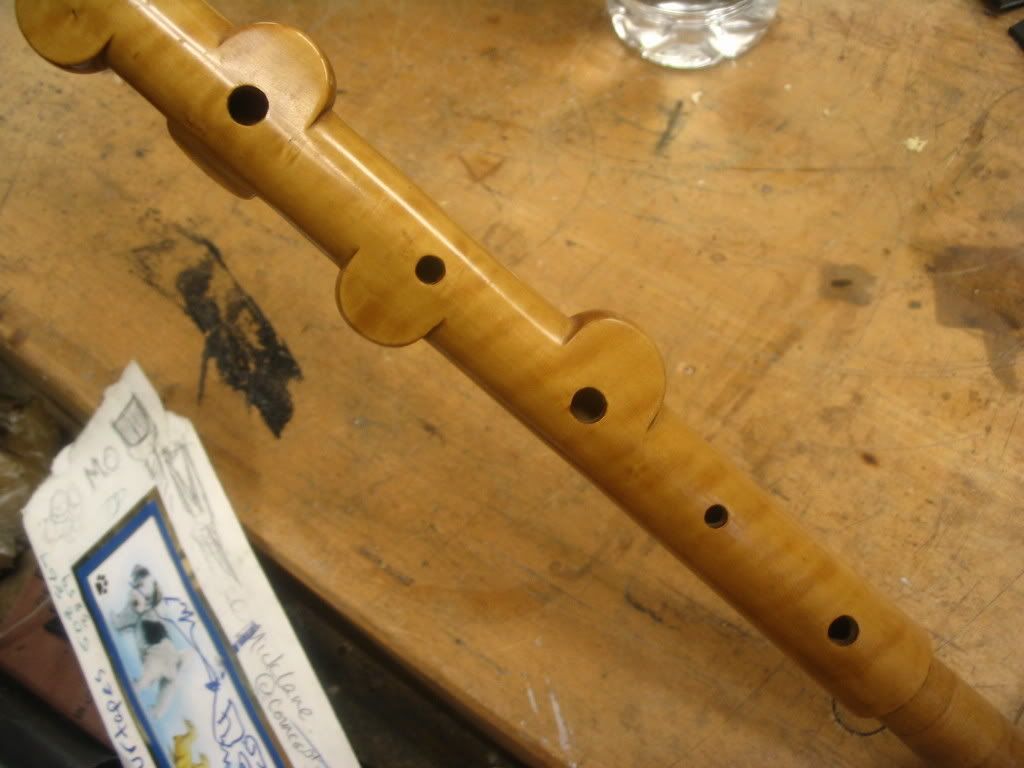
Having just recieved the July issue of An Píobaire, I noticed an ad on page 23 for European Boxwood from a business in Turkey. The wood is said to have originated in Turkey. For any (or all) of the pipemakers within the sound of my question: Have any of you ever used Turkish boxwood, and if so, how did it compare to the boxwood from Western Europe?
I’ve used Turkish boxwood, and it’s substantially the same thing as European boxwood (same species). However in the warmer climates it grows faster, so the growth rings are a good deal wider and possibly the density is a bit less.
I’ve had some problems with the octopus stuff, many pieces arrive substantially warped, and they seem to include the pith (center) all too often in the blanks. I figure a reject rate of about 40% or so.
Box has two common species across Europe. Generally Turkish box is preferred by instrument makers for obes and clarinets, etc, while European (French and English) box is used for violin fittings.
The specific gravity (relative density) does not vary very much between these relatives. What is more important is where the wood is taken from the tree. Separate pieces of wood taken from the same tree will often have different densities. This is to confuse pipemakers. It is also true of Arundo Donax, just to confuse reedmakers!
Even more importantly, box has a tendency to warp, and so must be dried and resawn more than ebony and blackwood if it is to be stable. My first full set was made from box, and the two lower drones were bent like bananas - sounded great though.
B. balearicos - from Spain, France, Italy and England
B. emarginatus - from the Himalayas
Of the three species B. balearicos is prized because it can exhibit flames in the figuring, like maple/sycamore; this looks nice on violins, but might weaken the integrity of conically bored tubes as the figuring is caused by the way the tree has grown, like maple. Flamed boxwood is about eight times the price of the usual wood. Turkish box can be quite warped and uneven in colour, depending in what season it is cut, and is a little harder than our native box (in the UK). I have only seen Himalayan box once; the grain was very close, as you would expect from very slow growth in a cold climate, but it was also softer than either ours or the Turkish variety.
Googling for buxus balearicus however turns up plenty of references in German, Spanish and Italian, so it depends on who and where you are as to what name you give to the primary ‘european’ species. It seems to me that the strongest instrument making traditions may be continentai european ones, so it makes sense that coming from that perspective you might prefer the ‘balearicus’ name for this material. All the english language timber merchants that I have encountered seem to refer to it (English/French box) as b. sempervirens however.
The one English description of balearicus which I found implies that it is NOT the common English/French species: (sorry, this one is cached) http://www.google.com/search?q=cache:1ZqbLpQeiNIJ:holkhamgardens.com/modules.php%3Fop%3Dmodload%26name%3DNews%26file%3Dindex+buxus+balearicus&hl=en
As the name implies, “balearicus” was originally associated with the Mediterrannean, so may more closely have resembled the Turkish variety (leaving aside the question of whether these are truly separate species).
My conclusion is English speakers refer to continental and English boxwood as b. sempervirens and may refer to the more mediterrannean varieties as balearicus (if they use that name at all), whereas for continental speakers the reverse may apply. This casts doubt on the notion that the two are botanically distinct.
I have not found Turkish boxwood to be harder than English or French, but I have only used one Turkish source.
BTW, I bought some boxwood which was sourced in France, from a German dealer, who called it ‘buxus sempervirens’, and some of it exhibits the strong flame pattern you refer to.
Yes, this is interesting; I have seen several samples of what is termed “French” flamed box, suitable for making violin fittings. It is celebrated because it is prettier and easier to carve than Turkish box, so I wonder whether the flamed variety (or sub-variety) is a vagary of the growth process - easier to carve=softer.
The other allied question is … is the same tree grown in sub-tropical/warmer climes - and therefore growing faster - likely to exhibit greater density/material hardness than one grown in a temperate area?
In England box grows plentifully at Boxhill in Surrey. I will ask a pipemaker who lives locally to grab some and put it to the test. It may well be that the species are the same, and it is just the growing conditon which have caused the differences. This will take some time, so I’ll get back when I have some info.
It usually works the other-way-round, faster growing timber is usually harder and more dense.
In England box grows plentifully at Boxhill in Surrey. I will ask a pipemaker who lives locally to grab some and put it to the test. It may well be that the species are the same, and it is just the growing conditon which have caused the differences. This will take some time, so I’ll get back when I have some info.
Mike
Sure. It appears to me that at most we’re dealing with local cultivars or growing condition variations. I think the situation where there are different botanical names used in different languages/countries is not so unusual. I’d like to try and find out that the “official” taxonomic body is for european flora, and see if they claim that the two species are synonymous or not.
In any case, your idea of putting local material to the test is probably of more relevance to us!