Those of you who may have missed the recent post from a commercial supplier of buxus empervirens in Turkey, and are interested in this timber for pipemaking, I have made a bookmark of their website. This post dissapeared, I suppose because it was totally and blatantly commercial. This is understandable. I, personally was delighted to find that there was a source for this elusive traditional pipemaking material. It is the only source I know of ( should it prove to be genuine) and I would not have heard of it if not through this forum.. I am not affiliated with the company, and offer none of this wood for sale. I enjoy working with boxwood, mostly for its magical and infuriating qualities. PM me for more info.
This post dissapeared, I suppose because it was totally and blatantly commercial. This is understandable. I, personally was delighted to find that there was a source for this elusive traditional pipemaking material.
You have a far more understanding nature than I do…in the brief period of time that suppliers post was up and I pm’ed Bill to ask about it…it was gone. Someone please explain to me why a notice about a commercial supply of boxwood tone wood, and uillmans later informative post about an offshore supplier of african blackwood is so damn threatening to this forum?
Isn’t boxwood notorious for warping?
I believe the policy involved is that vendors who are not actually involved in the musical areas represented on this forum are forbidden to post. It keeps the adverts from male enhancement companies, sub-African lotteries, and various others out.
I saw the posting from this company also. I had also just received a PM from them, so I had intended to make a post inquiring as to anyone who had ordered from this company until I saw their posting. So, without further ado: has anyone here ordered from the Turkish company Octopus? If you have, what results did you get as far as service and quality are concerned?
dave boling
DING! DING! DING! DING! DING!!!
Good answer. 
A little off the topic of adverts, but I have a question about boxwood. My Granda’ McElroy used to bury his boxwood pieces in manure out in the barn. He said it would turn the wood into plastic if left there long enough. I’m sure the wood didn’t transubstantiate into plastic, but is there a chemical reaction that takes place between the wood and the poop that makes it super stable? I know from experience that working with new boxwood that has not been stabilized by time or with a PEG solution is just asking for trouble.
Patrick Olwell once showed me a passage in an old book on woodwind making which described burying boxwood in the ground for twenty years in order to produce superior instruments. I don’t know if that works, but I can tell you for sure that air drying it for 18 years doesn’t seem to do any good.
I think this company had an advert or feature in An Piobaire some time in the last year. I seem to remember visiting their web site. Could be worth checking on the NPU archive, even if they are barred from the C&F and what ever other issues there are with this material.
Pipewort
What happened? Split? Warped?
PJ,
Here’s another article to read up on and worth considering..if it’s kept in a stable environment it’s basically ok.
The biggest problem with box is that the outer annular ring area is more humidity-volitile than the inner heart area. This would not be a problem if the instrument were all of either heart wood or sap wood, however this requires that the trees be at least 200 years old. You dont see box that old too often. In turning instruments from, say, 100 or 150 year old trees (more common), one side of the chanter will be more stable than the other, the dividing line between heart and sap wood running down the length of the chanter. Many times the color difference may be hard to distinguish, varying little or none at all between heart and sap. It helps to rough out instruments slowly, and if finish turned in a particular climate, and kept in that climate, good results may be obtained, but those conditions do not usually exist . Seasonal changes in humidity result in seasonal changes in the warping if the instrument. Nonetheless, box has its allure for some of us.
Uillmann very true enough.
I’m turned some over the weekend, and i’ve put it away for the time being allowing it to breath. In my case, the weather changes rapidly from about 40% humidity in the winter and then to upwards of 90% in the summer. Being surrounded by water, where I live…I was nevertheless, tempted to entain this little experiment to its full compliment.
D
I had several messages in my inbox today about this, so I guess some of you know I’ve ordered from Octopus before. (Hi Muzaffer!)
In fact I’ve ordered more than once, which should tell you something - I was satisfied enough with my initial order that I placed a second one. However, there are a number of issues that can arise with boxwood which could lead to disappointment if you are not expecting them. I would advise potential purchasers to be very specific about your needs when placing an order. I found Mr. Yeltekin to be very helpful and receptive to requests, and in my second order I avoided a number of defects and problems which were present in the first delivery - for an additional premium.
For our instruments, we need quite long billets that aren’t very warped. This can add a lot to the cost of boxwood - the amount of warping in the “standard instrument grade” billets from Octopus are fine for flutes and recorders, and certainly for mounts, but it can be too much for pipes. If you just want to make mounts, this is no problem and you could probably even arrange a deal to get highly figured billets that would be considered too unstable for acoustic sections.
To summarize problems:
-
bluestain - the standard grade still had some bluestain in a minority of pieces, though not a lot. You may wish to specify “absolutely no bluestain” if this is important to you.
-
warping - if you’re planning to turn chanters, or resaw for long drone sections, you need to specify the maximum amount of warping allowed in the billets (for instance, “40x40x370mm, maximum 8mm warping”) or similar. As the billets get longer, the price will go up very rapidly since long billets are more likely to warp during the initial drying phase after sawing. Allow for a few mm of longitudinal shrinkage, but don’t order overly long pieces unless price is unimportant to you
 I got a quote for some minimum-warp 500mm billets for flat chanters that was very high indeed, and compromised with a few 470mm billets and some 420s instead.
 -
Octopus seems still to be learning about how to saw wood for instruments, or was when I placed my first order nearly two years ago - a number of billets included the central growth ring/pith, which definitely is a problem. Specify “no pith”.
-
It’s a good idea to specify “no knots”.
The first order I placed probably had only about a 50% acceptance rate for chanter billets; of course I can work around that by resawing and being selective about the billets I use for other things such as mounts. The second order was much better, but I specified the above “extras” and paid nearly double, if I recall correctly. In my view it’s better to specify exactly what you need and expect, to avoid surprises.
I wouldn’t use the wood immediately on receipt, but I don’t use any wood immediately on receipt. A year or so under controlled conditions seems to be OK, at least so far.
Lastly, I would recommend payment via bank wire transfer - it’s relatively convenient here in Europe, less so in the US. Be aware that the money seems to go into limbo sometimes for a few days between the time your bank says it’s gone and the time Mr. Yeltekin’s bank reports receipt - don’t panic. Also be prepared to wait for wood to clear customs, sometimes it can take weeks, other times only a couple of days.
Best regards,
Bill
Sometimes you can get nice stuff for free!
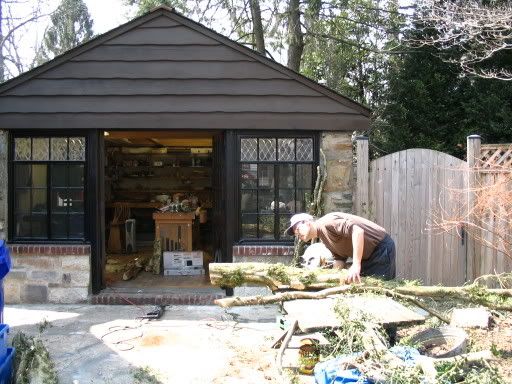
How many years are you going to wait for it to season?
Aren’t we talking about 8-10 years for chanters, less for parts and mounts?
The longer it seasons, the better. It must be sawn pretty shortly after harvesting, or else the logs will check, the check will run right through the best section of the log because it will favor the path of least resistance (where there are no knots). After a few years, the squares are turned round. A few years later again, the rounds are recentered, and retrued round once more. Then wait 10 years or so, and you are ready to go, roughing, boring, and settling with as much time between stages as your patience will allow ( for best results, finish turning the OD at least a year after the bore is nearly finished.) At this stage, the inportant thing to keep in mind is that with each successive turning, the ratio of heart wood to sap wood changes, and new patterns of warping stresses are introduced. Warped chanters may strighten or warp more. Straight chanters may warp or not. It is sort of a crap shoot, mostly determined by the placement of the bore in the wood with respect to the heartwood-sapwood division and the careful reduction of those streses over time.
To prevent the warping of Boxwood billets, I have to let you Pipe-makers onto the “secret” that I received, from Rod Cameron, the Scots (Baroque) Flute maker, of Mendocino, California, and Nairn, Scotland (most summers).
Rod bores out a small diameter pilot hole through the billet, with a gun drill
(on U-pipes,this would be the smallest diameter for the chanter throat).
Then, he COOKS the wood in a good sized microwave oven at the low power setting, for some minutes. He makes sure of the temperature with a microwave thermometer that can be placed inside the oven, together with the wood. He then uses a old electric skillett also on a low heat, as a cool down step and has some preheated oil (usualy linseed) in the skillett.
This process RELAXES all the pent-up “spring” in the wood fibers, that build up during the wood’s growth. Factors such as: The Prevaling Winds (from whatever direction), Magnetic North, the direction of growth toward the maximum amount of Sunlight etc. Rod’s Boxwood Flutes have a high frequency of stability, it isn’t foolproof. Some flute sections do still warp anyway, but this Microwaving means a lot less WASTEAGE which means more Boxwood Pipes, a wood that is beautiful, and easy to work.
GIVE IT A TRY ! WHAT HAVE YOU GOT TO LOSE! Sean Folsom
Joel Arpin has a good web site on boxwood. It’s in french but worth a translation. He describes a lot of tricks he uses, including where within a peice of wood, and curing time. http://joel.arpin.free.fr/ (le Buis)


There is a button in the middle-right side of his home page that will translate the webpage into english.
dave boling
[quote=“daveboling”]There is a button in the middle-right side of his home page that will translate the webpage into english.
dave boling[/quote]
Yeah, the little flag turn from the Ensign to stars and stripes..I have this type of wood at home “buis” doesn’t it mean yellow?
Daryl Mc.