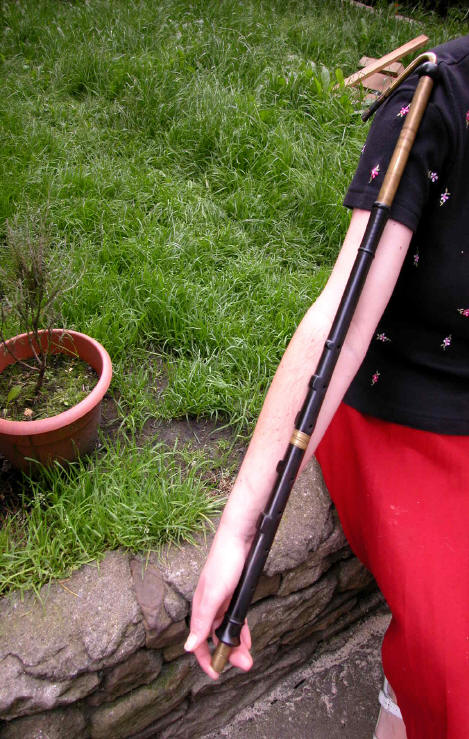
Some of your have Bb chanters IIRC - I’m interested in their lengths. I have a Bb chanter which is - according to a friend who’s also a pipemaker - extraordinary long for a Bb (47cm / 18.503 inch without reedcap (of course), click for image) - if I hold it like the woman on this picture holds a G chanter, its more or less the same length, but 1.5 semitones higher in pitch…
How long are your chanters? Or, how long are Bb chanters you know?
Length is an indication of pitch but other factors include the tone holes (size and position), bore and reed
as a rough guide and assuming A=440hz
D : 14.25" to 14.5"
C# : 15" to 15.5"
C : 16" to 16.5"
B : 17" to 17.5"
Bb : 18" to 18.5"
Wilbert Garvin - The Irish Bagpipes - D chanter 14" long
My double chanter (1900ish) is 14.625" and plays best close Eb
Longest historical chanter I have measured is an Egan at 18.75" spot on Bb
It should be borne in mind that modern concert pitch only became standardised at A=440hz in 1939 and chanters were built to the pitch that suited the pipe maker and / or the customers requirements
I thought the G chanter was made by Peter Hunter.
Brad Angus I think is making 18 1/2" Bb chanters now - he told me the other day, I’m having a new stick made and will have a look tommorow.
Where’s the 18.7" Egan, Chris?
I stand corrected. I recall having seen the photo on Davy Stephenson’s website. That’s probably why I though he had made it. Nice to see Davy’s website is back up. Looking forward to seeing and hearing more of his pipes.
Yessir! Davy has a nice touch to his work. I am particularly enamoured with the cocobolo and boxwood chater (of course ) presented in the gallery. Absolutely fecking beautiful! Keep up the great work Mr. Stephenson.
Yes, various things affect chanter length but the classic C19th flat sets all have similar designs so you can trace the effect of different fundamental notes and different pitch standards on length with some confidence, as follows:- 1.measure chanter length. 2.subtract about half an inch for reed seat. 3. add about eighth of inch for end correction. 4.multiply by 1.5. Result is wavelength of fundamental note. From there you can go up and down the tempered scale in semitone intervals by either dividing or multiplying by 1.059etc.etc. and transfer between various pitch standards using hertz numbers (e.g A440/A435 or A435/A440).
You can use shortcuts along the way but the advantage of calculating the fundamental wavelength is that you can then work out appropriate reed dimensions (i.e. the bottom of the staple is at the third harmonic, the eye is at the fourth, and the reed lips are at the fifth:- this is the origin of the old saying “an eighth of an inch of staple for each inch of chanter” but it is perhaps a bit mangled over time).
You need a reliable and appropriate starting point for all of this so if someone is about to measure their modern wide-bore chanter then maybe they shouldn’t as the numbers could go horribly wrong.
All of this is true until I discover my next inevitable mistake. Regards to all.

 ) presented in the gallery. Absolutely fecking beautiful! Keep up the great work Mr. Stephenson.
 It’ in Davy’s workshop for adding keys. Loud and Beautiful stick