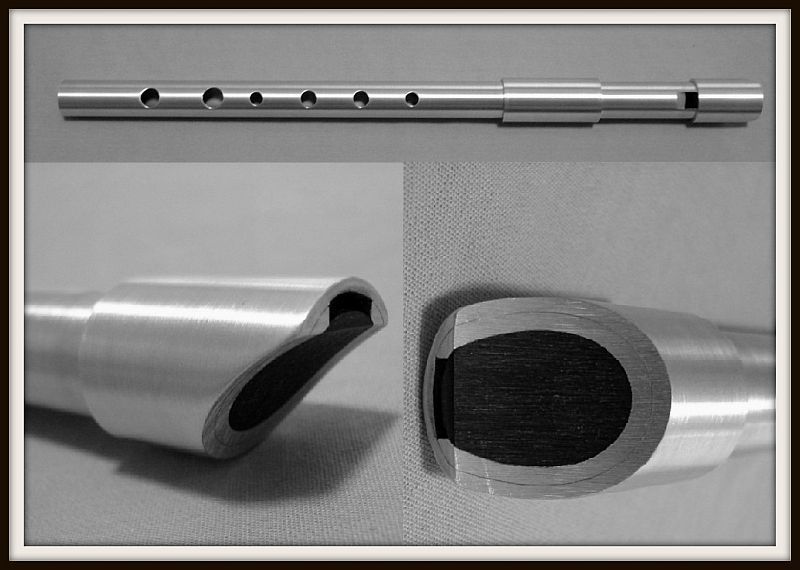
Airgead Whistle Tour

OK - so I’m the first one on the tour (Leo, you’re next)…

I wanted to give some initial impressions after playing it for about an hour tonight - I will be keeping it until the middle of next week so I can take it to our Monday session and get some impressions from the other whistlers in the group (there should be 3 more next week). I should also mention my background - I am primarily a flute player, but play whistle also (our group, Gallowglass, already has a whistler, so I don’t do a lot “in public”). I have owned (or still own) MANY of the little tooters, however - 3 different Burkes (DAN, DBN, DCN), lots of Gens, Parks Walkabout, 2 different O’Brien Rovers, Susatos, a Hoover narrow brass, Hoover PVC, etc, etc, and my current “go to” favorite, an Impempe. Just wanted to establish my “cred”…

So… Aesthetics first. Made of brushed aluminum, it’s very well-made and looks to be bullet-proof - it has an external tuning sleeve and a delrin insert in the fipple. Overall impression on first look is “utilitarian” (in a VERY nice way!). It is very comfortable to play and warms up quickly because of the delrin core to the windway. I think the delrin prevents moisture buildup as well.

The place it really shines is in its playability. As I said, my current favorite is an Impempe and it has been for a while - I like it more than any of my previous whistles. This Airgead, however sounds even better! It seems to have the exact amount of chiff that I find desirable - less that a Parks, but more than a Burke (I find Burkes to be a little too “pure”, personally). It even has a slight “bite” (can’t really think of a better description) to the tone that I really like and this is consistent across both octaves. In fact, this whistle is one of the most consistent across-octave players I have ever played. Rock solid notes all the way up and down.

Now the bad (but very fixable) - I have already discussed this with Curtis, but thought I’d mention it here as well. Intonation is a bit “off”. Curtis says this may be due to the fact that he uses “just” temperament and is entirely fixable. I don’t know if just or equal is the right way to go with a whistle - I just play it against a tuner. My Impempe is pretty close across both octaves using equal temperament, so I’ll let others advise Curtis on this point. The other issue is that there is no room to bring the tuning up to pitch (for me) without blowing so hard that the tone goes to pot. Curtis says it’ll be easy to shorten the tube slightly to allow this correction.

Overall, great whistle and I’ve already told Curtis I want one when the “tweaks” are done!

More later,

Pat

Nice review.
But how 'bout some photos?

Oops! Didn’t even think of it! Actually, the whistle is on its way back to Curtis to fix the intonation issues I mentioned and then the tour will start back up. I’ll be sure to take some pics when the replacement arrives…

Pat

I would never play a whistle with a tuner as judge of intonation. Play it with other instruments and hear how it sounds. Your ears are the best judge. I prefer a just tuned whistle to an equal tuned. For me, “fixing” the intonation from just to equal temperment is a negative, rather than a positive, especially if it was the tuner, rather than your ears who says it is out. I hope Curtis offers it in either temperment.

I believe he may keep it at just intonation, after he gets more feedback from people farther down the list (or the comment above). I don’t really know which is “best”. It does seem like the better whistles I’ve played are closest to equal temperament, though.

The main issue I had was the lack of ability to get it up to pitch. Curtis says he shortened it by a few millimeters to allow this. I was going to bring it to session, but knew it played too flat to blend (from experience) and decided to wait until the “fix is in”.

Pat

Thank you both, Pat and Ted, for voicing your opinions. As Pat stated, I’m kind of waiting to see what sort of feedback I get at the end of the tour and weigh that into making a decision as to making my stock line of whistles just or equal tuning. No matter what though, Ted, I will absolutely work with anyone to customize the whistle to their liking. I’ve been at this for a year now and dozens upon dozens of prototypes. I’m accumulating a rather good database of what variables in the fabrication process affect different facets of playability (and to what degree). My current blueprint (which is the whistle currently on tour), hits everything I’ve learned right down the middle. I think I’ve accomplished a median of volume, tonality, octave balance, back-pressure, and air requirements… though, that is up to anyone who plays them to decide and, of course, there should be more feedback on these points from other players as the tour continues. However, if someone wants more volume, or higher back-pressure, or whatever… I’ll be more than glad to custom make a whistle to suit any particulars. Along with a prerequisite notification of what other “side-affects” these customizations will produce. A change in any one aspect of my current design is going to shift some or everything else in one direction or another. But that’s one of the great things about whistles! We are all different and desire different qualities in our instruments. I own many and love each one for their own unique aspects. I have a hard time calling or acknowledging ANY whistle as “bad”. They are all just different and have their own place and purpose. :slight_smile:

Cheers,
Curtis

Curtis,
I think it was good of Pat to note the just intonation variable in his review of the whistle. Whistle “tours” are designed to provide crucial feedback to the maker, that objective being made early in this tour. I also think that there was a good decision made by yourself after consultation with Pat, to recall the whistle

Maybe if you are going to offer whistles in both just and equal temperments, you should send both examples out on the tour. You would get no complaints from me on that! :thumbsup.

In many regards, I do concur with yourself and Ted. Whistles often have their own individual voices and I really tend to let my ears tell me what I like, unless one must play in tune with other instruments.

It is nice to know that you are so willing to work with perspective clients in providing them with those charateristics they as individuals most desire in their whistle(s) ordered. :thumbsup:

Cheers,
Cayden


I echo the sentiment an informative review indeed. I collaged these photo’s from web sources on the Airgead Realta whistle.

Edit (collaging error)
Replaced whistle photo’s

Sorry, maybe it was mentioned elsewhere … But what the heck is that 8-hole layout?

That’s the one, except for the extra holes.

Pat

[EDIT] Disregard - the picture is now fixed


:blush: My fault I’ll fix that in a sec :laughing:

So, I sent the new whistle back to Pat last Thursday morning. Being in Alaska, even priority ans express mail can take a bit longer than usual… plus post office employees apparently had the last few days off for the holiday. I was really hoping it would have gotten to Pat earlier, but usps.com is showing that it is finally out for delivery to his house today!!!

Yup! It’s here! I’m gonna keep it 'til next Tuesday, or so, in order to let my session-mates check it out (on Monday night).

Pat

OK - played it for a while tonight and… This is really a GREAT whistle! My earlier impressions (see above) haven’t changed, but now it plays on pitch and has room for adjustment as well. For me, pulling the tuning slide out about 2-3 mm puts it perfectly in tune - actually pretty close across both octaves. Also, just for grins, I took it up to the 3rd octave G (thank goodness we don’t have a dog!) and it was still pretty close. As I said earlier, my current favorite whistle is an Impempe and, to be honest, it IS prettier, but my new favorite is THIS one! The Impempe has a touch more chiff across both octaves, but the Airgead has enough to let you know it’s a whistle without going overboard. The Airgead really shines in the low octave, however - it has a beautiful, “hollow” sound that I find really pleasing. Overall, a great whistle!

I’m still going to be keeping it until next Tuesday so I can get the opinions of my session-mates on Monday night and then it will move on - I MIGHT just play it a bit more, too!

Just to let you know how much I like it, I am planning to buy one once Curtis goes into full production.

Pat

The whistle is on it’s way to Leo…

Nothing really to add from taking it to session last night - 3 out of 4 of us really like it! The other thought there were some intonation issues on a few of the notes in the second octave. I did find it a little hard to “blend” sometimes, too, which isn’t a factor when testing it by its lonesome. We all thought the sound was really nice, though. Relatively even across octaves, not too shrill up high, and a truly awesome low octave. One of our members had a Goldie and the sound seems very similar.

Pat

So, my time with the Airgead Realta High D “tour whistle” has come to a close. Much like Pat Plunkett and Oleoresinator, I liked the whistle very much. :slight_smile:

Upon initial receipt of the Realta, I studied the instrument for the overall craftsmanship and aesthetic value. My immediate impression was that it shared the general attributes resultant in a function over form approach in making the whistle. The term minimalistic comes to mind. Looking beyond the first impression, I took note of the immediately less obvious elements of design and materials. It quickly became apparent that Realta maker Curtis Dashner makes use of thicker walls in his whistle tone body and that the metal work is of high quality and precision. The tuning sleeve is of the external variety and somewhat spartan in appearance. The sleeve was snug and held positive in adjustments made. Like Plunk, I found a micro adjustment of the slide had the instrument sounding well within tune for me. All tone holes were nicely finished and on center providing tactile reference for fingering and easy closure of the same. The sweep of the beak as viewed from the side perspective shows a gradual arch and positive placement while playing was without
problems. The use of a Delrin block with a curved windway made for clog free playing. I found the whistle to be in tune with itself, very responsive, moderately loud, and having a moderate level of back pressure. I thought the air demand to be a tad elevated compared to similar whistles, though certainly not problematic. Transition between octaves was generally smooth and one could play into the third octave with the shrillness of most whistles played into that range also being a factor for the Realta. There was just enough chiff to maintain that classic whistle sound and overall timbre was pleasant moving toward sweet as one climbed the scale.

Curtis Is making his whistles in a variety of keys and also makes a copper whistle for those wanting something other than aluminum. He has mentioned that the copper whistles have some unique characteristics of play inherent, and that has perked my interest. Curtis is also currently developing low whistle designs.

My overall impression on the Airgead Realta is that the whistle is made near bombproof with both quality materials and craftsmanship. At $79 for a high D, the Airgead is a true bargain given the performance characteristics and provides great bang for the buck value. Regardless if one is a fairly new player looking to move into buying their first quality whistle without breaking the bank, or a more experienced player looking to add yet another whistle to their fleet, the Airgead Realta would be a real contender.

Now, the factor I value the most regarding the instruments made by Curtis is that he is very receptive to customization requests and really works hard at meeting the specifications sought by his clients. Yes, there are other makers that offer similar services, but at perhaps two to four times the cost per instrument.

My only concerns for the Airgead line are; (1) Branding Identity. I think makers often sell themselves short in this regard by not having an identifiable marker, logo, stamping, engraving, or such, that clearly singles out the instruments as their work. It need not be overbearing, but something that lays their claim to production. (2) The aluminum metal to metal tuning slide should be kept properly lubricated and rotated now and then to prevent any potential lock up. (3) Potential increases in waiting periods as these whistles will without doubt grow a demand as their value is discovered by more players, something we have all seen happen with talented sole proprietor / makers.

As an additional sidenote, I enjoy time spent talking with craftsman who are genuinely nice people, talented makers, and are willing to put in the time to see that their clients are very happy with the final product. John Sindt, Fred Rose, Jerry Freeman, Gene Milligan, and Colin and Brigitte Goldie are among some of the nicest folks in the business. Add to that list Curtis Dashner of Airgead whistles, truly a good hearted, friendly, and talented maker. Not one to rest in his quest to provide fine whistles, I am sure we will see continued efforts on the part of Curtis to bring his whistlesmithing to the highest level he can attain. :thumbsup:

Slainte,
Cayden

I received this whistle from Cayden a couple weeks ago and his review of this whistle is spot on.
I really enjoyed playing this whistle. I found the tone to be full with a bit of chiff and breathiness that I have come to really love in a whistle. I had no clogging issues whatsoever going from my 70 degree house to playing outside on the porch at 34 degrees (some freakish spring weather here in Alabama).
I really like the sturdy and brushed aluminum design and would not hesitate to carrying this whistle with me during a hike or other travels in a backpack. I have a wooden/silver whistle that I just can’t see carrying around everywhere and chance a mishap due to the cost and time it took me to get it. The Realta sounds very similar to this particular whistle and I can see myself adding one soon to my small whistle collection!
My only issue was that the part of the mouthpiece that rests on the bottom lip is a bit rough and has sharp edges and would prefer it a bit smoother. I too would like to see a logo or an etched signature or something on the whistle for identification.
This is an overall fantastic whistle and I am sad to see it go back to Curtis way up there in Alaska ( I myself am a misplaced Alaskan and homesick…) This whistle being made in Alaska gives it more brownie points, which it doesn’t need at all!

I have to add one more message to the thread… Both myself and one of my session-mates have purchased this whistle from Curtis. That should speak to anyone having doubts. I should mention that, while I am a WhOA-afflicted player, my session-mate isn’t. This is the first “high-end” whistle he’s ever bought and he’s been playing for well over 20 years!

Good onya, Curtis!

Pat

Well, it looks like the tour is coming to an end and the whistle will be coming back to Alaska in the near future. I’m sad too, Pennycat! All of you have been so wonderful and helpful in your critiques. I could not have asked for more. Not only did every one of you have very positive words and affirmations of aspects that work well for the whistle… but each person on the tour had something to offer in way of possible improvement. I truly value that and some of the observations have already translated to amendments that I see making the whistle much more refined. As for any ideas/suggestions that may not be achievable right away… they at least have me thinking and planning towards incorporating them in the future. One of the great features of “Chiff and Fipple” in general is that we can come on here and share our thoughts on all sorts of things pertaining to music and whistles. When someone buys a whistle, they may or may not respond to the maker or seller with their feedback. As a community of players (as this forum represents), however, we can come share our observations and criticisms with each other. Whistle tours bridge that gap for whistle makers and enlist the help of players to give real insight on refining their craft. Being a player and having my own preferences in regard to how a whistle plays, sounds, and what it looks like makes me biased as a whistle maker. As well, my perspective may limit things that I notice (or don’t), and would not if someone else didn’t point them out. Saying that, some of the critiques I have received through this tour reflect ideas I had not even considered before.

I foresee a long and fruitful process in this venture of mine. I have goals and aspirations that include, among other things, one day expanding to other materials for whistles. Whether or not this happens, I predict that the crafting of whatever whistles I make is going to continually grow and be refined. Other people’s perspectives are always going to be a part of that growth and refinement. With that, I want to sincerely thank all of you who participated and volunteered your time, energy, and honesty. You have all been fantastic!

Cheers,
Curtis

Maybe this isn’t the right place to ask but what is the difference between just and equal temperament and how are most whistles tuned. I mainly play a Goldie Low D and haven’t a clue how Colin tunes his whistles. Mainly I play for myself right now but would like to play in the church worship group so I guess I need to know what kind of tuning is most relevant.