Heh heh, a quick quiz. What’s the difference between these two flutes?
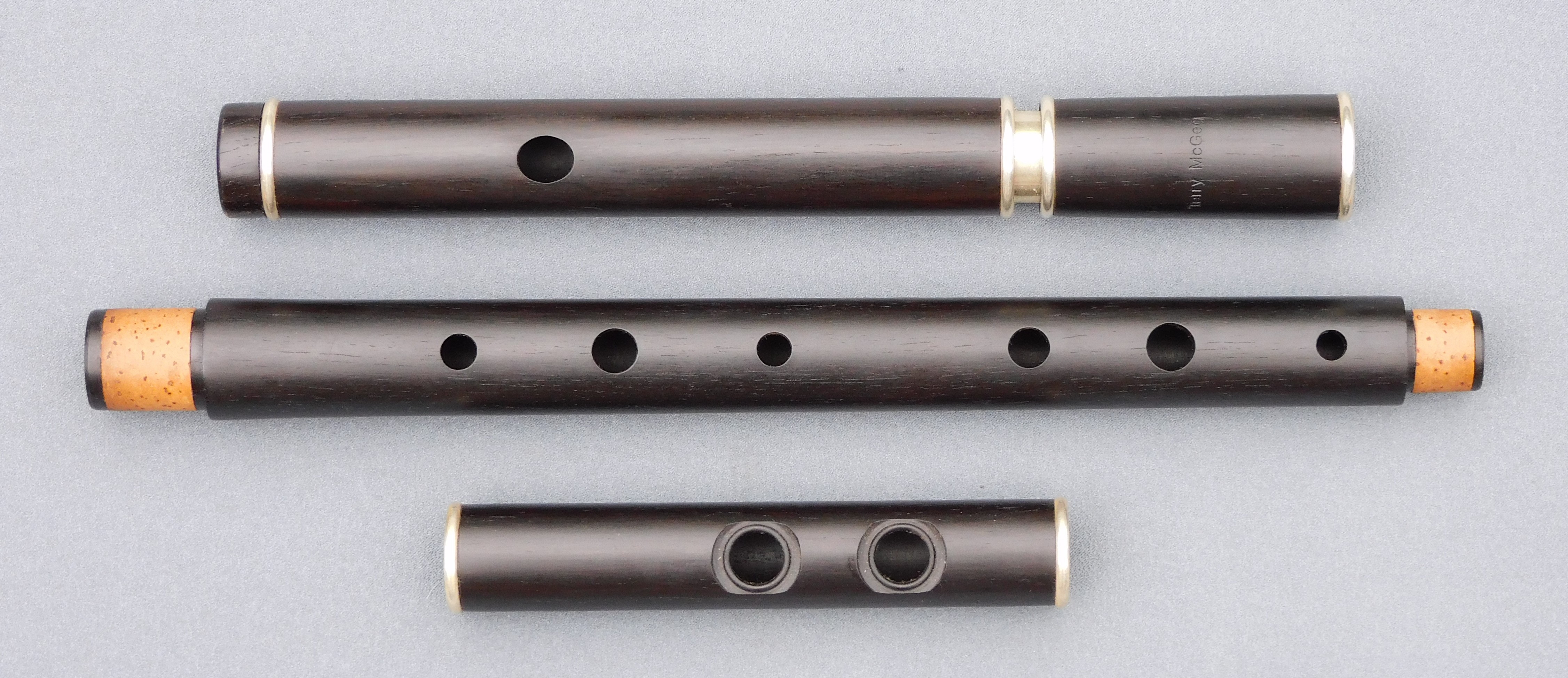
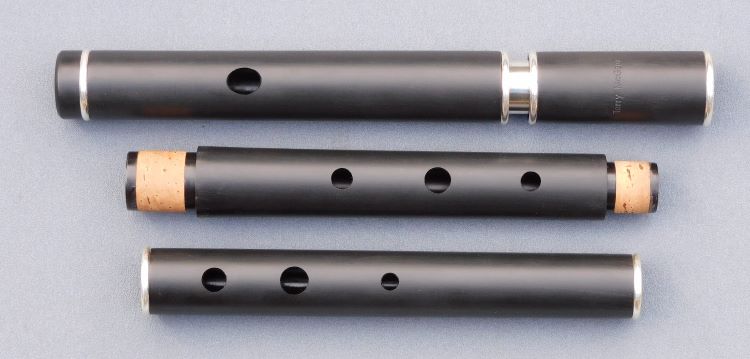
Easy, you might say. Top one is a Pratten’s Perfected style, the lower one a large-holed Rudall. Do I win a prize?
Sorry, no coconut. They’re both Prattens, just that the lower one has the long body split into two separate sections, and a short D foot integrated into the Right Hand section.
And why do that, you might ask? Because it allows you to rotate the two body sections to differing degrees, which might suit some people. Note that it’s only possible to split the Prattens body into separate left and right hand sections if you don’t have a G# key. Finding a better location for the G# key was probably one of Siccama’s goals when he introduced his long body Diatonic flute. And Pratten sensibly kept it that way when he revised Siccama’s 10-key design back to an 8-key.
There are other differences, but seeing them might depend on your screen resolution. The top flute is made from wood, our usual African Blackwood (a.k.a mpingo, grenadilla, or Dalbergia Melanoxylon). The lower flute is Delrin (acetyl).
And the lower flute has a C thumb hole, but of course you can’t see that from this angle!
One interesting thing I found is that, despite not having played a flute with a c thumb hole for years, I was immediately prompted to use it, both for playing c, and for sharpening c#. Funny thing, the brain. What’s left of it…