Firstly, I’m assuming you’d be in first or second octave for this.
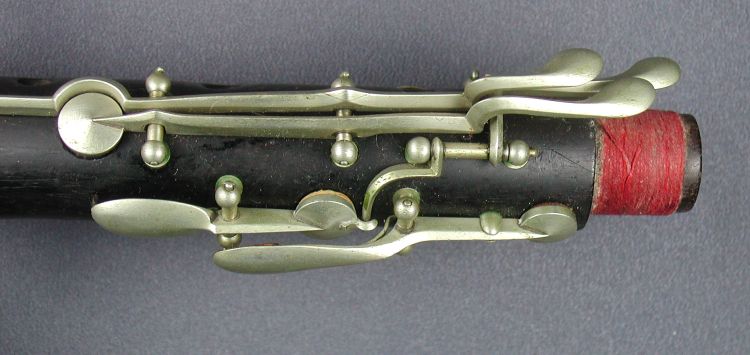
I’m not exactly an experienced player, but I’ve had to do some of that sort of stuff. It shouldn’t be too much of a problem to just sort of slide your finger (quickly of course!) off the short F key and onto the bottom hole. Your RH little finger (assuming you’re playing it right-handed) will already be on the Eb key, or should be. A lot of short F keys are made slightly tilted, purposely to allow you to slide your finger on and off the key going either from or to the bottom hole.
How fast is this stuff? 'Cos if it’s slow, it won’t be an issue. You just need to keep practising it. If it’s quick, then the way to do it is like with anything else - practise it slow.
As far as I can make out, although, as I say, I’m far from being an expert at this, you can’t use the old Baroque flute fingerings on an 8-key. All flutes have compromises built in, and 8-keyed flutes seem to have different compromises built into them than Baroque flutes do.
BTW, isn’t the 19c, 8-key, conical bore, wooden flute just the greatest instrument on the planet?
Thanks - it’s fast! One alternative I’m considering is leaving out connecting notes to make it cleaner… I’ve checked a few fingering charts and couldn’t find any alternative fingerings but thought I would just ask.
Yup, the 19th century 8-keyed wooden flute is a great instrument - but there are situations where something else would be better! Thankfully, I play the english concertina as well… but wouldn’t it be great to play the fiddle as well!!!
Another question: what’s after that Eb? I tried just the four notes a little while ago, and they weren’t t-o-o-o-o bad, but it depends what you have to do next …
A possible elegant solution, if it works on your flute, might be to un-Holster ( ) the Baroque cross fingering(s) for the Ab. I’ve just tried it on my R&R and it’s pretty decent in either octave - and way easier than F(short) Ab F(short) Eb, though I agree with Ben, with a bit of practice the only problem with that is the R3 slide off the 2nd F.
First compare which of these possible cross fingerings is closest to the keyed Ab:
1st 8ve possibilities:
xxo xxx
xxo xxx,
xxo xxo(,)
which gives you a sequence (using the long F):
xxx xx’o,
xxo xxx, (or one of the others)
xxx xx’o,
xxx xxx,
2nd 8ve possibilities:
xxo xox(,)
xxo xoo(,)
xxo xx’o(,) (- I like this one best - not Baroque, of course)
which gives you a sequence (using the long F):
xxx xx’o,
xxo xx’o, (or one of the others)
xxx xx’o,
(o/x)xx xxx, (L1 depends on your flute - some need it on, others off)
How’s that grab you?
BTW, there are no alternative Ebs whatever and these English medium-large holed flutes are unlikely to have an acceptable forked F natural. If they did, that’d be great. This little passage would actually be a doddle on Baroque flute or a French mid C19th 5/6 key… in either 8ve:
xxx xox
xxo xxx in 1st, xxo xox in 2nd
xxx xox
(o/x)xx xxx,
I’ve just tried and all of those ‘alternative’ Ab fingerings, in both octaves, are horribly sharp and really really veiled on my 8-key Rudall. Don’t know why it works on yours. Go on Jem - give us a demo with the alternative fingerings and the note using the key. I dare you.
Well, I would in principle, but in practice it’s too late and I don’t feel like it. I didn’t check 'em against a tuner and I don’t have your ears, Ben , but while they do tend sharp, I thought some of them potentially usable - I illustrated the ones which sounded best on my flute in the sequences above. The point was to provide Pamela with some possibilities to explore, but there’s no guarantee any of them will work for her, on her flute, in context, to conductorial satisfaction…
Anyway, when you get a chance, I would be interested in a better comparison on those alternative fingerings, 'cos seriously, they don’t work for me at all.
Oh, b
Right, then, just a quicky, on my R&R with Wilkes head. Box. I deliberately didn’t try to lip anything in, just blew them the same as the standard keyed fingering. First I go through the available possibilities as I showed them above, lower then middle 8ve. Admittedly the lower 8ve is dodgy - all the options are noticeably sharp, though when I did them to the tuner (not videoed) even the sharpest was less than a 1/4 tone up, about 40 cents. Then I play Pamela’s passage ditto, first with all orthodox keyed fingerings as discussed, then attempting to use the “best” alternative one. The 2nd 8ve is pretty good, IMO. If one practiced lipping them in (slower/longer notes) and/or barely lifting L3 (quicker/shorter notes) so it shades the hole, then I think even the bottom 8ve is tolerable, though that would depend on how exposed it is in context etc. The 2nd 8ve is very passable, even with fair volume and exposed.
But that’s just this flute. FWIW I tried the Baroque fingerings on the French 5 keyer which is currently lurking about the room and they were pretty perfect in the bottom 8ve but not good at all in the 2nd - I didn’t spend long trying to figure that out, though.
This raises a question I’ve wondered about for awhile. As we all know, the convention on the 19thC flutes was to drill a separate tone hole for the long F and the short F, which certainly makes for simply fabricated keys. But modern oboes, which have both a short and long F, use one hole (covered by the “short” F key pad) and then employ a lever with a linkage to open that same key as an alternative “long” F. The advantages are at least twofold: first, there’s only one hole in the bore instead of two, with whatever advantage there might be to having less disturbance in the bore and less chance of a leaky pad. Much more important is how you would execute the passage in question in this post. Because there is only one tone hole, you can switch hands with the note still sounding undisturbed. So the passage could easily be executed as Ab - short F (switch to long F to free up the right ring finger) - Eb. Quite simple, totally inaudible and it can be done very quickly with practice. Interestingly, this facility is provided on the oboe which also has a perfectly useable forked F (usually with a special mechanism to open a dedicated venting hole to improve pitch and resonance.).
The oboe offers the same “switchability” on Eb (right hand key with pad, left hand lever to same key) and, if I recall correctly, the clarinet has a similar mechanism on C#.
Since the short F key on the simple system flute has its own problems (not much leverage, hard to fit a spring and pad, and it is so short and curved that the action is often not very decisive) I have thought that contemporary flute makers might make a conventional long F key and then use a short F lever to lift that key. This is the same principle that is employed by many makers for right hand Bb levers that open the left hand thumb Bb key.
Also, FWIW, Nicholson apparently perfected the short F - Eb slide, since he preferred flutes without the long F.
Thanks for that Jem. In your clip, I don’t like your alternative fingerings in either octave. You might just about get away with it in the second octave, but it sounds awful in the lower octave, at any speed. Plus, you have obviously got the F - Eb slide perfected, because it sounded crisper and better executed than the alternative fingering in any case. Plus, you could hear each note clearly when you used the Ab/G# key and did the short F - Eb slide. They were dull and veiled with your alternative fingering, especially in the lower octave.
You can do that even on a flute with two tone holes for F. Done properly, it’s still inaudible. But I’d question whether doing that at speed was as easy as practising the F - Eb slide, which isn’t as difficult as all that, with a bit of practice.
Dunno about “more experience” - I haven’t tried to play Holst in an orchestra! Or anything much in Db… I’m just a fingering chart/flute history geek !
@ Ben, of course these cross-fingerings are veiled and inferior in tone, even the spot-on in tune 2nd 8ve one, and most are not in tune, but that doesn’t make them unserviceable for special circumstances. Myself, I would almost certainly practice up and use the R3 slide for this particular circumstance (I long ago optimised the angle of my short F touch to facilitate doing so, though I rarely need to go short F to Eb or D), but if for some reason Pamela can’t and/or one of the cross-fingerings is close-enough in tune and/or easier and not glaringly annoying in context on her flute, why not? It’s certainly worth experimenting, even if the ultimate answer isn’t all that helpful. And I certainly wasn’t fluent with the assorted alternatives in my clip, done experimentally, hastily and late at night without practicing them - they would improve if I chose to utilise them seriously (though I probably wouldn’t).
Terry - Those keys would certainly make my life easier - as would playing the oboe - but I guess for now, I’ll have to struggle with what I’ve got!
Tomorrow, when I’ve more time, I’m going to run through Jem’s alternate fingerings and see if any of them work. For me, the most difficult problem is that there’s an Eflat preceding the Fnat Aflat Fnat and an Eflat following it. At speed, I find it significantly difficult to slide off the short F and onto the Eflat - and yes, there are some other tunes where I do move from the short F to the long F to free up the finger, or vice versa - but there isn’t time for this in the Holst.
I’ve included the Dflat section below - it will certainly give everyone following this topic a workout for their keys!
More practice is definitely needed. But interesting to play nonTrad stuff on a Rudall and Rose.


 , but while they do tend sharp, I thought some of them potentially usable - I illustrated the ones which sounded best on my flute in the sequences above. The point was to provide Pamela with some possibilities to explore, but there’s no guarantee any of them will work for her, on her flute, in context, to conductorial satisfaction…