Though come to think of it, this may be an ideal solution to making a playable instrument in that shape. If all that really matters in determining pitch is the total area of holes uncovered, the task of coming up with a playable scale is much easier. All you have to worry about is the hole size, not size+location.
Some Ocarina makers increase the range by designing double- or triple-chambered ocarinas (sometimes simply referred to as double or triple ocarinas) tuned an octave or a tenth apart although some double ocarinas are not made to increase the range, but to play in harmony with the other chambers.
These double and triple ocarinas can also play chords. Different notes are produced by covering the holes, and by opening and closing more or less of the total hole area. The tone is then produced through the sound hole/embouchure. The tone can also be varied by changing blowing strength to bend pitch. [wiki]
I’ve finally had time to make the new fipple and can produce two notes on an open-ended pipe. Tonight I might see what kind of results I can get with a y-shaped, single chambered ocarina design. (No harmony sound expected, but the easiest of the designs to tune and construct, and so a good place to start.)
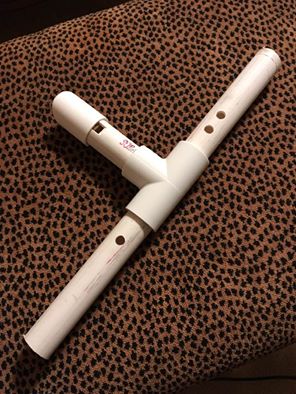
Brief update: I was getting terribly difficult to define results using the Y-splitter and duct tape to seal it, so I took a step back and bought a simple T-connector for PVC, with interesting results. I have also rearranged the pieces so that the branches are at right angles instead with similar results.
First off, capping either branch produces no sound with the new fipple design, so a forked ocarina seems to be out.
Not sure how this would be affected by a true Y shape, but here’s what I found for a t-shaped instrument with a single fipple blowing air into two pipes.
I can produce a series of single notes by uncovering holes on either branch. I currently have two holes on one branch and one hole on the other.
The pitch seems to be determined by the distance from the airway, like a normal whistle flute. Except the effect is cumulative, too…if you uncover only one of the two centermost holes, then cover that one and play the other, you will get about the same note, as they are roughly the same distance from the fipple. But if you uncover both, the pitch goes up.
I can presently achieve four notes.
Surprisingly, since I didn’t bother with precise placement or tuning, I can now play a brief riff from the musical Ragtime.
I can no longer achieve the higher/lower effect depending on how hard I blow, as I was able to when blowing down a straight piece of pipe with this fipple.
That’s what I’d expect. With two branches, the pitch will be higher than you’d get if you had a single pipe shorter than the shortest branch. Two equal branches would, roughly speaking, produce about the same pitch as if you had only one branch, half as long.
I’m actually relieved to hear you’re not getting two distinct pitches. That would have been harder to understand.
Try again after moving the fipple and windway cover closer to the soundblade, making the window smaller. As noted above, your branched whistle will be playing a higher pitch than your straight pipe, which calls for a shorter window.
Have been watching this experiment with considerable interest – I’ll add my thanks for getting all hands on as well!
One thing you might consider looking into are central embouchure flutes like this. Baines has some very good information on these, and while you’re attempting to make a “central embouchure whistle” I wonder if some of the same principles would apply.
Or like this “flutarina”; even though this flute maker is sadly mistaken if he believes he is ushering in a “new generation of wind instruments”!
Tumborough, no luck moving the fipple and windway cover closer to the soundblade. Then I get no sound. It seems very determined as to where it will be.
I wish I could do a proper test with a true Y-shaped connector, but they just don’t make them for 1/2 inch pvc. I tried reassembling it with the too-small y-shaped splitter I have, with lots of tape to seals the joints, but it’s not really working.
I guess the next thing to do is either carve a y-shaped connector, continuing development of the single-chambered flute, or start working on a double-chambered design.
I don’t really understand though why capping the ends produces no sound with all holes covered. Shouldn’t it be acting like an ocarina?
Oh, ok, so if I cover up all the holes on a normal recorder and stop the end it doesn’t make a noise either. So I guess it shouldn’t be acting like an ocarina…still a little confused by it. I guess there has to be a certain width to length ratio before it stops behaving as a tube and starts acting like a vessel?
Hmm. Not for closed-end flutes you blow across, like a pan flute. I can’t think of any closed-end fipple flutes, but there might be some.
I read through part one of Ocarina Physics, and from what I can see the volume of an ocarina chamber is defined only as area x height. There’s no mention of a shape requirement. The ocarinist/physicist who wrote it was responding to comments as recently as this May, so you might try asking him.
Edited: in fact, in part two the author says:
It doesn’t matter what shape the instrument is, giving ocarina makers the freedom for very artistic designs. You can have all kinds of shapes and sizes in a variety I haven’t seen in any other instrument.
No, it’ll make a sound. The pitch should be approximately an octave below the ordinary bell tone. This principle is what allows organ builders to produce very low pitch pipes that don’t take up a lot of space or materials.
It’s all in the angle of the airflow. Overtone flutes, pan pipes, beer bottles and cider jugs can all be made to resonate, but you have to blow them just right. Your first windway worked with a closed pipe but not open. Your new windway works with an open pipe but not closed.
So an ocarina of the same diameter and length as an open tube will play an octave lower, is that what you’re saying? (I actually did do a test on two recorders I have, stopped them up, and got no tone, but that may be a function of the type of fipple, or possibly that neither is a particularly high-end recorder)
I did find a tutorial on making a PVC ocarina, but the sound sample is appalling…still, might be worth a test.
Remember, I’m a total woodwind newb here, and my basic goal is to produce a playable y-shaped instrument at a pitch that doesn’t make my ears bleed. Right now the sample sounds all right, but I’m not really sure how to tune it, whereas the tuning of an ocarina seems to be pretty straightforward: You get the core tone and then you drill each new hole bigger and bigger till the next note comes out right. Also, if I ever try the double-chambered idea, I’ll be dealing with half the pipe volume, which would, I think, make each pipe very high, so if capping the ends will bring the tone down, I need to know that.
The difference is between a volume, which exhibits Helmholz resonance, and a long tube, in which a standing wave develops at resonance. For the ocarina, the area of the open toneholes increases the resonant frequency. For the long tube, opening a tonehole makes it behave like an open tube (even if the bottom end is closed) of roughly the length from the fipple to the nearest open tonehole. Unless your tubes are really fat, my guess would be that your Y-shaped flute would behave more like a long tube, one long(ish) tube that’s somewhat shorter than the distance from the fipple to the nearest open tonehole, regardless of which branch the open tonehole is on. If you’re aiming for low pitch, the double tube puts you at a disadvantage right out of the gate.
Figuring out where to put your toneholes to produce some kind of scale, even if you’re resigned to a higher pitch, … well, in principle it’s do-able, but it would be quite a puzzle to assemble.
The math gets more complicated if one or both branches are totally closed. I’m not going to attempt predictions or generalizations for that one.
Ah, I see what you’re saying, and it makes sense in my head, however it seems to conflict with this instrument from Wood n Bone?
The tubes can’t be all THAT fat, or the double pipe wouldn’t fit in one’s mouth. (He sells singles too.) Mind you I can’t get the sample files to play, so can’t tell how they sound.
Are the any toneholes on the farther flute, or does that do nothing but play a bell-note drone? Does the term bell-note mean anything when it comes to ocarinas?
I think that part of the confusion is that we actually have three kinds of flutes: fipple flutes (whistles), ocarinas, and overtone flutes. Each has distinct physics, hence their own set of variables. We - by which I mean I - might be talking as if there are only two kinds. However, I can find no way of determining where an ocarina stops and where a closed-end overtone flute begins, if shape means nothing to an ocarina resonator. I wonder if, as possible standing wave length increases (ie, bore length vs width) there comes a point at which the standing wave overpowers the Helmholtz resonance and the chamber switches modes.
In short, a member would like to make a working version of the (fake) Y-shaped prop played by Mr Tumnus in the Narnia movie The Lion, the Witch & the Wardrobe. Yes, we know that the prop was fake and the sound was actually two Georgian Duduks.
We’ve ended up in a morass discussing where an ocarina ends and where a closed-end overtone flute begins. Do you have cogent insight to add? How do the physics differ?
To answer your question, I believe the second ocarina in the picture is a drone, but in the video both ocarinas can play multiple notes, together or separately. (This is where I may hit problems if I try to give the illusion of a single mouthpiece feeding two chambers. Playing only one side or the other might be almost impossible.)
On a separate note, everything I read about crafting woodwinds and wooden ocarinas says to use hardwood. Is there any particular problem using something like white pine for prototyping once I’m past the PVC stage?
None. Durability will be an issue - even a soft bite will dent white pine - but I expect for a prototype pine will suffice. Unlike a stringed instrument in which the various tonewoods resonate and hence matter, in woodwinds it’s the air in the chamber/body that resonates with near zero (if not absolute zero) influence from the enclosing material. Coarser grained woods might result in a more turbulent stream of air through your flute if you’re not careful with finish/oil, but the properties of the wood itself has little or no effect.
Or at least, such is the current consensus. It’s a hotly debated issue.
Allen (of Ocarina Physics) sent a message saying that he’ll be happy to contribute once his forum membership is approved. I’m eager to hear what he has to say, and I hope I understand it.