Hi all. It’s been a LONG time since I’ve visited. Happy to be back! I’m wondering who is currently manufacturing high quality high D tapered whistles.
I perform primarily in a fairly rugged, very crowded environment (a renaissance festival) and played a Copeland for many years until I found out how high the prices had gone and realized that whistle should mostly stay at home where it’s safe and sound. I looked around a bit for a replacement and bought a Carbony last year. I like a lot of things about the Carbony (the tone, the volume, the unique look of the carbon fiber, and the ruggedness/lifetime guarantee), but I don’t like the feel of it, especially how light it is in my hands. I’ve been trying to bond with it for about a year and a half now, and I just don’t love it. I want a whistle with a little heft.
I have had (and currently have) many whistles, and I MUCH prefer a tapered whistle for performing. I’d like it to be tuneable, and a fairly rugged material (bumps and scrapes happen all the time at the festival. I have a Shaw low D that is dented all to hell–but still plays great!). My budget is several hundred dollars, though obviously I’d feel better about paying $100 for a site-unseen whistle than I would $300. I’ve been clear of my “whistle acquisition disorder” for a long while, and haven’t really been keeping up with the whistling world. I have no idea who are the current manufacturers of “performance quality”, tapered high Ds. I’d appreciate if someone could point me in the right direction. Thanks!
Note that Carbony has gone through a few mouthpiece iterations, and they’re wildly different. You might talk to Rob about what sound you enjoy, and maybe he has an older mouthpiece that might suit you better. Mine is a softer, breathier, higher backpressure version than the later models I tried. I wouldn’t mind slightly a more focused tone, but I like that it doesn’t kill my ears, and I love the backpressure.
Other than the Carbony, there are wooden whistles like the Bleazey or the Swayne that are conical bore, and then there’s the legendary Copeland whistles which can go for $600 or more when they crop up. Aside from that, a Delrin/polymer Black Pearl might be what you’re looking for, but that’s also discontinued. I’m not aware of a current maker of a really sturdy conical bore high whistle beyond the Carbony.
If conical is so rare of a find, and if you have one that is otherwise suitable, you might consider applying
a strip of metal or metal tape to the underside of an existing whistle, for the “heft”. That will to some
degree alter the tone as the responding vibration behavior of the tube then changes, it’s impact
on the tone will change. How much, can only be realized by experimenting with whistles at hand.
I’ve seen whistle reviews where people have done something like this and they liked the altered tone.
You’d have to search through the various ways to do this; soft metal tape, strip of harder metal with adhesive,
metal wrapped around the body. Any harder metal attached like this would theoretically make the whistle
more resistant to damage, depending on the offending circumstances of course.
You can try get a second hand Hudson whistle by Pete Bonsteel (not the ones currently marketed as Hudson, they are something completely different) , if anyone is willing to sell. They’d be scarce enough though.
I have been enjoying whistles by John Shaw. I have had a silver Copeland high D some years ago, and quite liked it.
I have also been looking for a whistle like a Copeland, for a more pure sound, then the Shaw has,
and have decided to have a go at making one up in the Copeland style. But in the meantime the Shaw I have is doing well.
Ed in Lakebay Washington USA
Tommy Martin (Thornton Whistles) makes a conical bore wooden whistle from time to time, looks like he’s back in Ireland now. Probably my favorite wooden whistle (Blackwood high D), but he also makes other keys in other woods, in addition to his pipes.
Revisiting this thread to see if we can coax any numbers out of those who have access to tapered/conical whistles. You might have seen at https://forums.chiffandfipple.com/t/comparison-of-high-d-whistle-bores/104767/62 we’ve been assembling data about the various bore diameters and other parameters makers have alighted upon. The vast majority of the data we have accumulated (31 entries) have been for cylindrical whistles; indeed we have but one data point for an untunable tapered whistle (the venerable Clarke’s) and one for a tunable whistle, a Bleazey. Sad or what?
So just extending an invitation that if you can supply any information about other tapered/conical whistles, that has to be a great leap forward. I have to concede, measuring tapered whistles can be quite a bit trickier than measuring cylinders. But make a start, explain any challenges you are running into and we can probably suggest alternative approaches.
That won’t alter the tone.Whistles don’t produce sound in the same manner as a guitar. Putting something on the underside isn’t going to change how the sound is produced.
Are you only wanting measurements from D whistles? I have a number of old conical whistles I could measure, but it seems many of those companies were not producing D whistles, and focusing on E, C, and B whistles, or at least that’s what I’ve come across over the years.
As for the main question of the thread- There really aren’t too many makers putting out conical whistles right now. Were I in your shoes, I’d just keep my eyes peeled for a decent deal on another Copeland, or alter the Carbony to make it heavier, as it’s not hard to add weight, and you already like it.
Yeah, only looking for measurements on D whistles at the moment. But I wouldn’t rule out some wanting to replicate the process for other keys later!
I guess I’d be interested in comments as to whether tapered bores on treble D whistles are warranted. What improvements do players note compared to a good cylindrical whistle? Better balance between high and low notes? In what terms? Volume? Easy speaking? Tone? Nicer feel? Better tuning overall? What’s in it for us?
Terry, what do you mean by “good cylindrical whistle”? I think the better cylindrical whistles have some way to counterbalance the inherent flatness of second octave notes otherwise observed in a purely cylindrical design. This is exactly the reason why a tapered bore whistle is tapered… One can shift the taper into the head section, or add some material there doing basically the same thing. And by not having a tapered low end, the low notes can be stronger. Same as on flutes.
Hi Hans
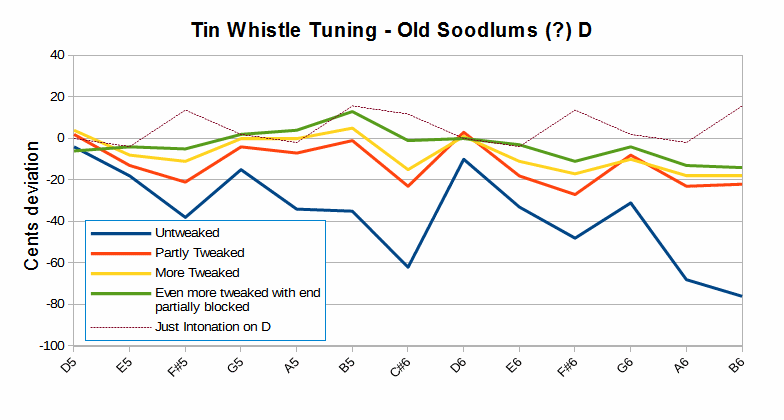
I’m certainly aware that cylindrical whistles can get “almost good enough” in terms of 2nd octave tuning, although not ideal. My heavily tweaked Soodlums/Mellow D perhaps demonstrates what’s possible. My tweaking pulled it up from the navy blue trace to the green trace.
In my (limited) experience, this assumes thin-walled brass tubing, not say thicker wood or delrin bodies. Their extra wall thickness seems to flatten the second octave too much. Now that’s been my limited experience, shoot me down in flames if it’s not accurate!
Now, I’m assuming that, as with flutes, a conical/tapered bore could address that upper note flattening issue. I’m also guessing that it would take less taper than flutes, as we push whistles into the second octave with more pressure, so we get a bit of sharpening for free. Also whistles don’t suffer the complications of the stopper-face-to-embouchure-hole Helmholtz resonator that flutes have. You can see why a flute maker is at a bit of loose end in regard to whistle acoustics!
And you had some intriguing notes on transferring the taper into the head section. “And by not having a tapered low end, the low notes can be stronger. Same as on flutes.” That sounds like it needs following up!
Terry, that is a strange graph, without further explanations as to what kind of tweaking you did! And I don’t understand the “Just intonation” curve at all. To me the F# and C# should be “flat” compared to ET for a sweet tuned whistle. Thew red line looks fairly good, even though I’d prefer a flatter B, which suits me more for playing in G, and then push it sharper for playing in D. And with all the tweaking, the high second octave end is still quite a bit too flat.
And I don’t understand the “Just intonation” curve at all. To me the F# and C# should be “flat” compared to ET for a sweet tuned whistle.
I think I would have just taken that from the usual maths for Just Temperament. Because I mostly play in sessions and bands with Equal Temperament instruments, I aim for best match to them. But it’s an interesting thought that one should really have (at least?) two instruments - one tuned maximally sweet, the other tuned to regulation. Heh heh, there you go, whistle makers - a whole new line in marketing. “You trying to scrape by on one whistle, when you really know you need at least…?” The whistle makers version of the shampoo maker’s best sales line: “rinse and repeat”.
The red line looks fairly good, even though I’d prefer a flatter B, which suits me more for playing in G, and then push it sharper for playing in D.
OK, an interesting point I should muse over. This was my first foray into retuning whistles, and given the dismal starting point, was more of a rescue mission than Great Expectations. Interestingly, it’s still my favourite whistle. But I am sneaking around behind its back…
And with all the tweaking, the high second octave end is still quite a bit too flat.
Indeed, and I assume that this is a limitation on cylindrical whistles - that if you want to avoid low B going too sharp, you have to put up with a slightly flat high B. (But not as flat as the maker had left it - navy trace, high b at -76 cents, three quarters of the way to Bb!) Or do you reckon we can hope for better from cylindrical bores? Move the top holes down a bit and make them bigger? I don’t want to fall for the trap of having oxx xxx playing a ghost Bb!
Terry, a just intoned scale with a sharp major third is just not sweet. It is perhaps a phythagorean tuning. My own deliberations I once wrote down here: https://music.bracker.uk/Music/Just-Intonation.html
and came to these figures of deviation from ET in cents, for an optimised just tuning of a D whistle to play in G major, and some associated modes:
D  E  F#  G  A  B   C  C#
0 +4 -14 -2 +2 -16 -4 -12
You see the major third is 14 cents flat of ET, both the F# over the D, and the B over the G, giving sweet thirds for both D and G major scales.
And then in practice I would aim for an even lower tuned C#, in order to get a good cross-fingered C natural (OXXOOO).
I remember those old Soodlum Mellow D whistles, I bought two boxes once, so I could infect others with the joy of whistle playing… All had a far too sharp bottom D, the tubes were simply too short, and I needed to put poster putty blobs into the ends… and all were definitely not ET tuned, but more traditional sweet, which I think a good thing. Some makers build ET tuned whistles, some sweet trad tuned. Another criteria for your list!
As to the problem of flat second second octave high notes in cylindrical bore whistles: my answer now is to insert some material into the head, a bit below the window edge. A short tubular ring of approximately 0.5mm wall thickness and 10 to 15 mm length may do a good trick there, by creating a bore restriction which affects the higher octave more than the lower, and thus serving to balance the tuning of the octaves.
I haven’t tried it myself yet, but computer modelling suggests the stepped cylindrical insert has almost magical potential in the design of an in-tune whistle.
Hmmm, interesting, Hans and Tunborough. A sort of Boehm approach - a small reduction at the blowing end, rather than a big reduction over the full length of the fingering end?
Now, if a small reduction in bore up at the head end offers this desired improvement in tuning, what mischief does the inverse do? I’m thinking of the shallow cavity created when we pull our tuning slides out say 5mm to tune. In modern whistles, that cavity is located approximately where the proposed reduction would go.
In some other whistle designs, the tuning slide is further down the whistle. Is there an ideal location likely to be less affected by the introduction of a short expansion?
And, if you were to introduce the reduction up at the head end, could you use that to “hide” the tuning slide cavity?
Or could you base the whole head design (stopper, bore under the window and ramp) on the reduced bore, followed up by the fingering section at the 'next size up" tubing.
Not really a Boehm approach, Boehm used tapering in the head. It is also distinctly different from a Fajardo wedge design. Tunborough called it a “stepped cylinder headjoint profile”, but I think there are many other geometries possible which produce similar effects. “Bore restriction in the head” might be a fairly general term we could use. This restriction in the bore profile over a small amount of length could be achieved by various means, like inserting a thin cylinder, inserting just part of a cylinder, inserting some other shape (I’ve been using a piece of credit card wedged in the head bore on some cheap whistles), a blob of putty, etc. We’ve got, thanks to some experiments, and to Tunborough’s modelling work, some idea about the size of a cylindrical insert we need. We have little ideas what the “step” thus introduced does, or if it should be mitigated with chamfering for instance. There is still a lot of experimental work necessary.
Now, if a small reduction in bore up at the head end offers this desired improvement in tuning, what mischief does the inverse do? I’m thinking of the shallow cavity created when we pull our tuning slides out say 5mm to tune. In modern whistles, that cavity is located approximately where the proposed reduction would go.
In some other whistle designs, the tuning slide is further down the whistle. Is there an ideal location likely to be less affected by the introduction of a short expansion?
…
In the past, looking at recorders etc, the small cavity created by the tuning slide is further down, say, about a quarter of the length or more, down from the window. Modern factory produced whistles with plastic heads may have the tuning cavity high up closer to the window, but they were not really built to be tuned. I don’t know if there is an ideal location, but further down may be a safer bet.