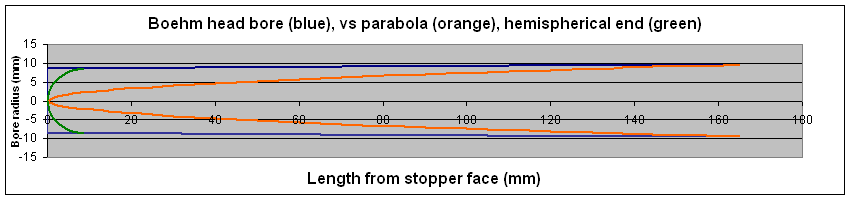
Certainly not literally a Boehm approach, but perhaps functionally pretty similar. It would be interesting to take a drawing of Boehm’s bore, eg:
and overlay on it Tunborough’s “stepped cylinder headjoint profile”. There would be a clear difference between their broad shapes, but I imagine a fair degree of functional agreement. But perhaps somebody’s already done that, Tunborough?
I always think what is extraordinary about Boehm’s headjoint bore is that for such a small intervention, it achieves so much. But we Irish flute players much prefer the darker sound provided by the steep taper at the fingering end. Question arising, can we assert anything similar in the whistle world? Why are most Irish flutes conical, but most Irish whistles cylindrical?
The stepped cylinder is a much smaller intervention: about 1 mm in total bore reduction, for around 50 to 100 mm (for a low D whistle or flute). For me, the remarkable aspect is that I was looking for the Boehm taper when I found this; the computer model said, “No, try this instead.” Under some circumstances, it might suggest a more gradual ramp instead of a step at the end of the insert, but not usually. The only profiles that provided better tuning between the octaves had two bulges with a constriction between them, and the improvement wasn’t much for all the added complication, although this may mean a tuning slide in the right position could work to our advantage. I can’t speak to the effect on tone colour, but the Boehm taper isn’t the best way to balance the octaves (although to be fair, I haven’t yet looked at what happens in the third octave).
The availability of brass tubing may explain a lot.
Now, this discussion on reducing the diameter at the top of the whistle bore made me wonder about the cavity that lives up under the windway in moulded plastic head instruments. A cavity “off” would seem to be the opposite of a bore reduction. I’m aware that “serial whistle tweakers” are inclined to poke stuff in there, although I can’t remember if they have specified why. (Tuning? Power? Response? Tone? All of the above? Other?) That lump of poster putty sitting on the end of my desk beckoned. I tore off lumps and pressed them into the cavity of my old retuned Soodlums head with the flat back end of a pencil, until the cavity was full and flat-faced. Playing it again, no immediately noticeable downsides, and a definite benefit to top-end tuning. And I felt the top B spoke more cleanly which can be an issue with this 13.5mm bore instrument. I’ll leave it there for a while and see if anything else occurs to me.
I also thought that it might be possible to test the notion of a protruding stopper by adding a bit more poster putty and moulding a protrusion and chamfer but stuffy performance and nothing positive ensued. Probably not a fair test - the rest of the head would need to have been made to assume the extra material.
While in the mood to poke things up my poor innocent whistle, I cast around the office for something that would simulate a bore reduction at the top end of the bore. Hmmm, slim pickings, but I settled on a needle I use to manipulate things under the zoom microscope. The needle is too small to be significant, but I have set it into 90mm of 4.7mm aluminium rod as a handle. Overkill I know, but it follows the old military approach of one shot over the bows, the second shot too near, and the third shot amidships. This test was to make sure I could detect change and that the whistle would still function. Sure enough, it has dramatic effect. Enough to confirm that a more subtle approach could be useful. I understand that this process used to be called “fishing” in earlier times, as it makes placement of the item easier if you attach it to some fine piano wire.
And so of course I couldn’t then resist going down to the workshop and cutting off 15mm of 13.5mm OD brass tubing to pop into the top end of the fingering tube. Yes, further sharpening, but probably a bit much. Still, gives me plenty to play with.
Hmmm, if I keep making improvements to the old Soodlums, I won’t need to make a new whistle…
As I understand it, the cavity is a necessary attribute of the molding process and not a deliberate musically oriented design feature. The poster-putty fix is clearly beneficial to all the whistles of other manufacture that I’ve tried it on and to the detriment of none.
I also thought that it might be possible to test the notion of a protruding stopper by adding a bit more poster putty and moulding a protrusion and chamfer but stuffy performance and nothing positive ensued. Probably not a fair test - the rest of the head would need to have been made to assume the extra material.
The increasingly tenuous overlap between the discussion in this thread and the one headed New style whistle heads may have reached the point where it’s getting in the way of a focused discussion. My most recent contribution to the other thread is appropriate at this point in the present one but unless someone more familiar with the House Rules than I am indicates that it would be acceptable to cross-post it, there’s more about protruding blocks to be read here.
I wonder if we can quantify a kind of optimum for head bore reduction, Tunborough? Optimum for me would be a reasonable good tuning of the octaves, without choking the voice. Is an 8% to 9% reduction of the bore cross-cut area over a length of 8% to 9% of the length from blade to end, starting just a little below the blade a reasonable approximation? Can we be more precise? I hope some percentage figures proof to be scalable for different whistle keys.
Not what I wanted to hear, but thanks for answering! So we keep going with experimenting!
From the limited way I have been using head bore restrictions I was thinking, that the shape did not matter so much as the amount of restriction. Sticking a piece of credit card cut-off into the head seems to have a similar effect than sticking a thin tube into it, or a blob of poster putty… But this was all done on a very unscientific basis, just try and hear and see (on a tuner).
A couple of thoughts here - first, the idea that there is no reason for the depression under the windway exit face. A lot of people put poster putty in here, but I don’t find it has a meaningful effect on the tuning of the second octave and seems likely to be the placebo effect, at least with the whistles I’ve had access to. Might be interesting to check that on my water gauge whistle tuner. But anyway, I made a stepped series of plugs with 0.1", 0.2", and 0.4" depressions. I found that the tone was richer and rounder the deeper the depression was. I think this is due to the extra resonating space created by the depression - the same reason keyed flutes, despite having more interruptions in the bore from more holes, often sound richer and livelier than a keyless flute of the same design.
By the time we got to 0.4," however, I was noticing some second octave flatness, so there might be something to the octave issue after all - it’s tough for me not to just blow things into tune. I also tried grids and gyroid infill to the plug to allow the same air volume but interrupt any turbulence the cavity might cause, but I didn’t really notice a benefit to this. Ultimately I found the best solution was a 0.1" depression and a ramp under the windway exit face to smooth out the entrained air from the whistle body. I haven’t played with depression depth since adding the ramp because my CAD software shits itself over that particular feature, and the bodge I had to pull to get it to work took ages.
Now as to Hans’s points about bore restrictions - I experimented with this heavily for several weeks, and every time found that the detrimental effect on the tone was not worth the slight 2nd octave boost it provided. It always made the low notes rattle and the overall tone just a bit duller than when unrestricted, but I am using a 0.503" bore, and I believe Hans uses larger sizes which might tolerate restriction better. Perplexingly, I found that a slanted, fang-shaped insert of brass sheet had a much greater effect on the 2nd octave than a bore restriction in the corresponding location, and disrupted the tone far less.
I’d still like to find a different solution as it’d be easier to clean, but so far this has had the best result in terms of taking a design with a tone and response I like, and boosting the 2nd octave without making a significant change.
Edit: I wonder if the perceived performance increase doesn’t come from reducing the boundary layer under the air jet. Thinking about it in terms of flow, the entrained air from the air jet might cause more turbulence with a large area of still-ish air right underneath it. Since turbulence seems to be the enemy of good whistle tone and performance, perhaps having a flat surface reduces the ability to entrain air and cause turbulence.