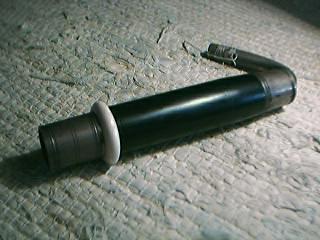
Have a chanter in for reeding that owner thinks is a Dave Williams however from the style and dimensions it is more likely Peter Hunter (or one of his pupils).
Tubes are all hand rolled and feed pipe from bag has the characteristic rounded triangle section. Mounts are of elephant ivory which unless the maker has a cache dates it to before 1986. It is 367.5mm (14 7/16") long and is playing spot on 440hz (22C) this morning
If anyone can do a positive ID it would at least help the owner who is thinking of selling it.
Chris
That is almost deffinatley a Hunter chanter. I have one that is identical to it. If you get it reeded up right, it will blow your mind. They are great chanters.
Yes! lovely, that is one of Mr Peter Hunters Chanter, but it looks like one of his earlier ones, what is the length of the chanter,
14"1/2 inches should be the length, 42-44mm hand rolled staple, I find works for his sticks.
Yes, certainly a Hunter. Dave Williams has never made those ugly (I think) bulbous wind caps. Dave has also always stamped his pipes from the beginning. My chanter is stamped Williams Newark for ex.
The chanter cap was designed by Peter to (in an ideal world) be largely hidden by the bag cover, which would be elasticated and sit about 2" above the ivory ring (hence the taper). The intermediate design between tying in the chanter directly and Peter’s design was a roughly made swan neck - unpolished - which you were never meant to see, but which avoided the crinkly bag syndrome of directly tying in.
Problems with splitting can occur in caps with less meat at the top, I’ve seen this happen myself when you try to get a good seal on the swan neck, lots of thread, shove it in hard - oops I’ve split me cap . . . .
The swan neck design that Hunter uses now is only 11mm in diameter, in a brass plug (below), which takes some of the bulbosity away. More bulbosity will be removed “in the fullness of time . .”
It’d be a dull world annyway if we all liked the same aesthetics . . .
I was gonna post a pic of it, since it’s nearly identical to the one the thread is centered on, but it seem redundant after all the confirmations. Thanks again Sam.
Fair enough then if the bulbous wooden part is meant to be hidden by the bag cover then I could prehaps tolerate it But I don’t really like the idea of it lurking there bulbously


 but it looks like one of his earlier ones, what is the length of the chanter,
 careful,
  that was the old tradition way they were made.