Uilleann Pipes wood, mounts, and tone

Hi Wyatt,

I would have jumped in a little sooner, but I’ve been under the weather for a few days.

In my experience, the things that impact tone the most are (roughly in this order):

  1. the reed;
  2. the details of the chanter bore

[N.B. - these first two are not independent, since the bore will determine what sort of reed will give the best results, and vice-versa];

  1. the player;
  2. the material.

My experience, and that of many experienced makers, is that material does have a significant tonal impact (though secondary to the bore+reed combination). It’s true that the physics of this phenomenon are not well understood. It’s worth noting that pipes are not soundbox instruments, nor are they flutes. From the reports I’ve read of the few anecdotal studies, for instance of flute materials, I don’t think they prove much. I would say however that it makes little sense to make a materials decision without taking into account the maker’s preference and opinions.

I think the other advice you’re getting is sound. I wouldn’t recommend a new learner, or ‘prospective learner’, as it were, to purchase a full set of pipes. This is for multiple reasons - price and availability for starters, but also because no matter how smitten you may be with the sound or idea of the pipes, actually playing them is a big commitment and there is a high attrition rate. For an adult learner, especially, it may be many years before you are ready to tackle the regulators - just getting to grips with the chanter may take a couple of years. At least as important is the fact that you won’t really be in a position to choose a maker for a full set of pipes, let alone a timber, until you’ve gained some experience on the instrument. Given that most full-time makers only make a handful of sets per year at full output, they will want to be confident that the set will be played rather than stored in a closet.

The good news in all this is that it gives you plenty of time to gain experience and get your chanter, bag and bellows skills together while you select a maker and wait for a set to be produced; if you find that your practice set doesn’t meet your requirements for expansion to a full set, you haven’t over-committed. You will also be able, hopefully, to see and hear instruments firsthand. These decisions are highly personal, so it’s not very practical to just ask around on the internet.

best regards,

Bill Haneman

Hope you’re back to health and then some, Bill!

Thanks Cathy - I’m on the mend! (nothing serious)

Thanks especially to Bill and Cathy for the good advice they’ve given me.
It’s really helpful and I appreciate your comments a lot.

Since, as I’ve mentioned, I do know that the uilleann pipes are not the kind of instrument you would just pick up one day and dedice “Hey, I’m gunna start playing uilleann pipes and then become the best piper ever.” I would like to keep thinking on these things and you know, any ideas about this are nice to have. So, what I’m trying to do right now is finding which direction this crazy thing is taking me and if it is even what I’m supposed to be doing. I’m hopeing someday to become a luthier and specialize in electric guitars and basses, not so much acoustics, but maybe them too. :slight_smile: But hey, has anyone ever heard of electric uilleann pipes? I know Ger Fahy uses a mic on his pipes to add delay effects. But is there really any way to put pickups on woodwind instruments? Just wondering, anyways.

Can anyone recomend some good pipe makers who don’t have a website, or that are known as quality makers, I know that Koehler and Quinn’s waiting list is closed at the moment. What I’m looking for is a maker who is able to add custom touches, not because I want a set of bling or really fancy pipes, but just so that I can be assured that the pipe makers is more than a pattern builder. one who has the ability to deviate from course, try new things, and do crazy things like extra regulators, or special keys or drones bending designs or Whatever. AGAIN, not saying that pattern building is not quality, or cheap, because it’s not, it can be very fine, but what I am searching for at the moment is the above.

And if anyone else lives in Oregon and knows about any toinals (however that’s spelled, sorry) or uilleann pipes convetion things, :laughing: that would be nice to hear.


Being an electric guitarist and using powerchords in both metal, rock, and Irish trad.
I would find it very usful to have that same ability to play such chords on the uilleann pipes.
Yesterday I was braistorming about the possibility of having a six drone system, or eight drone system would also be useful for this. Were two drones (or in the case of eight or nine drones, 3, or 2) playing the Bass and Baritone D notes, two drones playing Bass an baritone G notes, and also having two drones both with on /off switches, of the notes of A and E. There would also need to be a switch for the changes between D and G, so that A and E could be left playing.

Available chords would be: D power chord=DAD, G power chord=GDG, A power chord=AEA

Other arrangements could be that keys that could open on the drones, (I guess), to macke these extra notes. This would also be extrememly effective for playing complex chords with the regulators as a partner to the drones.

This would be useful for the rigslip styles I play. With a C key on the Chanter Am rigslips could be played with the power chord of AEA, and Dm rigslips or minor jigs, could be played with the DAD power chord. It would also be extremely effective for jigs, reels, and airs, in major keys, as (if the Switch sytem was easy and effectively accsessable) to add more power, or to diminish sound, as a song is played.

Also I think it would be found very useful if the regulators could be adjusted as such: to give powerful fifthe chords.
Tenor: F# G A B
Baritone: D E F# G A
Bass: G A B C
Double Bass: D E F#

It eliminates the usual dissonance between tenor and baritie regulatrors and it adds for complex major or minor seventh chords, while also alowwing power chords, and fifthe chords to be played alone or with the drones. also if the chanter is fitted with at least four keys of G#, F nat, D#, and C nat, then a wide array of Irish or world music could be played masterfully if mastered correctly. Songss such as Maurice Casey’s fancy with G#, and songs like the boys of Ballinchalla, with the D# major run, would be played effectivaly,
Playing the power chord of GDG with a song such as The Musical Priest adds the flavor or a major seventh chord with a drving Irish reel, try it sometimes its fun.

Any Thoughts?

BTW, sorry my last post was so dang loooooooooooonnnnnnnnnnnnnnnnnnggggggggggggg.

Also the Power chord regulators was used (apparently) in the Dungannon pipes, but I’m not sure I’d want to play pipes with the word dung in their name.

http://www.bagpipeworld.co.uk/country/britain/dungannon.html

Hear hear, Bill! Very well written…! :thumbsup:

Its hard to believe what I just read. Take Bills advice and get a cheap practice set. Practice for a few years and then make a decision. Don’t write about multiple regs and drones untill you have used a bellows. Physically you will find it challenging.

I’ll second that and have had a half set for ten years and am only just feeling up to the task of taking on regulators :smiley:
Even better advice was given in the first reply to your posting

Chris Bayley wrote:
Best advice I can give is get yourself along to a pipers gathering, club or tional and see and hear sets by different makers and form an opinion from this. Sound clips on U Tube and websites are all very well but live is best and you will in a better position to see how an instrument plays. Some clubs have practice sets to lend out or at least use at their meetings to get an idea of how the instrument feels

I think most makers if reading what you have written would want to run away from this potential order :astonished:
John

I think most makers if reading what you have written would want to run away from this potential order

I think most pipemakers will be too busy filling their existing orders without spending time on the R&D to realise the fantasy of someone who doesn’t know, and possibly doesn’t understand, the nature and realities of piping with the risk of always being associated with a particular monstrosity.


The six drone/separate switches thing has been done though, Nick Adams’ ‘travelling set’ springs to mind, weird regulator configurations have all been done too. As have sets that cost a fortune and weighed a ton or two. Makes you wonder why they never caught on though, doesn’t it?

Why worry about the design of your black belt when you haven’t even ordered your keikogi or stepped onto the mat.
Hell, you haven’t even found the dojo yet.

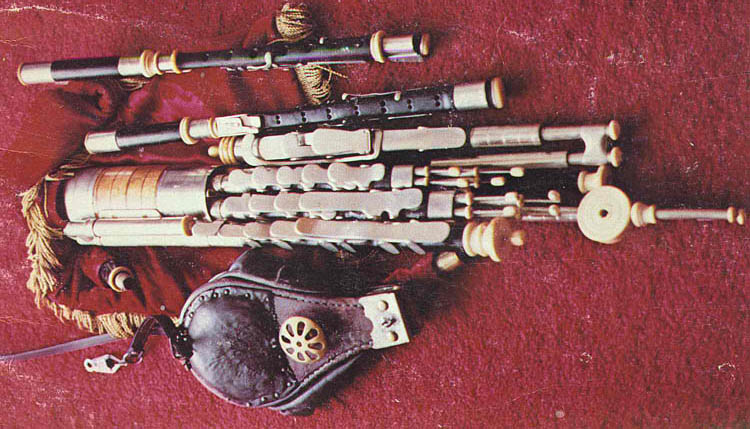
A nice picture Mr Gumby but I cannot help but feel that Wyatt would find this set with just four regulators a wee bit restrictive for his needs

Pehaps this would be better for him as it has effectively 10 regulators :laughing:

Cannot think of many makers who would want / could do a copy of a set in this style and suspect it would be rather expensive (mortgage level ?) if they did

A Question: why do people come onto the forums for advice and help and then ignore everything they are told ? (Perhaps this should be a separate thread)

John

Cannot think of many makers who would want / could do a copy of a set in this style and suspect it would be rather expensive (mortgage level ?) if they did

Well that’s one that weighs a ton or two anyway. And it has the ability for powerchords, or to insert a traffic jam imitation into the Foxchase (‘fox crosses the motorway here’).

I can remember a few people who were pushing makers to do exactly that job. I think one of them managed to get someone to actually do it.

Pipemakers do get that sort of requests, problem is that a lot of the time the people making the request just want something big to get a what they think is impressive, look.

I think makers are slightly more likely to be responsive to well thought through balanced musical needs when asked to make something out of the ordinary.

Since we’re there, I’m going to resurrect my suggestion for a rotating mainstock with 10 drones, and when you play it, the whole unit rotates like a gatling gun:

The carriage would be an optional extra.

I actually played a Taylor set that had a stock a bit like that. Steampacket took the pic.:

Joe Doyles set made by Joe Burke( ? ) is kinda heading in that direction

RORY

That would be Johnny Burke. In fairness to Joe, he does make good use of those extra low notes at times. Had forgotten about that picture, it has been a while since I took that.

Wow. Just looking at all that gear makes me feel very tired.

Agreed. I’ll be quite happy (and quite a bit less terrified) to add two non-weapons-grade regulators to my half-set some day!

I’m not considering going out and buying pipes like what I exlplained, but what I’m doing right now is brainstorming.
You can braistorm as much as you want, because the possibilities and world of music and pipes is multifarious.
Even if a finished product does not meet up at the highest level of said brainstorming, the finished peice will at least end up better than if you decided not to braistorm on the extreme levels. I’m only thinking about extra regulators because I know that it could be useful. And Chris Bayley offers a six drone system on his pipes, three drones D, and three drones G. Extra drones are a very viable possibility.

Does anyone think any of my ideas were good ideas? Or should I just dump all the thinking in the river and leave it alone at the prospect of a mere everyday desicion? Personally, I would think it is worthwhile to consider every possible extra you could add.

Pick up the saxaphone, that goes well with electric guitars. That only has one reed. The basic full set has 7 reeds and you are talking about 10 reeds or so. You have no idea how fussy a double reed can be. It rains, its hot out, its cool, its arid, the reed needs adjustment, over adjustment can kill the reed. Then you have to make one, that may take 20 tries to get a reed that is as good as the one that has been ruined. You have no idea what you are getting involved in. Do you have the patience to make so many reeds and then nurture them to keep each one working. There is no standard chanter or standard reed, each makers is different, you can’t just buy reeds, even from the original maker they arrive and will need adjustment. You should spend time reading the FAQ’s on this forum and research the net, watch youtube videos about reedmaking and think this out again. Honestly, this is a big bag of worms and needs dedication. Sax is a cool instrument and the reward will be much quicker.