Tweaking a whistle with a dirty/harsh sound

Look familiar?

The mouthpieces are interchangeable without the slightest strain and the casting marks on them are identical. The visible blob of poster putty in the one on the body labeled Feadóg got there by my hand, and before you ask, its audible effect follows with the mouthpiece when placed on body labeled Oak. I can’t find a dimension in which they differ either by hard measurement or optical comparison (and I’ve stared down a fair number of windways in my day).

They were initially US made. I think Feadóg teo then made them for a while but some years ago they became US made again. Feadóg put their own heads on but before and after that they were different. If you get a current one (I have seen them in Custy’s) you won’t get a Feadóg with a different label. I have one I bought some twenty five years ago that’s a nice whistle.

Both whistles in my photo are of recent manufacture. I bought the Oak from Custy’s and the Feadóg directly. They differ noticeably from the Oak I picked up many decades ago on 48th Street in NYC. The recent acquisitions were packaged under their own brands and there’s no question of post-production label swapping. If there’s anything that needs wondering about, it seems to be which is OEM, who actually runs the production line, and where.

I thought I’d have a go at shimming one of my very old Feadógs. One of them hasn’t the lovely tone of the other, possibly because the blade’s rough or because the window’s longer than on the first whistle.

The back of the ramp is curved on this whistle, so whatever I used had to be the same shape. My sheet brass is thin enough to cut with scissors, so it’d be a breeze to hammer into shape if I had a vice to hold a dowel of the right diameter. No space for tools, though, so I had to do my best by wrapping PTFE tape round the whistle to give it some protection, taping my shim over that, and then tapping it gently to curve it.

It did sort of work, but glueing it was tricky. The only thin adhesive that wanted to stick to plastic was superglue, and it’s a bit too runny. It’s hard to apply enough to stick it to the whistle, but not so much that it oozes out onto whatever is supporting it.

In the event it slipped round slightly on one side, and also left a tiny gap between the edge of the blade and the shim itself. The tone was unsurprisingly slightly woolly.

The shim popped off again easily enough, so I could have another go if I find a better glue. I think a slightly heavier brass would make a much better shim, but cutting it with tin snips might mangle it up so much that it’s hard to reshape.

https://www.dropbox.com/scl/fi/wkyqva4w9qj68m3552uqh/Feadog-6490.jpg?rlkey=o3cx61keqyiv32s4bltuep9gd&dl=0

The other thing I discovered during the experiment is that lip salve works as slide grease, but slide grease does not work as lip salve. Best to get them in different coloured packaging.

Both whistles in my photo are of recent manufacture.

I assumed you showed D whistles. The C s I have seen are still identical to Feadógs, I assume because they don’t sell in any volume compared to the Ds. The D s aren’t anymore and haven’t been for some time. The Feadóg identical Ds were sold as made in Ireland but changed design when that changed back to ‘made in USA’.

Here’s the same comparison with D whistles, both acquired with the C’s in the previous pic. I didn’t use the D’s before because the Feadóg Pro mouthpiece does differ from the one on their regular whistles. The most noticeable detail is the absence of the bump at the lower end of the ramp. Both flavors of Feadóg D mouthpiece otherwise fit perfectly on the Oak body, which does not differ from the Feadóg Pro body in any way that I can determine. I would certainly have thought this to provide further evidence of an OEM somewhere in the mix.

Even more important is not to confuse your lip balm and the superglue tube!

Sorry, what was that Moof? You’re mumbling again…

And thanks Mr Gumby and stringbed on the Oak/Feadog comparisons.

This is getting more and more confusing. I thought Oak was American. The Lark in the Morning website tells us: “Designed and crafted in the USA, the cylindrical bore Oak Pennywhistle offers a full two and one half octave range. The body is made of nickel plated steel, and includes a tunable, precision molded plastic fipple mouthpiece. 12 inches in overall length, available in the key D, sounding in a natural, round, mellow tone. A Best Buy!”

but the Whistleshop site tells us: This is an Oak Classic Pennywhistle, made in Ireland. It’s made of solid brass, and then is triple nickel plated to give it a wonderful shine. It has a bright tone that has a bit of an “edge” in the upper register, and requires less air than many other inexpensive whistles.

But I see we’ve been here before: https://forums.chiffandfipple.com/t/oak-classic-manufacturer/102421/8

It raises the question of Music Sales Group London, 14-15 Berners St, London, Greater London W1T 3LJ, GB, which I note is a brief walk from Rudall Carte’s old address, no 23!

But I see we’ve been here before

Several times, I reckon. :sleep:

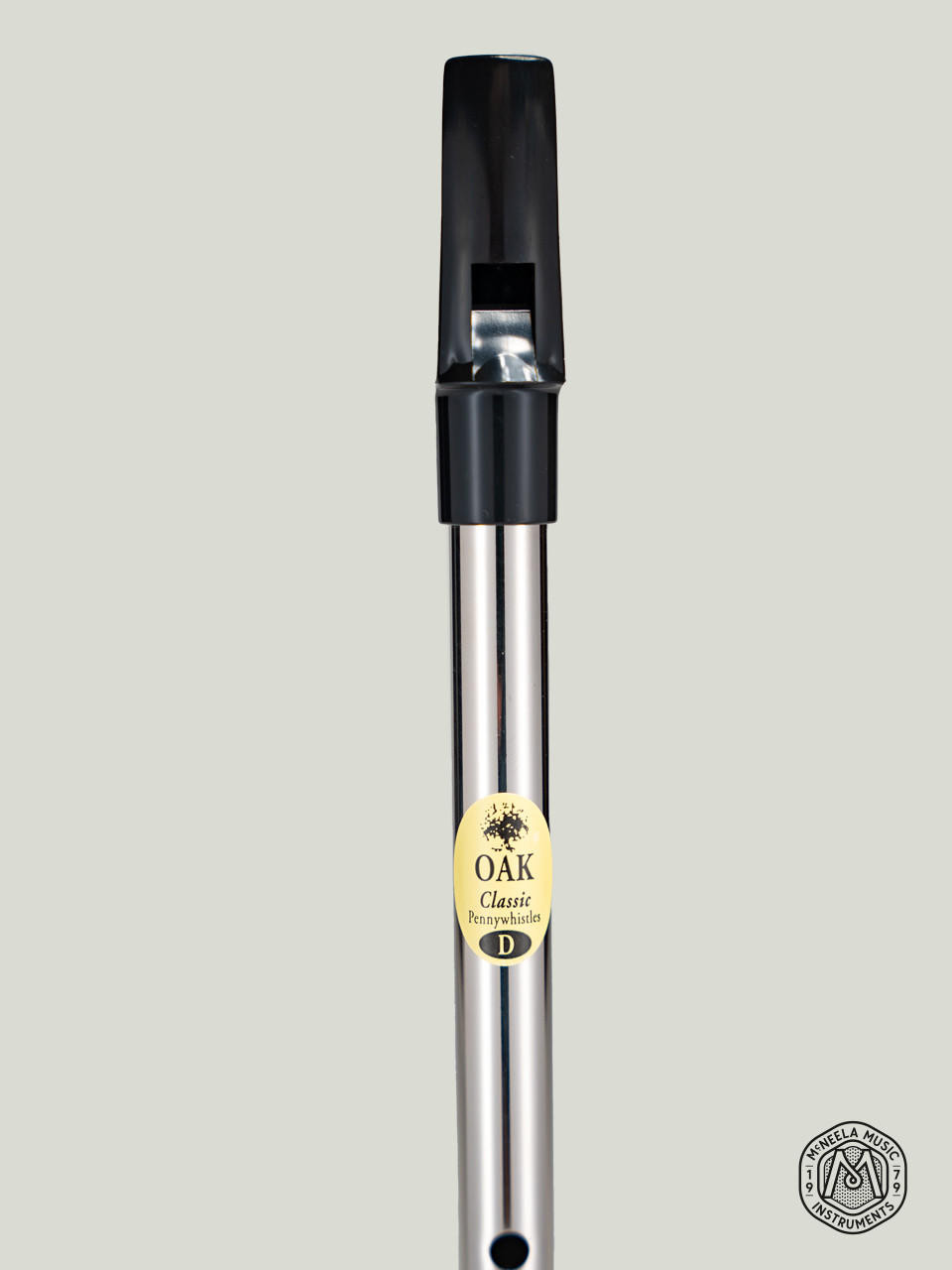
Here is an image of a current Oak D for sale at McNeela (and elsewhere, obviously). It’s the design I referred to in an earlier post as seen in Custy’s:


Clearly sporting the hump that is not present in the Feadóg design but is reminiscent of the original Oak design.

The bump is also on the mouthpiece of the Feadóg C, which is identical to the one on the Oak C by any metric that I can apply to them. The same goes for all of the bodies marketed under both labels. The OEM issue is not moot (nor do I understand the desire to make it so) but I agree that the present discussion is tedious. Perhaps it will become otherwise if we ever look further into the role played by OEMs in a wider range of what are widely believed to be whistles of Irish origin.

Yes, and reminiscent of the saying about those who do not study history being condemned to repeating it, I suspect we are condemned to endlessly revisiting these sorts of discussions until we find and document what really happened!

Do we know anyone within staggering distance of the Feadog address, 8 The Westway Centre, Ballymount Avenue, Dublin 12 who could drop in and ask for a look around? I’d be interested to learn what “made in Ireland” actually means. Just poking heads on tubes as the only factory image on their website shows?

Clearly sporting the hump that is not present in the Feadóg design but is reminiscent of the original Oak design.

Yeah, earlier Generations also had a hump like that. Does that imply a connection between those companies?

I’m wondering if its purpose was more structural than acoustic.

Does that imply a connection between those companies?

I wouldn’t think so. Not directly or in itself anyway. I imagine anyone developing a new design at the time would have a had a close look at existing designs.

But..

I have a whistle I bought around 1980/81. I have mentioned it here a few times too in the past. It is identical to the post 1982 Generation design although the head was green and the label showed a harp.
I have speculated about the origins in the past but will not repeat all that. I don’t think these were available widely or for very long. It sold as the ‘Darra’ . Now like which Irish word for which tree does that sound? (Crann darach perhaps?). :smiley:

Oh dear. Oak. And then there’s the Acorn/Oak play on words. Do we get the feeling that perhaps they are fooling with us?

Hmmm. Referring to the bump, I had said: “I’m wondering if its purpose was more structural than acoustic.” Having spent some time looking at it, on a number of Generation whistles, I’m thinking it’s just an aesthetic thing. I can’t see any need for additional structural support at that point. I can’t see any acoustical justifications. I’m thinking that they didn’t want the ramp to cut through the maximum diameter at the end of the ramp. So they put in a bulge that maintained that diameter, and looked for a way to fade that away further down the ramp. I have some whistles where the bump starts halfway down the ramp, and others where it starts earlier.

Interesting that they put some effort into the appearance of the top of the whistle head, and so little into the appearance of the underside. The one I used for my pic-whistle has mould lines running along and around. And they are sometimes higher and sometimes lower than the adjacent section. And there’s an ugly patch which was probably the flue through which the molten plastic was injected. Scooped off with a pocket knife when half set?

It’s been my experience when revoicing the things, that the bump is of no particular audible consequence except with the D. That’s not an inordinately surprising scaling detail and I had always assumed its recognition to be the reason for Feadóg’s bumpless “Pro D” design. Filing the bump off their ordinary D, or an equivalent one bearing another label, is a straightforward operation that I feel to be worth the effort. The bump does reinforce the plastic casting where the end of the tube can cause particular stress, which I’m guessing can have been its initial rationale.

It could be that the manufacture of the whistle bodies is outsourced to a country such as China for cost reasons?

But it wouldn’t be all that surprising if mass produced D whistles look identical, even if they are finished by different manufacturers. The tubing is all likely to be purchased from the same source, ditto the plastic, and ditto the computerised instructions for the head mould. The finish of the tubes and the colours of the heads may converge for cost reasons – if one maker is ordering chrome tube and black plastic in bulk, that combination might be available more cheaply to others. And as they’ve basically all got to put the same tone holes in the same places to get a D scale, all they’re left with to customise is the label and the box.

It would make very logical sense, Moof. If we imagined for a moment that I came up with a hair-brained get-rich-quick scheme to flood the lucrative Australian market (er, what?) with my own line of “Aussie” brand tin whistles, would I set up a whole new factory, or simply order a few boxloads of unmarked whistles from whoever is pumping them out wherever? Or probably just send them the artwork, and the dots for Waltzing Matilda to include on the brochure, sit back and wait for the postman.

Interesting to look closely at the only “factory” image we can see on the Feadog website:

At front left, a massive pile of assembled whistles. Note, no labels at this point.

At back of bench, a pile of whistle bodies without heads. Seems reasonable to believe we are at the point where the heads meet their bodies.

In front of the operator, a very solidly constructed fabricated device, presumably a jig to assist in the tube heading process.

Pause for a moment to think. You or I would expect to pop a head on a whistle with a deft flick of the wrist, but that assumes the heads are meant or have later been forced to be detachable. And anyway, what do you call 144 deft flicks of the wrist? Repetitive Strain Injury.

Now, note that there are two ducts running horizontally along the wall at the back of the worksurface. The lower one is for mains power, the upper one for compressed air. At the right hand end, we can see a pressure regulator and a thin tube heading off in the general direction of the tube heading jig. We can see by the regulator gauge that it is pressurised. I’m guessing that the heads are pressed onto the tubes by a small pneumatic ram, the jig providing support and guidance for the parts, and presumably an adjustable end-stop to get the tuning right. Rightish…

Presumably, the job after this one is to whack on the labels, and pop whistles and pamphlets into boxes.

Question: Is popping heads and labels on tubes enough to be characterised as “actually made in Ireland”?


Now there’s a philosophical enquiry for you! :laughing:

Does it matter whether the tubing arrives in Ireland in five-metre lengths, or is already cut down to 26 cm pieces packed into boxes? Does it matter whether the holes are drilled by the tube manufacturer or the finisher? The whistle only actually becomes a whistle once that pneumatic thingie has shoved the head on, so maybe that is the point where it gets “made”.

The photo made me laugh, as you imagine the whole assembly line is probably a couple of people – the head sticker-on, and his/her apprentice, the label sticker-on. Then there’s Brian the grumpy forklift driver, Moira in the post room, Pat in accounts, and 27 graduates in the marketing department.

Ha ha, very good Moof. What we’re missing here is Old Tom, in Quality Control. Bugger for the bottle, but you’ll remember he was the one who could play the whistle…

Hmmm, had a quick look around to see if I could find other images or videos from the factories of commercial whistle companies. Nothing so far. Any leads?