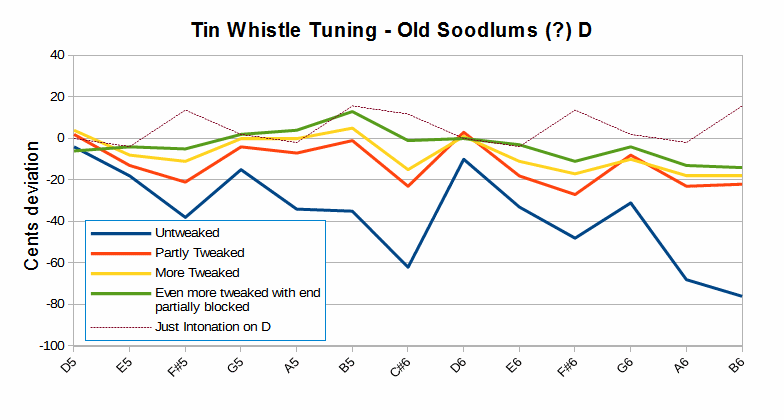
Seems that it’s rare to find whistles that are perfect as they come, particularly the inexpensive mass-produced Generations and others of that sort.
What you found there, flat F# and sharp G, is common on that type. Also common is having the entire 2nd octave flat.
Back around 1980 I acquired two fine whistles which I still use, a Feadog MK1 and a Generation C, but neither were acceptably in tune as they came. I packed the heads of both to raise the 2nd octaves and did some carving to even out the scales.
The C was well in tune save for that sharp G (actually F, it being a C whistle) and I played it for years with a bit of tape on that hole. I often saw that, a taped G, back in the old days. One day I said “enough!” and I sawed off a bit from the bottom and carved out all the other holes, and I’ve had a wonderfully in-tune whistle ever since.
It’s quite easy to carve out holes on that sort of whistle with an Exacto knife. No machines needed.
A curious tuning approach made itself apparent to me with several of the various Generation whistles I owned back in the late 70s and early 80s. That is, the notes of each octave got flatter as you went up the scale in a fairly even progression. Add to this the fact that the 2nd octave on these whistles was quite flat, and what you have is an even flattening across the entire two-octave gamut, logical in its own strange way.
For argument’s sake let’s say that the scale of the low octave was something like this:
D 0
E -3
F# -6
G -9
A -12
B -15
C# -18
and that the 2nd octave was around 20 cents flat. So, we have an even progression, meaning that you had to blow Bottom D very softly, and increase your blowing at a steady rate over the entire gamut, to play in tune.
I don’t think the makers ever consciously thought of any such thing! But it was the observable, measurable effect of the way these whistles were tuned.
I’ve come across many curiously tuned whistles over the last 40 years, sometimes high-end whistles from famous makers, who (one would think) wouldn’t have such problems.
I’ve owned two Overton Low Whistles on which the bell-note, Bottom D and Middle D (or the equivalent notes for whatever pitch whistle) were quite flat of all the notes made with the fingerholes, a quartertone flat, approximately. No, skillful blowing could not fix the problem. Partially covering all the fingerholes with tape, or sawing off some of the bottom of the tube, were the only ways to get these whistles in tune. I did the latter and achieved great-playing whistles.
Strangest of all have been the twenty or so Susato whistles I’ve owned, in every key (yes even G flat and A flat). Almost none of them gave a true scale as they came. The oddest thing was that each whistle had its very own unique bad scale; there was no pattern to it. Some had a very flat bell-note but were otherwise good; some had a very sharp bell-note; some had certain fingerhole notes which were very flat, or very sharp, or a combination of both. One in particular was so bad that I ended up sawing off the bottom, drastically carving out a couple of the holes, and yet still needed to have one hole half-covered with tape.
I should have charted all these whistles before modifying them! It would have made an amazing display. But my goal was to have whistles which were professionally usable, and I modified them all quickly without thinking about making written records.
Happily Susatos are made from soft plastic which is easy to saw and carve. As I recall the only Susatos that didn’t require modification were a couple of the Low Ds.
I’m actually surprised when I pick up a whistle that’s perfect as it comes. I think this is becoming more common nowadays, with so many musicians using whistles with ordinary instruments and demanding that the things be in tune. New makers such as Burke, MK, Reyburn, etc produce whistles with quite perfect scales in my experience.