Wondering if you have any experience of what I saw today. A lady called in the morning, asking if she could bring me a flute she had been given, to see if I could tell her anything about it. She revealed that she had been given my name by a highly respected early flute teacher in Sydney. Intrigued, of course I said yes.
She came a few hours later and showed me the flute. If you can imagine a slightly short Bb band flute, brown in colour, with 5 keys, you’d be on the right track. I pulled out a few Bb flutes to compare it to, and they were very clearly longer. So a treble flute halfway between a Bb band flute and a piccolo.
Sure enough, on playing it into a tuner with the head pressed right up to the body (no tuning slide), it played in C. I.E. XXX XXX = C.
Hmmm, a 5 key flute in C. And no names or markings. With keys that look just like a Bb band flute’s keys. Who would need such a thing? Who would have made such a thing?
Just a (random) thought: this instrument would go well with other transposing woodwinds such as clarinets, tenor saxophones and trumpets which are also Bb instruments (C on the instrument = Bb on a tuner). But then, why don’t we find more of these?
Band flutes, such as the Bb I mentioned above, are sort of “transposing”. Band flutes come in 3 keys, Bb, Eb and F, and at least two sizes of each, typically referred to as treble and bass. Band music is traditionally scored in D, so that any members of the band can swap around if say the lead Bb treble player can’t make it on the day. And the three keys, Bb, Eb and F, fit in with the typical brass instruments keys.
So we traditionally had two ecosystems. Concert flutes had XXX XXX = D, while Band flutes had XXX XXX = Bb, Eb or F, depending on length.
But the flute I was confronted with doesn’t fit either ecosystem. It has XXX XXX = C.
Unless there’s another family of band instruments I’m unfamiliar with?
Interesting that, being pitched in C, it falls exactly halfway between piccolo in D and Bb band flute. XXX XXX =
D: Piccolo
C#: vacant
C: normally vacant, but now this flute…
B: vacant
Bb: Bb band flute
We’ve had C whistles for a long time. Maybe someone just saw a vacancy?
It’s before coffee here, but isn’t an XXXXXX=C flute the same as a common or garden Bb (in orchestral terminology) clarinet. And I think that C melody sax is what we would call a D instrument.
I can see that a clarinet or sax player used to playing a “Bb instruments” score might have use for a flute (though I would have expected Boehm) they could use with the same score.
No great mystery. 7th flutes in C were very much a thing in the C19th, if less common than other pitches. I have a 1-key boxwood one stamped Metzler. Please take a look through this document of mine, particularly pp3-5.
One thing that has confused me, and continues to, to some degree, is why the pitches of these flutes tend to be chosen as they are. For example, the 3rd, 6th, 7th flutes we see are all minor intervals (m3, m6, m7) from the standard flute. Why exactly is that? Why minor and not major?
My first thought was that perhaps they enable easier playing in key signatures that are particularly difficult on the standard flute, allowing a player to switch instruments and use more familiar fingering rather than struggle on the same instrument. So, to more easily facilitate playing with other fully chromatic instruments, using more natural fingering.
This usage seems quite distinct from the use of different size flutes in the Renaissance, where the flute keys were chosen so that the flutes could play simultaneously together in a consort, and were spaced perfect 5ths apart.
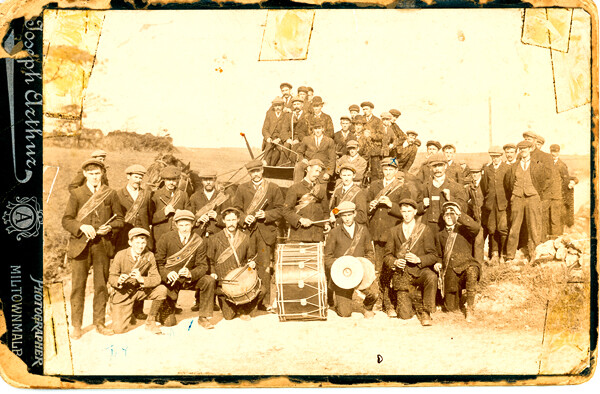
FWIW, Fluteplayer Brian O’Loughlin from Corofin has an F flute that came out of the old Kilfenora fife/flute band. I have seen him play that in duets with (low) C and Bb flutes. It worked very well.
You could assume those combinations were used in the old flutebands as well.
Thanks for that! That makes sense to me, given that they (C-F and F-Bb) are perfect intervals and C, F and Bb are closely related keys. I could see how the flute Terry has would work in that kind of scheme, with a high C flute being a perfect 5th above an F flute. That does seem to mesh with the baroque consort kind of usage.
But its the usage relationship between these F and Bb flutes (and C) to our “standard” D flutes that I’m trying to get my head around. I’ve always thought of them more as alternatives to each other rather than instruments intended to be played simultaneously (by different people).
It was not unusual for traditional musicians to play in C. Concertina players and accordion players did sometimes. I recently heard Mary and Andrew MacNamara talk about how they played everything in C until they discovered in their mid teens there were people in the wider world playing in D. So they had to learn that as well.