G#
'course ya gotta learn to run T3 & T4 together most of the time…
G#
'course ya gotta learn to run T3 & T4 together most of the time…
Upper pinkie for G#, I hadn’t even thought of that. I really need to get back into making pvc whistles. That would make for a fun challenge. 
Logically, it would have to be T3 for G# and T4 for G with open holes (no closed-standing keys)…
yer one of those people that don’t understand what I say, aren’t ya
I was thinking it would work like xxox oooo
I thought  like who’d a thunk it, eh
G  TXXXX  OOOO
G# TXXXO  OOOO
oh, BTW, for youse that’s managed not to encounter the open/closed G# key issue
g’day! do enjoy 
I played the C holed varient that MtGuru has this last weekend. It was a little odd at first but after a few minutes I could use it very easily. It’s a really nice whistle ta boot.
It gives you a really nice c when you need it.
I suspect we’ve all grown so used to having a weak veiled Cnat that we don’t even realize we might need it. Once you hear the difference the choice is pretty easy.
I have a C key on my flute so it is not such a difficult idea to wrap my head around.
Now, I won’t be running out and drilling holes in all my whistles but I might consider buying a new one with it.
You were, like, totally grooving on that thumbhole, Aanvil. It was downright scary. 
I’ll be posting a write-up on the thumbhole and whistle very soon …
Please have fun with checking out my thumbhole-variation.
educciman’s viedeo shows, that we can find two different versions of thumbholes.
I will call it the “Burke type” (I think it is the most common one)
In this case you open the thumbhole only for the Cnat (while playing xoo ooo)
You are free to play the whistle exactly as any other whistle.
And you can tape the thumbhole, if you don’t like it and the whistle works as any other.
Let’s call it “additional type” thumbhole.
In this case, you have to open the thumbhole for the Csharp as well. If you don’t, the Csharp is flat.
educciman is using this type in his video.
So, you have to use the thumbhole, or the intonation of the whistle is bad.
You can’t tape the thumbhole on this whistles.
I think, it is important to know, what type of thumbhole a whistle has before ordering a whistle.
I favour the first version, because I’m not willing to learn a new Csharp fingering that only works on specific whistles.
BTW: The position on educciman’s thumbhole seems very unusual to me.
It seems to sit more at the side than at the bottom of the barrel.
I like to correct that: it is true that I’ve built some whistles which needed the thumb hole open for a good C#, but I have for a long time designed the finger holes on my whistles, so that the thumb hole does not need to be opened for the C#, and the whistle has a good cross-fingered Cnat as well as the thumb hole Cnat (if one is requested). So a thumb hole could indeed be taped over without upsetting the intonation of C#. It is just an additional hole, without the locations or diameters of the other holes being redesigned. Perhaps it may be called more correctly an “additional type” thumb hole.
But please also note that if the tone holes are designed to give a good cross-fingered Cnat with OXXOOO (on a six hole whistle), the C# will be a bit flat, and needs to be pushed a bit. If you want to play a C# in equal temperament you will need to push it even more. There is no way to avoid that. Using an additional thumb hole can correct this anomaly, as you can raise the C# a bit by opening the thumb hole, without resorting to additional air pressure.
Sorry, Hans
I’ve edited the post, ok?
Cheers, David
I like to raise the thumb for C# (O OOOOOO as opposed to X OOOOOO). This makes the fingering similar to a Boehm flute C# and makes moving chromatically easier since you don’t have to flip-flop the index finger and thumb when playing C nat. to C# or C# to C nat. If the whistle is designed to play C# with the thumbhole covered the C# will be a little sharp with the thumbhole open. This can be corrected by taping over part of the first hole, maybe a third to even half of the hole. Of course this will also flatten and possibly ruin the cross-fingered C but if you use thumbhole C exclusively as I do it’s not an issue.
But what you call #1 “Burke type” I would call “additional type”, and #2 I would perhaps call “integrated type” (not such a great name), where the thumb hole is integrated into the design with all the other finger holes, rather than just added to the design layout. I am building according to #1.
Do you agree with the following:
“standard thumb hole”: A thumb hole, that doesn’t affect the normal fingering of the whistle. Can be taped to get a normal whistle.
“Boehm type thumbhole”: A thumb hole than can be opend to play Cnat, but has to be opend for C#
“Boehm type” according to:
Yes to #1.
But regards #2:
That the thumb hole is for playing a C nat goes without saying.
But does it need to be opened for C#?
Some players may prefer to open it as well for C#, others not.
It depends on how one likes ones C#s, and also how the C#s are tuned.
For instance on a Burke whistle you need to keep the thumb hole closed to get a reasonable C#. If you keep it open, the C# is far too sharp. That is because the C# is tuned according to ET (equal tempered), as are all the notes, as far as I can tell. On whistles with more of a trad tuning the C# (as well as the F#, to name the two most important deviations) is flat according to ET. And it is even flatter if you want a OXXOOO cross-fingered Cnat. In these cases one can open the thumb hole to raise the C#, according to one’s taste. But it is not necessary, just a player’s preference.
On my whistles (which include a couple of Brackers, a Burke, and a W. D. Sweet) the difference between open C# (O OOOOOO) and thumbhole C# (X OOOOOO) is only 5-10 cents. Well within the range of being able to adjust the pitch with breath pressure. The Brackers have a dead on cross fingered C (X OXXOOO) and the thumbhole C# (X OOOOOO) is slightly flat (according to my ears and tuner) so I use the open C# (O OOOOOO) which is dead on and my preferred fingering anyway. The W. D. Sweet and the Burke have a sharp cross fingered C (X OXXOOO) and the C# is best in tune with the thumbhole fingering. On the W. D. Sweet I partly closed the first hole with tape to lower the pitch of the open C#. I haven’t done this to the Burke. The thumbhole C# is probably the easier of the two C# fingerings for most traditional diatonic scale tunes. While, as I mentioned above, the open C# has the advantage when moving up or down chromatically. This is not as complicated as I’m probably making it seem. Hans has explained it well. And I should add that Hans tuned my (Bracker) whistles according to my notion of a fully chromatic whistle in equal temperament tuning and are not based on his usual tuning scheme.
Hi, all. I’m a complete whistle ‘newbie’ (technically, I haven’t even really got started  ) so please forgive my lack of basic knowledge .
I’d like to know more about whistles that have a thumb hole at the back and, specifically, if the fingering is the same as that on a flute. I’d be very grateful if any of you guys can help me out here .
I had some flute lessons as a kid, but never really got beyond the beginner stage. The only fingerings I remember are as follows (X represents a covered hole and O represents an open hole):
XOO OOO > C
O
XOO OOO > B
X
XXO OOO > A
X
XXX OOO > G
X
I know the conventional flute is in C key, so I suspect I’d need a C key whistle with a thumb hole… (?)
(Edited: Somehow my finger chart thing got all squashed up on the original post, so I’ve reformatted it to make it clearer.)
you were doin’ okay until ya told us ya knew somethin’
this one is in “C”
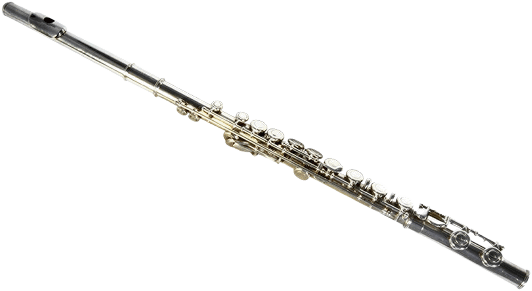
this one is in “D”

the problem is that they’re in two different naming conventions.
These notes finger the same on both
D  XXX XXX
E  XXX XXO
G  XXX OOO
A  XXO OOO
B  XOO OOO
C# OOO OOO
the odd bit is that XXX XOO is F nat on the metal and F# on the wood
C natural has different fingerings on different whistles (try first octave OXX OOO)
The problem is that without all the key work there is a bit of compromising about the pitch of C & C# on a whistle.
Adding a thumb hole might reduce the compromise.
Hi Annamal, welcome. I like your name.
Yes, your Boehm flute fingerings are now correct, and they’re equivalent to a whistle with a C thumb hole. But frankly, if you’re just starting out, a thumb hole is the last thing you should worry about, and Boehm flute fingerings the second-to-last thing.  Basic trad whistle technique requires neither, though your flute experience will probably help you. After you’ve played for a while, you’ll be in a better position to judge the various technical and physical options available. So relax, enjoy …