I am thinking about buying a Burke Brass D Session and was wondering if anyone has had experience (good or bad) with the thumb hole option? For instance does it make fingering transitions any easier? … if I keep it covered can I finger the whistle as I normally do? Thanks in advance for any advice.
Hi theperroman, welcome.
Yes, you can, either keeping the thumb planted on it or covering it with tape.
The thumb hole issue is one of those toxic, flamey topics, so I’ll keep my comment brief.
Basically, the thumb hole does make fingering some passages easier, but it also makes some more difficult, if you want to achieve the proper sound. So it’s best to think of it as giving you an additional, alternate fingering (“bis” fingering), and not as a complete substitute for the standard C fingering. The trick is then to know when to use the thumb hole C and when not to. And IMO, that requires some experience with both the instrument and the repertoire, and it’s one more technical point to master. So I don’t recommend it for beginners, especially since the temptation can interfere with mastery of the standard cross-fingering technique. But as you say, you can always ignore it until you’re ready. Hope that helps.
Conisider too that it genrally tends to lower the resale value of the instrument by significantly reducing the number of people the whistle style will appeal to. This being no reflection on the great whistles that Michael Burke makes, it is simply a matter of choice and far more players seem to avoid the thumb hole.
Cayden
MTGuru said pretty much what I was going to write.
Learning with a thumbhole might cause someone to become too reliant on it, and then they’ll be left with difficulty when playing any whistle that doesn’t have the thumbhole. I think it’s better left as an occasional tool, and not the primary means of playing c-nat. Or at very least, learn to play the tunes properly without it first.
I have it on two of my burkes, but if I were to have bought them today I would probably not bother getting them with a thumbhole, as the occasions when I use them are extremely rare (nonexistent anymore). It’s nice if you want a nice c-natural with spot on tuning and a clear sound just like any other note, but I don’t really think burkes lack much in that area with cross-fingering the note, either. I got them at first, but now I don’t see much point. Between half-holing and cross fingering that note, there are plenty of options already, and another isn’t really needed.
That being said, they don’t get in the way at all on a soprano whistle, so if you are in question about whether to get one or not, you may as well. The hole is where you likely set your thumb anyway, so it shouldn’t interfere and you can likely just ignore it if you don’t like it. Keep in mind though, it could possibly impact resale value later. (x post with Cayden)
Note that in the above paragraph I wrote “soprano whistle”. I say that because on a low D whistle I have found the thumbhole position to be a little bit less convenient in where it’s placed, and I don’t like it there. So, while it won’t hurt anything if you get it on a soprano whistle and don’t like it and just ignore it, that might not be true for low whistles, especially if you prefer to place your thumb a tiny bit higher than where the hole is located on a low D, like I do. I put my thumb on the exact opposite side as my L1 finger on a low D, but the hole is slightly below that. Not a big deal and doesn’t bother me much, but I’d prefer not to have it on low D’s.
I have several Burkes (Low D, Low Eb, F, G, A, high D) and the two lowest ones, got used, both came with thumbholes.
While I would never order a whistle with a thumbhole, don’t ever use the thumbholes, and have philosophical reasons to be opposed to them, they are in practice benign things and I don’t have any problem keeping my thumb there.
You never know! One of these days I might have a gig for which the thumbholes will come in handy.
Spending 35 years playing keyless flutes and ordinary six-hole whistles makes me quite fluent with the crossfingered Cnat in both octaves.
My philosophical reasons for disliking thumbholes are
- they’re not traditional
- they’re not necessary
- they represent people coming to the whistle from the Boehm flute attempting to mutate a perfectly good instrument to conform to their foreign concept of fingering, in other words making a futile attempt to turn a whistle into a sort-of-Boehm flute. (Not a sort-of-Irish flute, because the Boehm flute was the instrument to introduce an openstanding thumbkey for C natural.)
This last is a natural human tendency (laziness) and the precise reverse is sometimes seen in the ITM world: trad players playing Boehm flutes using the crossfingered Cnat rather than the thumbkey, in addition to rotating the footjoint to get all those pesky keys out of the way.
The only advantage, so far, to having the thumbholes is the laugh I get when other whistleplayers pick up one of those Burkes and try to play it and only get squeaking noises! “WTF??” they say and after a minute see the thumbhole there on the back.
Or maybe not…
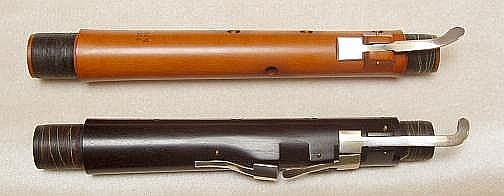
That said, I’ve gone for the thumb hole on my transverse flutes, but don’t like it on whistles where I find the position between T1 and T2 uncomfortable (unlike recorders and Highland-fingered chanters where it’s above T1).
I have a thumbhole on my Burke D whistle and I find it quite useful, FWIW. One does have to learn how to use it.
On one hand some people like thumbholes and use them. And on the other some people don’t like thumbholes or don’t use them. But that matters very little. I think you should answer the thumbholes question for yourself.
The question is, do you need the thumbhole, personally? Do you currently play instruments with a dedicated C natural hole or key? If so, then it may be a natural (heehee) fit for your previous experience and playing habits. What other wind instruments do you plan to play in the future? Do they offer or have a C natural key as part of their architecture? Will you feel like a fish out of water if they don’t have one? Will using a thumbhole on the whistle develop a habit that will be difficult to break when playing, let’s say, a keyless Irish flute? So this is a decision about your past and current playing as well as your future, potential musical adventures. You must choose wisely (Hmmm, what would Dale do?).
I own and play a couple dozen Burke whistles. They are good whistles IMO. A few had the C natural hole on them when I received them. The Burke whistles are well designed and I don’t find a particular need for the extra hole. Half-holing and cross-fingerings work well enough and that is how I learned to play. So I don’t use them - tape on every one. But sure, if I uncover the hole it plays a nice, strong, in-tune C natural - as the maker intended.
You can read through this older thread on the subject where Mike Burke, the man himself, weighs in on his reasoning for the thumbhole. https://forums.chiffandfipple.com/t/michael-burke-whistles-thumbhole/54365/1
It is interesting to me that on the one fully chromatic but keyless fife that I play there are ten holes and the only note (relative to the instrument’s scale) which does not have a dedicated hole is the C natural. I could go into the reasoning on why that is but that would be too much to write here. Gives you something to think about though.
And as others have stated even if you do buy a Burke with the extra hole, just to see for yourself how it works, you can always tape over the hole and carry on even if it does not thrill you. No biggie. You will have a good whistle in any case.
Feadoggie
There’s not much I can say that hasn’t been said, so I’ll be brief- the thumbhole leaks. Any condensation in your whistle will naturally pool in the thumbhole as it rolls along the bottom of the whistle, resulting in a wet thumb and a leaky hole that occasionally burbles and buzzes. Skip it.
Thanks one and all for all the kind and well put advice. In a nutshell I am relatively new to the instrument with only some brief exposure to a standard flute in my youth. I love the sound of the whistle and think I will likely stick to a traditional setup to ensure I don’t shortcut any skills and so that I will be readily able to comfortably play any other whistle. The resale value is something I hadn’t considered, but hope I will never be tempted to part company with such a fine whistle. However, since my soothsaying skills are lacking (that is to say nonexistent) I will happily take the advice just in case.
Since this thread is not flamey …
I’m pretty much philosophically disinclined toward the thumb hole for the same reasons as Richard (pancelt). But to keep myself honest, at one point I borrowed a thumb hole Burke D for an extended period and spent some time exploring its use for both trad and non-trad repertoire. Ultimately, I came to the conclusions I wrote above.
I actually liked the thumb hole more than I expected, and I wouldn’t mind playing one. But I think you need to be very clear about what it does. Basically, it makes back-and-forth transitions between B and C very easy. But it can make other note transitions with C much more difficult than either cross-fingering or half-holing. So you need to chose and plan the alternate fingering in advance when working out settings (or intuit when it works and when it doesn’t). And that’s one more complication for less experienced players. It’s definitely not a panacea for an “easy C-nat”. And, unfortunately, I think that’s how many new players might tend to see it.
Yes, there’s that, too. When you have a wet thumb, you tend to lose your grip. When you lose your grip, you drop your Guinness on someone’s foot. When you drop your Guinness on their foot, you get sued for bodily injury. When you get sued, you lose everything you own. And when you lose everything, you end up living in a cardboard box. Don’t end up living in a cardboard box. 
I think for now I shouldn’t mess with trying to add another layer of complexity to the old muscle memory. My only issue with some of the fingering transitions is keeping the whistle stable which I seem to often be able to remedy by covering the last hole.
I love the logical string about the consequences of a wet thumb hole … although I was convinced at the dropping of the Guinness.
the thumbhole leaks. Any condensation in your whistle will naturally pool in the thumbhole as it rolls along the bottom of the whistle, resulting in a wet thumb and a leaky hole that occasionally burbles and buzzes.
Yes, you sometimes get a wet thumb, but what do you mean it “leaks”? Are you referring to the wet thumb again, or are you saying the hole doesn’t seal properly? I can’t say I’ve had the hole on mine burble or buzz before.
Well Peter I learn something every day!
I’ve read Nancy Toff’s The Development of the Modern Flute cover to cover (the tome for 19th century flute history with all the Boehm controversies fully covered), I’ve seen numerous collections of antique flutes, I’ve played and handled hundreds of vintage flutes, I studied Baroque flute in university, I toured the workshop of a leading maker of reproduction Baroque flutes… but I’ve never come across a C hole drilled in the back of a Baroque flute, or a vintage keyed flute with an openstanding key for C.
Makes me wonder if that C hole in the Baroque flute was original, or added in the 19th century. Any 18th century documentation of a thumbhole there?
I would think that such was extremely rare.
Yes, it’s pretty unusual, and Rick Wilson’s photos here actually show modern copies, but he’s describing authentic classical (not baroque) flutes…
And, as we know, it didn’t ‘stick’ (in terms of becoming standard) at the time…
(The main reason I’ve remembered those Grenser and Tromlitz examples is having looked at and discussed just about every possible model with Dave Copley for my ‘flute for nine fingers’.)
I wouldn’t want one personally. I’ve tried them and didn’t find the hole to be any advantage. I even made a test version body of one of my own whistles with a C hole and was unimpressed.
Learn to half hole! It’s really not hard and that simple technique can also give you a good Fnat, G#, Eb, Bb, etc thus allowing you to play in more keys. Half holing is related to the also useful technique of slurring notes upwards which is a nice variation/ornament to add to tunes. Why WOULDN’T you want to learn this?
Not long ago I went to a pub to listen to a couple of friends who were playing there. They spotted me and asked if I’d like to join them for a tune or two. They handed me a D whistle and then launched into a familiar tune but in a key not natural to that whistle. Not a problem-- with half holes I was able to soldier on without much trouble, including taking a solo or two.
Paul, I know that half-holing is a favorite theme of yours. And sure, I agree everyone should master it.
But I’d really like to hear a recording of you playing The Chicago Reel or The Graf Spey in C, or even something like The Easy Club reel in G, using nothing but half-holed C-nats, and no tonguing the C-nats or B’s, and no sliding notes. (Yes, those are all a bit challenging.) Convince me that my concerns about routinely choosing half-holing over cross-fingering C are unfounded.
I’ll buy you a tall glass of Saratoga sulfur water at Caffé Lena the next time I’m there.
Busman whistles do indeed half-hole marvelously well. I can play all the accidentals on Harlem Nocturne no problem on that whistle.
I can play all the accidentals on Harlem Nocturne no problem on that whistle.[/quote]
What key? Seriously, I’m curious, and I’ll try it. Maybe Em or Am?
I’ve found that with low D’s, the ease of half-holing + slurring really can vary. Basically, I’ve found that some sculpted holes make it very difficult. Or, at least, require very different finger articulations, compared to simple holes.
trill