As I have previously mentioned, for a time I stopped advertising my cylindrical-bore low Bb pvc flute because, let’s face it, they were a wee bit on the large size and difficult to finger unless you were blessed with very large hands. I have recently been experimenting with ways to compress the fingering so that they would be more comfortable for a person with average-size adult male hands to play. So, once again, I am offering a low Bb flute that is a big improvement over my previous flute.
I am constructing a separate page at my website about my low flutes, and I have photos and another separate page that compares the fingering of my larger flutes. The link to my website is at the bottom of this page if you are interested in reading further about this.
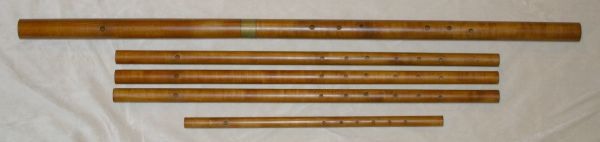
The photo compares the relative size and finger hole spread of my standard low D flute and my improved low Bb flute. The headjoints for the two flutes are the same size and are not pictured in the thumbnail photo. You can click to enlarge the photo.
The following photo of my newly improved low Bb flute shows my 2-circles embouchure hole design. Again, keep clicking to enlarge the photo.
I do make high D piccolos, but I am not selling them because I think that they are not good enough. I don’t have the right size pipe to make the best small flute in this range.
Jem Hammond (Jemtheflute) in Wales, however, is making a very nice one-piece high D piccolo that he sells for not much money. I have one, and I can recommend them to you. Jem has a youtube video of him describing and playing his piccolo. http://www.youtube.com/watch?v=U31mvRi4iJY
Oh well, i said that because some time ago (last year) i was looking for a cheap piccolo, went to your site and didn’t find it (only up to C). Few month ago i bought a sweetheart “fife” (that’s how they call them) in D. But i’m sure even other people wondered why your flutes and fifes didn’t go above high C.
I don’t know if you still have one of the old models in stock… but if the answer is yes… can you provide a comparison pic between the old and the new one? (or a sketch or drawing, to see how better is the strech now)
and another question… are you planning to apply this trick to the D flutes in order to get that RH3 closer to RH2?
To answer the last question, the low D flute in the first comparison photo does have a smaller 6th finger hole (~1/4" or 6.8 mm). This reduces the stretch between the 5th and 6th finger hole by 5 mm when compared to my original low D design. I hope to have some audio files of my low Bb flute soon. I think that the photo of the low D and low Bb comparison is the best that I can do with regard to fingering required for the low Bb flute.
The size that is printed on the pvc pipe is a nominal size only. For example, a 1/2" schedule 40 pvc pipe has an internal diameter of ~ .610", which is 15.5 mm. This is the pipe that I use to make my small-bore flutes. High D flutes made from this pipe will have a strong first octave but will begin to become much less responsive in the upper part of the second octave. The only way to get the highest notes is to blow hard, and the resultant note is loud and shrill. You won’t play those notes very many times before your ears begin to ring.
On the other hand, as I mentioned before, Jem Hammond (Jemtheflute) is making a one-piece high D piccolo from black pvc pipe that he buys in the UK. The ID of this pipe is .485", a much better diameter for a high D flute.
To my knowledge, the next size of pvc pipe smaller than 1/2" pipe that is available in the USA is 3/8" pipe. This is not something that you can usually buy in a standard supply store. In my opinion, this 3/8" pipe is too small for a D flute. I didn’t like the flutes that I made from this pipe. It would be nice to know if there is such a thing as 7/16" pvc pipe. I have never heard of it.
Just looked at McMaster Carr and only one thing comes close some thick walled aluminum. Considering what they have I find it odd that 7/16 or 11mm I.D. tubing is uncommon. Have a fife (I think) that has that ID and although the lowest note takes some work, the second and third registers are sweet. D would sit well with that bore size.
Have you considered adding a half or full loop to the bore? There seems to be enough space for adding one. With a loop (like on the old Bb band flutes, or like on the uilleann pipes bass drone), the flute could be playable just like a D flute regarding overall length. For me the biggest problem is not the spread, but the distance from embouchure to first finger hole.
I’m fairly certain you are familiar with 1/2" CPVC with an inside diameter of 0.475". Does the thinner wall thickness of this pipe make it unacceptable for a high D piccolo?
Yes and no. The pipe’s bore is quite appropriate. The wall could be a bit thicker for better tone production, IMO. It’s perhaps not the best solution but it works. I’ve made a few out of that pipe and they can be played ok. Give it a shot! It’s not too much trouble to double the wall thickness at the blow hole by adding another piece of the same pipe as a lip plate. Cut the pipe down the center. Soften it up in acetone(or via some other method you may prefer). Then mold it to the head of your fife (or another piece of the same pipe). Once the inside diameter is firmly set, shape the edges as you like and glue it in place. Then cut the embouchure.
1/2" CPVC pipe will work for a high D flute. However, I have found that certain materials are a no-no for me, and CPVC is one of them. CPVC has more chlorine in the compound than PVC, and it has a yellowish color. Whenever I hold a piece of CPVC pipe in my hands, I can feel a buzzing sensation that makes me feel bad. Rather than try to understand what is actually going on with my reaction to CPVC, I simply avoid it. One good thing about CPVC pipe is that it deforms at a higher temperature than PVC pipe. PVC pipe will start to deform at 140 degrees F, and for this reason it is not approved for household hot water pipe. CPVC pipe is approved for household hot water pipe.
I shape PVC pipe for wedges and lip plates in hot water or the toaster oven. I remove them from the hot water with gloves and shape them while they are still hot. I don’t think that you can soften CPVC with boiling water, but it wouldn’t be difficult to find a suitable temperature in a small oven. I would start at 250 degrees F for 5 minutes.
I appreciate the info Feadoggie and Doug, and sorry to be late getting back with the thanks. Doug, I don’t doubt you at all but it must be weird picking something up and “feeling” it’s bad for you.
A couple of weeks ago I bought one of these new Bb models Doug is making now, and this is a Tipple Flute 2.0f or sure.
It Does play much easier, via the narrower finger strech, and the new embouchure makes it bark! Loud and rich tone (except for the XXX XXO, which is something I have to master, due to the smaller rh3 hole.
I have played the old Bb model and it’s great, but this one rocks
I can only imagine how these new designs must work in a D flute… absolutely the best flute at the best price.
Thanks for the review, Bullfighter. To add more to the story, Ruben was using one of my older monster low Bb flutes for a movie score. The producer of the film really likes the sound of the low flute. The only problem was that Ruben’s hands were cramping after he played the first flute because of the very large finger stretches. Hopefully, my newly designed flute will help lessen the hand cramping. What I am looking for now is an audio clip of the movie score so that I can put up something on my website other than my noodling on the flute.


 )
)

 The pipe’s bore is quite appropriate. The wall could be a bit thicker for better tone production, IMO. It’s perhaps not the best solution but it works. I’ve made a few out of that pipe and they can be played ok. Give it a shot! It’s not too much trouble to double the wall thickness at the blow hole by adding another piece of the same pipe as a lip plate. Cut the pipe down the center. Soften it up in acetone(or via some other method you may prefer). Then mold it to the head of your fife (or another piece of the same pipe). Once the inside diameter is firmly set, shape the edges as you like and glue it in place. Then cut the embouchure.