It almost looks like someone put in a new ‘ramp’ or blade (my terminology banks aren’t activated yet at this hour of the morning), soldered it in place and perhaps filed down the bump of solder a bit. Which would explain the bulge around the window. I say that with the caveat that the solder on the side of the tube may create a (false) impression of there being a seam of sorts in the top picture above.
It can mean an attempt was made to make it play better, or a major repair was needed. But whistles of that age (or any age really) may or may not be great players, it’s always the luck of the draw and you won’t know until you blow into it. Whatever the way, I agree $85 is silly money for a whistle like that, even one that is pristine and plays well.
For comparison, whistleheads of similar style and vintage:
More like the owner doesn’t know how to, to borrow a phrase, govern these ventages with his fingers and thumb. In other words, air is probably leaking from under his fingers.
I concur.
On looking closely, that ramp looks an awful lot like the ramp you see on lead organ pipes. I wonder if we have the work of some apprentice organ builder here? Even though the solder is lumpy, the actual repair, with that nicely bevelled ramp, is pretty cute work.
I have a tin whistle, actually made of tin, rolled and crimped, with a square wooden block that forms the mouthpiece, similar to the one pictured here.
It’s a reproduction, which I bought in the gift shop at Fort Robinson State Park, near Crawford Nebraska. Doesn’t have an eagle or any markings. I’m not an expert, but I believe it would look quite at home in a reenactment camp or the like.
It is kind of interesting to play. Basically, it takes a while to warm up. The block doesn’t fit tightly until it absorbs some moisture and swells a bit. Before that, it’s kind of breathy.
A tin whistle, also known as a penny whistle, or flageolet, is an end-blown, fipple type instrument. The most common type available today are made of brass, or chromed metal of some sort, often with a plastic mouthpiece/fipple. Higher end models may be made of various types of wood, sometimes with metal ferrules and the mouthpiece made out of some other material.
If I understand correctly, a fife is a transverse-blown instrument, similar to a piccolo, but usually without keys. Not really very similar to a whiste at all.
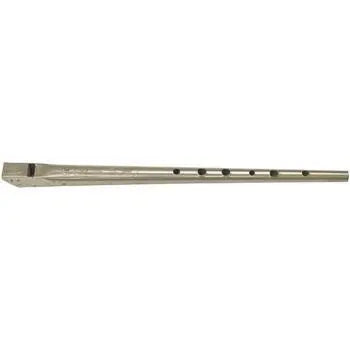
The Original Clarkes Tin Whistle is exactly the same as your picture above.
A fife is similar to a piccolo except that it is made to play in the higher registers, rather than the lower ones, so that the sound carries further, as was used by the military of various countries.
I don’t have any actual information about tin whistles in the Civil War. However, Clarke’s original tin whistle was patented in 1843, so it’s a definite possibility.
I concur. I used to have a book on CW era musical instruments (Garafalo & Elrod). I don’t recall any mention of penny whistles. Mind you, their focus was regimental instruments.
The whistle type in question could easily have been owned and played by soldiers in camp. (Maybe C.W., maybe Indian Wars, maybe War of 1898, maybe action against Mexico, maybe even WWI.) The U.S. / Eagle marked whistle is almost certainly post-war, as you find those in Sears & Wards catalogues of the late 19th & early 20th century era.
For the OP, a generic brass whistle with lead fipple or a vintage Calura or Clarke would not be out of place in a C.W. display. But the likelihood of this particular (or any particular) whistle being associated with the C.W. itself is a much dodgier prospect.
a generic brass whistle with lead fipple or a vintage Calura or Clarke would not be out of place in a C.W. display.
I have to wonder if the Caluras go back that far. I doubt it to be honest.
They’'re surely easy enough to find though. Several on ebay at the moment although some sellers are looking for silly money (saw one for $125). Shouldn’t pay more than a tenner, if you have any sense.
You should, perhaps, be looking at something like this, plain and un-printed. And even then I’d have my doubts about time and place:
If you don’t mind, I have a snap handy : The plain grey one is an old Clarke, plain without their typical print exterior. No eagles on any Clarke. It does say Clarke 1843 but that’s more the date the company started than the date the model was made. These, or something close to it, are made again, but shinier. In fact I think that was what fatmac was saying in reply to michaelpthompson’s post.
The Williamsburg souvenir whistles (see michaelpthompson’s post) and Coopermans for that matter, are along similar lines, and both flirting with CW enthusiasts. Without eagles.
Shaws do another shiny take on the classic tapered whistle.
That is my thinking as the eagle is identical to coins, tokens and other memoralbilia of that era.
Thank you everyone for contributing. Since I know so little about tin whistles, can you give me a little bit of help explaining B and G and E. I assume that the different whistles are designed by the musical scale. Is there truly a lot of difference. Can you find music for every tones on the scale?




 In fact I think that was what fatmac was saying in reply to michaelpthompson’s post.