The Very Rare Parrot Flower

SUMMARY: Circulating via email, authentic pictures of the rare parrot flower (Impatiens psittacina), which is native to northern Thailand, Myanmar (Burma), and northern India and bears a remarkable resemblance to its avian namesake.

Description: Emailed pictures
Circulating since: 2006
Status: Authentic

Email example contributed by Carol L., Aug. 23, 2006:

Subject: VERY RARE PARROT FLOWER

A FLOWER ALL THE WAY FROM THAILAND.
THE VERY RARE PARROT FLOWER

Thought this was too beautiful not to share.

Despite the eruption of a minor controversy over their authenticity when these photos first appeared on the Internet in 2006, they are quite real, as is the birdlike plant they depict, Impatiens psittacina, commonly known as a “parrot flower.”

The species was first identified by British botanist Joseph Dalton Hooker in 1901, and it may well be Hooker’s own description of it that appears in the Bulletin of Miscellaneous Information of the Royal Botanic Gardens published that year:
Impatiens psittacina. (B. M. t. 7809.) 8. A handsome species with axillary solitary flowers 2 in. long pendulous from an arching peduncle 1 in. long. Sepals green, standard pale rose-coloured, wings streaked with red, hooked spur white with an irregular dash of bright carmine towards the base. “The Cockatoo Balsam.” Burma. (Kew.)
More photos of parrot flowers can be viewed on the website of the Queen Sirikit Botanic Garden, Thailand, and the illustration that accompanied J.D. Hooker’s original description of Impatiens Psittacina in Curtis’s Botanical Magazine in 1901 has been posted on the UBC Botanical Garden website.

Other flowers that resemble birds include Impatiens arguta and Strelitzia reginae (Bird of Paradise).
The appearance of the flowers in these photos is at odds with the illustration and description of the flowers on wiki. I’m somewhat mystified as to why this plant has acquired such mystique. There are plenty of rare plants!


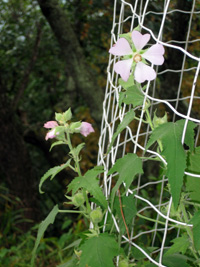
Peters Mountain mallow, Iliamna corei gives a whole new meaning to rare.
Distribution
The Peter’s Mountain mallow is a globally rare
species, known only from the Narrows, a site
on Peter’s Mountain, in Giles County, Virginia.
A similar mallow, I. remota, is found in Allegheny
and Bedford counties.
Habitat
The plant grows in direct sunlight on shallow
sandstone outcrops on the northwest slope of the
mountain near the ridge line, approximately 3,000
ft. above sea level. The mountain is hardwooddominated.
Pitch pine (Pinus rigida) is also present,
but now, in the absence of the natural fires
that once allowed it to be more prevalent, it cannot
compete with less fire-intolerant hardwoods and so
grows mainly on the rocky outcrops.
Life History
When Iliamna corei was discovered in 1927, the
population numbered only 50 plants. By 1992 the
species had declined to only three plants. While
the exact cause of this dramatic decline is not
known, threats to the species include grazing by
deer (and in one case, a feral goat), competition
with other plants (particularly the Canadian leafcup,
Polymnia canadensis), shading by trees, the
proximity of hiking trails, and fire suppression.

Another threat, rarely discussed or acknowledged, is collecting by plant taxonomy students. :boggle:

I found St Hilarion’s Cabbage in northern Cyprus. It is confined to a tiny area in the Kyrenian range. That’s rare!

Beautiful indeed.
And here’s an other parrot. The parrot pitcher plant. Sarracenia psittacina:

:slight_smile:

One of my sisters has a bog, but all of her plants are vegans. :boggle:

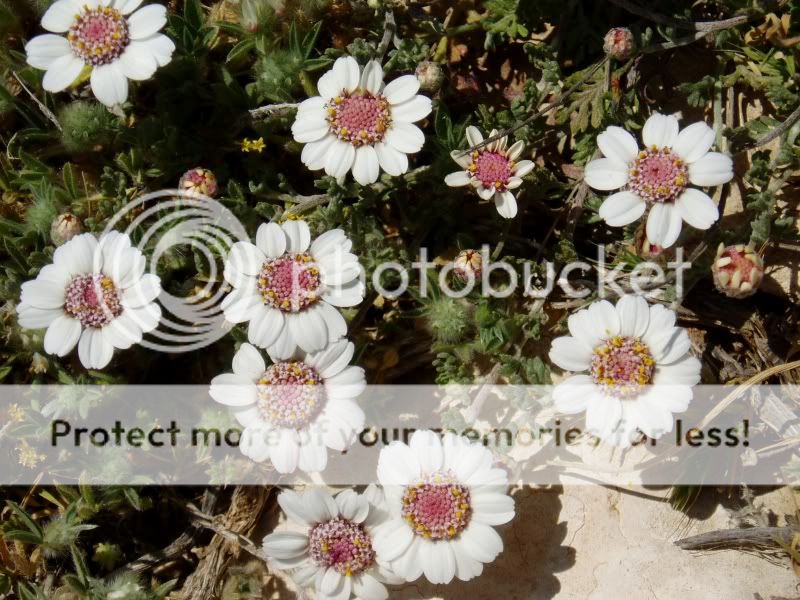
I took this picture of a plant on the seashore near Cap Greco in Cyprus in 2004 because I thought it was very pretty:

Years later I was looking at a natural history book and discovered that it was the rare endemic Anthemis tricolor (meaning it grows nowhere else in the world). Well-chuffed I was! :party:

this sarracenia species isn’t a very good insect catcher either, the plant is often swamped over, so mainly catches aquatic insects.

This one is remarkably life-like:

A good friend of mine is a Nepenthaceae and Sarraceniaceae nutritionalist. My sister who raises Sarracenias is a vegan. Wouldn’t dream of owning a pet that was an omnivore or carnivore, but has no problem with arthropod, amphibian eating plants.

Ancestor to bird of paradise, now sells auto insurance.