With all the plant photos being shared, I thought I’d put a couple of mine up. Most of the plants in the photos are carnivorous types, though an orchid or three is visible, too. (Funny, I’m an herbivore myself, but my herbivorous companions eat – or try to eat – animals. I worry sometimes that they’re plotting to evolve legs so they can exact their revenge on me for eating all that salad . . .)
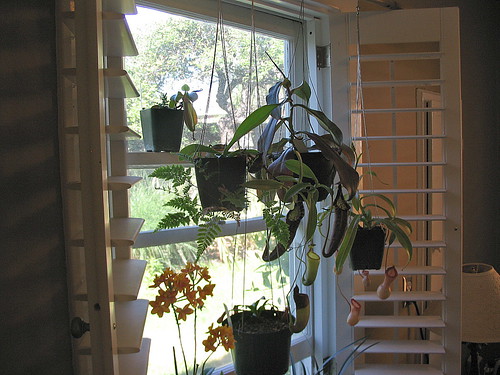
The plants in the dining room window:
A close-up of Nepenthes ventricosa pitchers:
. . . and of N. spectabilis pitchers:
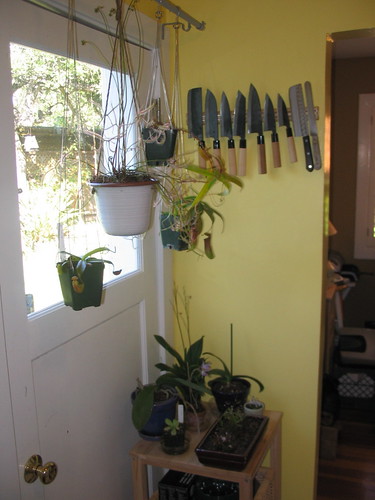
More in the kitchen:
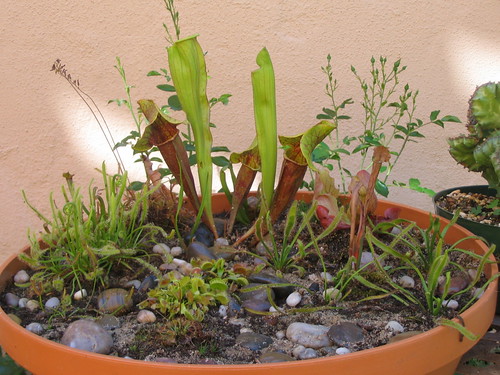
and finally, a little bog garden outside, with sundews, pitcher plants of the genus Sarracenia, and Venus flytraps:
Anyone else out there grow these? They’re fascinating things.
(Thanks to Walden and Fearfaoin for setting me right in how to post these things!)
I used to have some venus fly traps, but we never get enough flies that are small enough, and I could never remember to feed them raw hamburger, so they kind of … um … persished.
Way cool, pitchers, though. I thought it was illegal to plant/transplant them due to their rarity in the wild (?).
Very cool-looking plants. I’m afraid I have to grow near-indestructibles like pothos, myself. Question, though: do your pitcher plants do a decent enough job feeding themselves, or do you catch the odd fly now and again (I suspect not) for them?
The conventional wisdom on Venus flytraps turns out to be all wrong. What you need is to 1) keep them outside in full, or nearly full, sun; 2) never ever feed them hamburger or anything; they’ll usually catch all they need outdoors, but if one must feed them, it should only be with bugs; 3) use purified (RO/DI) water to water them, and keep them wet all the time (the bog pictured is an undrained container)–the minerals and dissolved solids in most tap water will kill carnivorous plants; and 4) let them go dormant in the winter. They’ll come back when it warms up.
The pitchers are cultivated. It’s in fact illegal to collect them from the wild almost everywhere, but you can get them from nurseries that specialize in carnivores. There’s a very neat one – California Carnivores – about an hour from where I live. Enthralling place.
Thankfully, they do a fine job all on their own! I do fertilize them occasionally with 1/4 strength orchid fertilizer sprayed on 'em, though.
Otherwise, they catch those ubiquitous fungus gnats that always hover around houseplants, and the odd housefly. The ones outside almost fill up, sometimes, they are so gluttonous.
Hey, those knives are some fine veggie-slicing machines. (They’re actually great knives, from Japan, recommended to me by a friend who builds violins and knows his blades. Inexpensive, unshowy, but the sharpest damn things.)
And in Little Shop of Horrors, there’s this bit where Seymour says that the, um . . . anthropiverous (?) plant Audrey was formed thus: “Well, it’s a cross between a butterwort and a Venus flytrap.” I get the venus flytrap bit, because look:
Scary!
But a butterwort? Here’s the scariest butterwort you’ll ever see:
Harmless (except to tiny bugs that land on the sticky leaves).
A better choice would’ve been one of these fellows, but maybe Audrey would’ve been too frightening: Nepenthes bicalcarata (check out the fangs!)
or Nepenthes hamata (ringed with barbed teeth to keep prey in):
Didn’t really matter how scarry Audrey was in our production: our dentist’s office was furnished with antique equipment from the museum. We went a bit too far into the Cronnenberg zone with that one.