Review housed at http://www.tinwhistler.com/reviews.asp
The “Low-Tech” Whistle
(Review written April 2006)
Preface
Guido Gonzato, of Verona Italy, has had a do-it-yourself](http://profs.sci.univr.it/~gonzato/whistle/index.html%22%3Edo-it-yourself) whistle page up for a while. The site tells how to make your own tinwhistle out of household items (a little PVC, a hacksaw, scissors, etc.). He recently asked me to do a review of one of his DYI whistles, and mentioned that he would be interested in selling these to people if they felt less industrious. This is actually a pretty good deal, as Guido’s whistles are inexpensively priced, and as you’ll see, there’s a lot of care and attention in their construction.
At a Glance
Whistle Reviewed: The “Low-Tech” Whistle
Models Available: Tunable and non-tunable Soprano D whistles
Construction: PVC with plastic fipple
Price at time of review: €18 for non-tunable and €20 for tunable (approx $23 & $25 US)
Available From:
Guido’s](http://profs.sci.univr.it/~gonzato/whistle/index.html%22%3EGuido%27s) website Please surf to the website and look up Guido’s email. He’s spam-obfuscated it, so I don’t feel comfortable putting it in a mail link here.
How Acquired: product sample from manufacturer
Appearance/Construction
The whistle lives up to it’s name: it’s definitely low-tech when you look at it up close. From a distance, however, it pretty much looks just like any other whistle, And, really, it’s all about the way it sounds. For me, it could look like a recorder, and I’d still play it if it sounded good–though I’m aware that some people have different opinions about that!
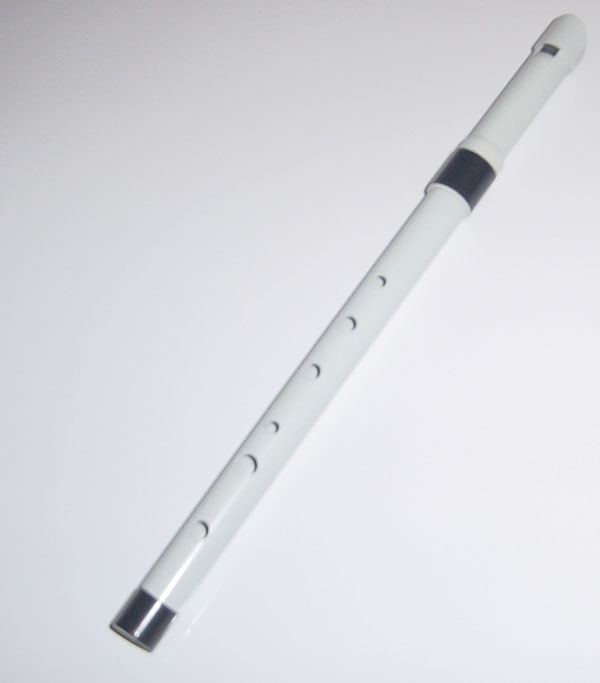
Here’s the full whistle. From this distance, the whistle just looks like a whistle, with some black trim. I certainly wouldn’t be embarrassed to play this in public
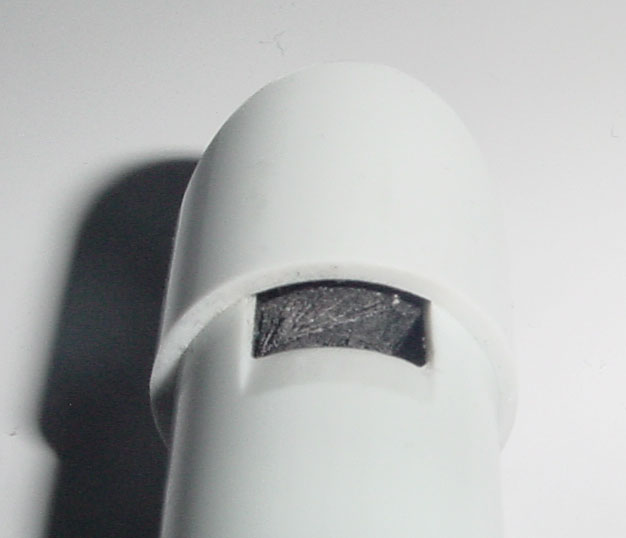
A close-up view of the mouthpiece. The labium ramp is really well-done, and everything is finished nicely. I’ve seen “high-tech” whistles that weren’t put together this nicely.
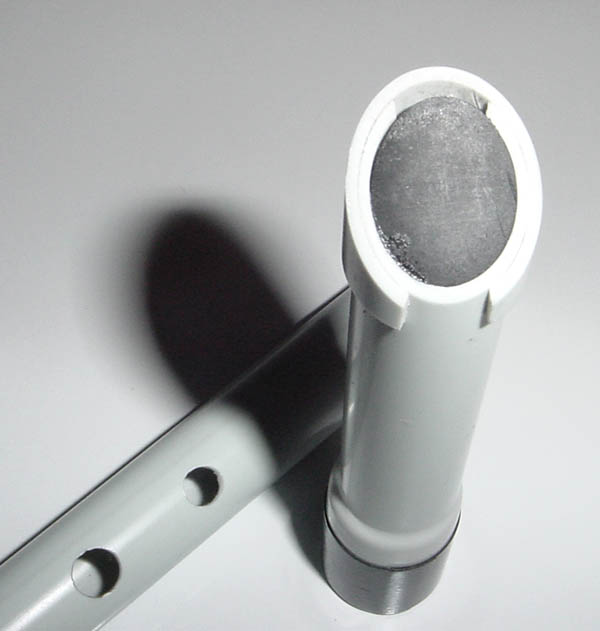
Another angle on the mouthpiece. The mouthpiece is cut “Abell-style”–just a straight angle cut. This takes some getting used to, but honestly, I don’t think about it any more after playing an Abell for a good long while.
You can see a spot of glue showing here. But I don’t care about that. You can see some spots of glue on Pat O’Riordan’s whistles too.
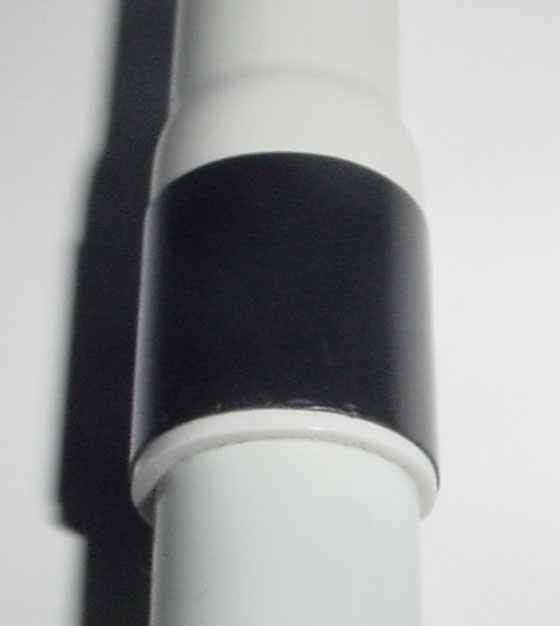
Here’s the tuning slide, complete with decorative electrical tape trim! The tape is really a cute touch, really. The slide itself was formed by expanding the pipe with acetone, as Guido mentions on his website. This is really amazing work! when I first got the whistle, Guido hadn’t updated his site with the acetone trick, and I spent a good two hours shopping around my local hardware stores looking for plumbing that joined together like this. It really looked machine formed, and not something someone did at their house!
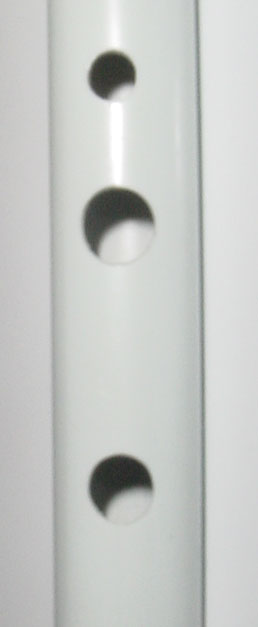
The last three holes of the whistle. The last hole is kind of far away, and the E and F# holes are a little close together (as on many whistles), but I didn’t find this akward, and I never found my fingers colliding.
Sound clips of the whistle:
Sean South
Volume: The whistle is a little on the quiet side, but not too quiet. It’s a little quieter than a Sweetone, so it will get a bit lost in loud sessions. It’s great for playing around the house, or when learning a new tune. I tend to be a bit shy when learning a new tune, and don’t want a really loud instrument or one that takes a lot of agression, so I tend to pick instruments like this one to do my learning on.
Responsiveness: Very responsive. I didn’t have any issues with it at all.
Tuning: In tune across the range. Unlike many whistles, you have to back off on the F#, rather than giving it a little push, so this will take a little getting used to. My biggest complaint here is that the whistle is in tune to A=440 with the slide pushed all the way in, so you can only flatten the whistle and not sharpen it. I could fix this easily by trimming about 1/4" to 3/8" off the part of the whistle that slides into the tuning slide, but if I were paying for one of these, I’d probably ask Guido to ensure that there was enough play on both sides of A=440 before shipping it out.
C-natural: OXXOOO produces a good in-tune C-natural. All of the alternate fingerings I know were some degree of sharp or flat.
Hole size and placement: This whistles holes are on the smaller side, making it ideal for folks with smaller fingers. I didn’t find the hole placement to be akward, though if you have pudgy fingers, you might find the E and F# a little close.
Air volume requirements: Low. I can get a bit more use out of my breath than with a Clarke Sweetone.
Air pressure requirements: Also low. When I first got this whistle, I was used to playing Thin Weasels and other whistles that take more agression in the second octave. As a result, I found myself pushing the whistle into the third octave sometimes! If you like a whistle that doesn’t take much effort or thought to play in the second octave, this one is a good candidate.
Clogging: I never had this whistle have any clogging issues whatosever. I never had to blow it out, shake it out, treat it, or otherwise give any consideration to clogging.
Wind Resistance: Medium. This whistle has some wind resistance in medium breezes, but I stronger winds get the better of it. This actually makes it a good outdoor whistle, unless you’re in a windier locale.
Summary
Very nice whistle, and well worth paying the price Guido is asking for if you plan on having one of these made for ou. Guido has made a number of these, and it shows. I think I’d have to make a few before I could execute his low-tech plans as well, if I ever could. If you plan on making one yourself via his low-tech instructions, they definitely produce a very nice whistle.