Review housed at http://www.tinwhistler.com/music/reviews.asp
O’Riordan Soprano C/D Kingwood + Ebonite D set
(Review written June 2005)
Preface
Shortly after taking up the whistle in 1995, I started hearing about O’Riordan whistles. Made by Patrick O’Riordan, these whistles were favored by the famous Joanie Madden. I’m not a big on long waiting lists (and in fact, have bought most of my high-end whistles secondhand to avoid them), so when I learned that Pat’s waiting list was a couple of years long, I put off getting on it, assuming that I could get one used, or get on the list later. Sometime in 2004, I think it was, Pat closed his waiting list, which had grown to several years long. So, really, the aftermarket is the only way to get one of these whistles any more. That’s what I get for not seizing the day!
I have three of these in my hands now, because of the wonderful generosity of a fellow whistler. Well, really 3 bodies and one head, C and D bodies in kingwood, and a D body in ebonite (the stuff they make bowling balls out of). They’re not mine to keep, unfortunately, but I was given the opportunity to keep them for a month. And what a heavenly month it’s been so far!
I want to take the time out here to thank Jim Durdin publicly, even though I run the risk of embarrassing him. He really is a great guy. We correspond a bit on the Chiff and Fipple message board but the truth is, I really hardly know him. Just the same, he’s loaned me his Delrin Seery flute in the past, and has loaned me this O’Riordan set for review. If anyone deserves to have good things come his way, he does. Thanks Jim!
The review is going to focus on the kingwood D body of the set. I’ve spent the most time evaluating this body, though the time I’ve spent with the other two was enough to let me know that they have extremely similar characteristics (though with the minor variations that are common with hand-crafted instruments–the ebonite body is a little more pure and sweet).
At a Glance
Whistle Reviewed: O’Riordan Concert set. C/D in Kingwood & D in ebonite.
Models Available: Pat O’Riordan no longer takes whistle orders. If you’re extremely lucky, you can occasionally find one secondhand.
Construction: Kingwood, with brass fittings and Delrin(?) fipple
Price at time of review: I’ve seen single O’Riordan whistles go as high as $650-$700 on eBay, and complete whistle sets go for more than $5,000. I don’t expect that will go down any time soon.
Available From: eBay, if you’re lucky. A fellow whistler willing to cut you a deal on the price if you’re even luckier. I haven’t been that lucky.
How Acquired: Received on loan.
Appearance/Construction
In my Greenwood Soprano D review, I mention that a member of the Chiff and Fipple message board named Jessie Driscoll had said that the Greenwood had the same dimensions as the O’Riordan Concert D. Jessie’s owned a lot of whistles, and I tend to give her words a lot of credibility. It was nice to see her statements confirmed when I got the O’Riordans in. Now, I haven’t taken a micrometer to them, but the I’d say that the Greenwood definitely mimics these concert O’Riordans, from the huge barrel down to the extra-long tuning slide.
The whistles are sturdy-feeling and well made. The labium ramp doesn’t appear as “machinery precise” as a Thin Weasel, Busman, or Abell. It looks a little more hand-crafted. There are a couple of places where it looks like there was maybe a bit of glue or something visible on the barrel of the whistle. But even so, the whistle still has a very professional look to it overall.
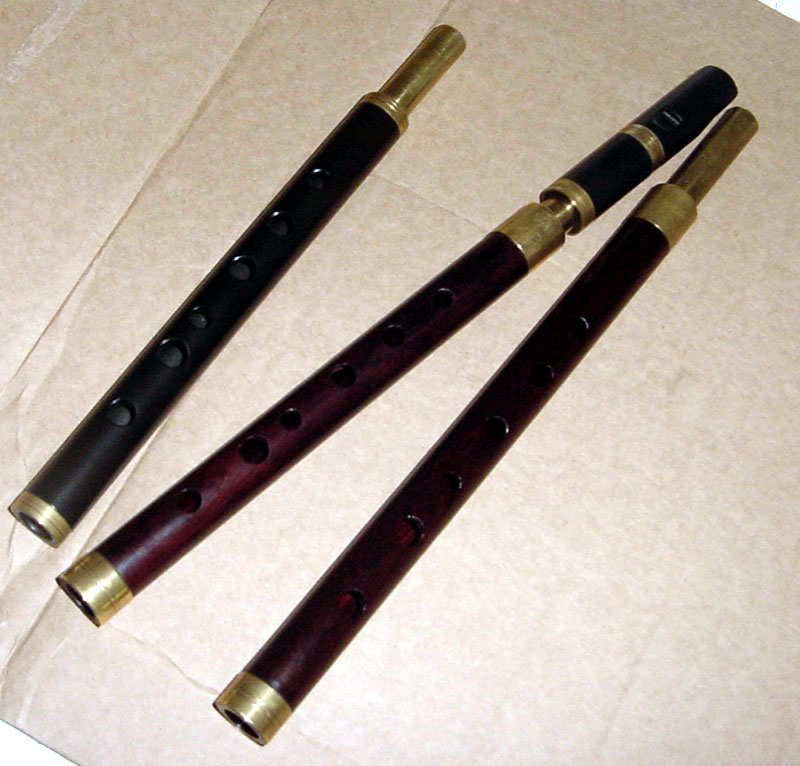
Here’s a picture of all three whistles. They’re all pretty dark, so you’ll get a better idea of the grain and look on the close-ups. You can get a good look at the long tuning slides here.
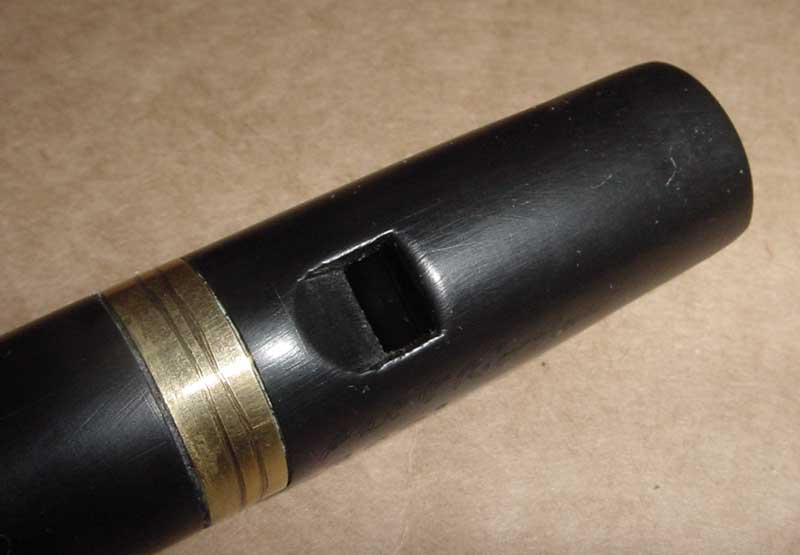
Here’s a close-up of the mouthpiece.
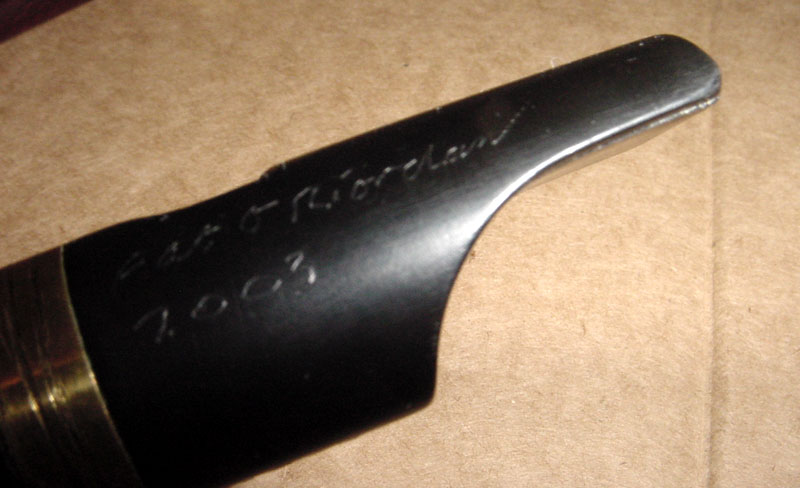
Here’s another angle on the mouthpiece. The beak of the whistle is not quite as stubby as some high-end whistles. Pat’s name, and 2003 (the year of manufacture) is engraved here, but it’s really hard for me to take a good picture of it.
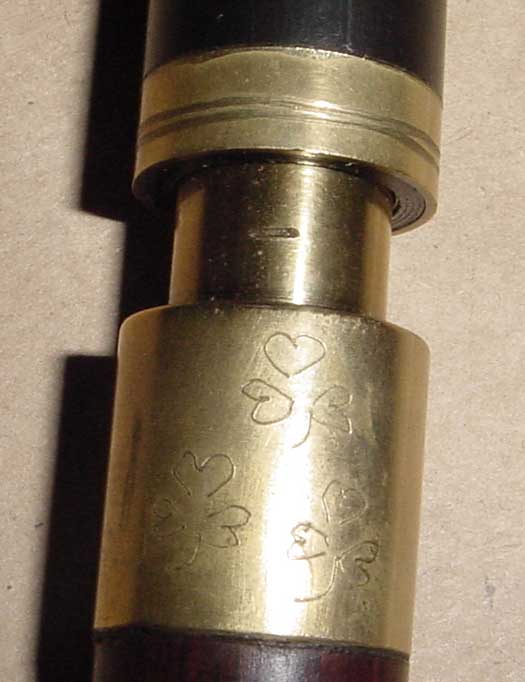
It really is extra long! On some of his whistles, Pat engraved cute little shamrocks here, as you can see. The ebonite tube doesn’t have the large decorative piece here, and so no shamrocks. The little nick on the tuning slide is a mark Pat put for marking the “in tune” location. At my house, the whistle’s actually in tune just a hair off from this mark.
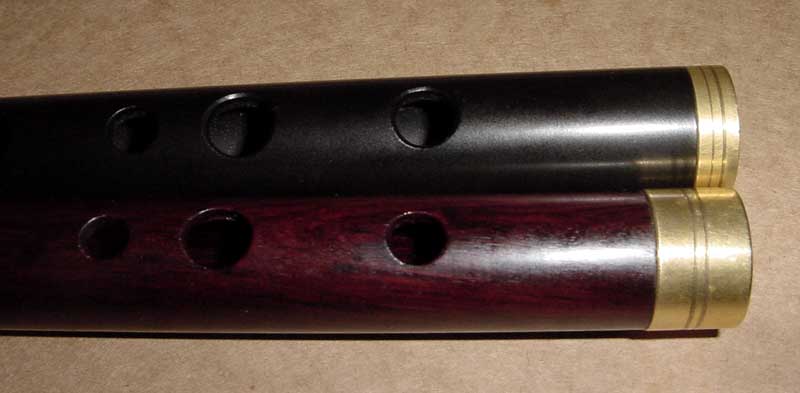
A shot at the end of the whistle, showing the last three holes. You can also see the evolution of the decorative trim. Jim mentioned that the ebonite whistles were probably made in the 80’s. The Kingwood bodies were made in the neighborhood of 20 years later, and there’s a definite difference in execution.
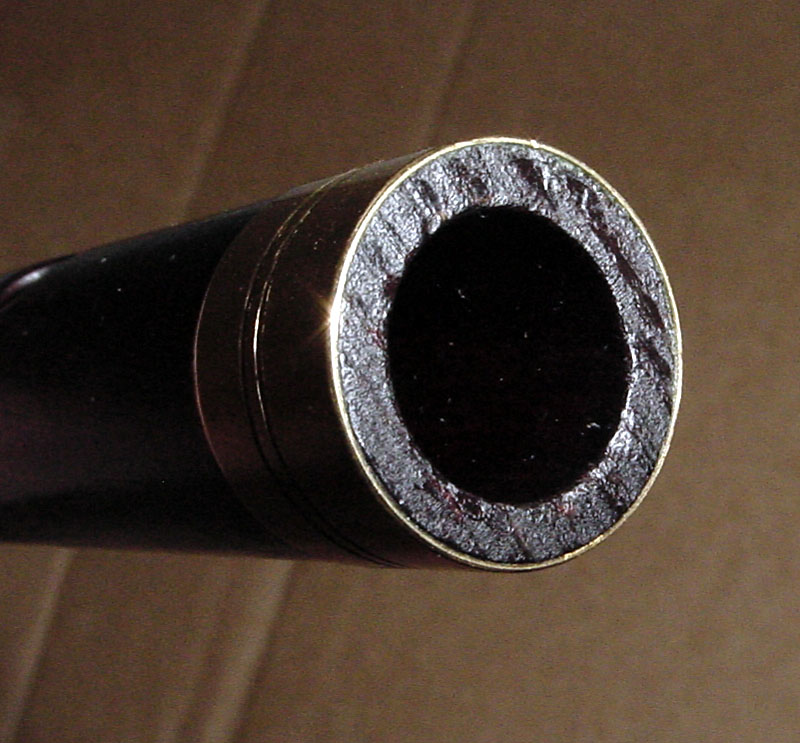
Here’s a glance at the very end of the whistle, so you can see how thick the wood of the bore is. I think this helps the whistles feel extra sturdy.
Playing Characteristics
Very sweet and pure, with decent start-of-note chiff.
The Greenwood really is made to similar dimensions as the O’Riordan, and therefore has similar playing characteristics. Sweet, somewhat loud, and with very little chiff, strong, and with a rich presence. The second octave seems even purer than the first. This is an awesome instrument. It’s no surprise to me that I would love the sound of these whistles, considering how much I like my Greenwood.
Sound clips of the whistle:
Si Beag Si Mor
Mug of Brown Ale
Volume: Slightly louder than average. Like the Greenwood, this whistle isn’t as loud as my Copeland or Abell, but the sound really feels “full”, giving it a presence that makes you think it’s louder than it is. It really does get your attention!
Responsiveness: Very responsive. I didn’t have any issues at all; ornaments just tripped off of my fingers.
Tuning: The whistle plays in tune with the proper breath control. There’s a little notch on the tuning slide of the two kingwood whistles where the in-tune spot is, but that’s not where I preferred it. I pulled the slide out about an eighth of an inch from the notch, because I like to lean into the whistle a little more. Where I like the slide, I was able to get a ± 25 cent range on the whistle with breath control. Since the ebonite body wasn’t really made to go with this head, the tuning took a bit more effort with the breath control.
C-natural: OXXOOO produces an in tune C-Natural. Though it has to be pushed a little to be in tune, OXXXOX sounds a lot more stable to my ears. OXOOOO is pretty sharp.
Hole size and placement: I wonder if Pat uses a jig to place the holes on his whistles. Across both D barrels, the hole placement is alike (as you can see on the pictures above), even though they were made a couple decades apart.
Air volume requirements: Average. I really didn’t notice this whistle taking much more or less air than my Sweetone.
Air pressure requirements: low to medium. Both octaves are relatively easy to hit, and the whistle jumps into the second octave cleanly and easily–but not too easily! That said, there is a big difference in the way the second and first octave handle. If you play the 1st octave with the aggression that the 2nd octave requires, you’ll be sharp. If you play the second octave with the same softness the first requires, you’ll be flat. The last three notes of the second octave especially require more air than the rest of the whistle. But I’d put those last three holes at maybe the upper end of “medium” The rest of the whistle is “low” in terms of pressure required. I took these whistles to session after having them a week, and I had a hard time blowing those top three notes into tune, because I kept falling into accustomed breathing habits. Definitely something that would take some time to get used to.
I should note that the whistle has a very small and subtle amount of backpressure, which I like. I didn’t even really consciously notice it until I started playing it back-to-back with my Sweetone. I do this to try to help establish baselines for volume, air requirements, etc. After playing this whistle a while, and the lack of backpressure in the Sweetone was really evident.
Clogging: Average, but not that big of a deal. What I mean by that is that the whistle actually was about as wet as an average whistle, but moisture didn’t seem to affect it that much. Since it’s not my whistle, I am not going to see how it responds to the Duponol treatment. By the same token, I haven’t played this whistle for hours and hours to see how it holds up, since I want to treat it a bit gently.
Wind Resistance: Medium. In high winds and at certain angles, this whistle cuts out, but it withstood medium breezes pretty admirably.
Summary
This is not a whistle for everyone. It has a lot of characteristics “traditionalists” won’t like out of a whistle: it’s sweet-sounding, without that characteristic traditional scratchiness, and a bit on the loud side. It’s got a strong tone, and stands out more than whistles of comparable volume. If you like those characteristics in a whistle, this baby really sings! If, instead, you like a raspier sounding instrument that will totally blend in with the folks around you, this one’s probably not for you. Probably also not a great whistle for beginners to cut their teeth on, owing to the breath control required, the second-octave push, and the volume. Many beginners don’t like louder whistles. Maybe it’s a shyness issue. But after all is said, these really are awesome instruments.