Review housed at http://www.tinwhistler.com/reviews.asp
Reyburn Soprano D/C Set
(Review written November 2005)
Preface
Ronaldo Reyburn’s instruments have always intrigued me, mostly becuse his low D is made with a maple head which looks kind of rustic and outdoorsy to me. It evokes the same feelings that meerschaum pipes and cabins in the woods evoke. Salt-of-the-Earth, and all that. Very nifty. I’m sad to say that the soprano whistles (being made of acetal) don’t evoke the same kind of nostalgia but it’s got some nifty features in it’s own right.
I wanted to take a moment to mention that there have been various reviews of Reyburn whistles that have differing characteristics. Some are reported to be easy blowing, some a bit harder, etc. Like Bernard Overton and Colin Goldie, Ronaldo Reyburn prefers to create individual whistles to individual tastes. Part of the buying process is a bit of back-and-forth with Ronaldo to determine exactly what you’re looking for out of your instrument, and then he does his best to provide that. So, like an Overton whistle, if you have specific needs, it’s best to order from Ronaldo so that he can accomodate them. When getting a Reyburn whistle secondhand or retail, it’d be worthwhile to ask some questions about how the specific whistle you’re interested in plays, so that you know what you’re getting into.
I will be focusing my attention on the D body of this set, though will make notes about the C body as necessary. This whistle set is a couple of years old.
At a Glance
Whistle Reviewed: Reyburn D/C Set
Models Available: Lots of choices here. Best to visit the website.
Construction: Acetal and brass (though, as noted, the low whistles are made of maple and brass).
Price at time of review: $140.00 US for the D/C set.
Available From: Reyburn Whistles
The Irish Flute Store
How Acquired: Acquired secondhand
Appearance/Construction
Reyburn soprano whistles are very sleek and professional looking. The mouthpiece and fipple is made of Delrin, held together with brass pins. All of the edges and points are rounded smooth. The body is brass and professionally drilled and finished. Quite a nice whistle! Since I got this whistle secondhand, it’s not all shiny and new. It’s started to acquire a nice patina, and unlike some brass whistles, I don’t think it looks that bad on these, so I haven’t had the urge to shine it all up.
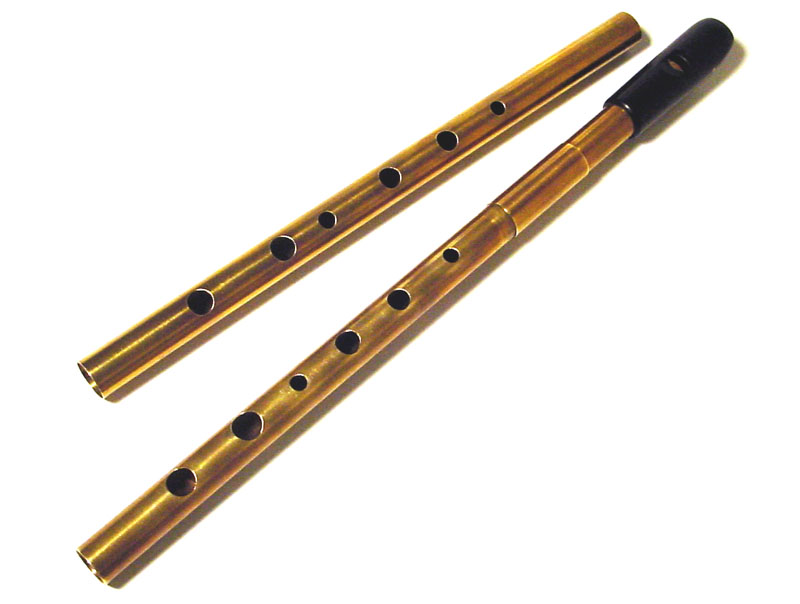
Here’s the full set.
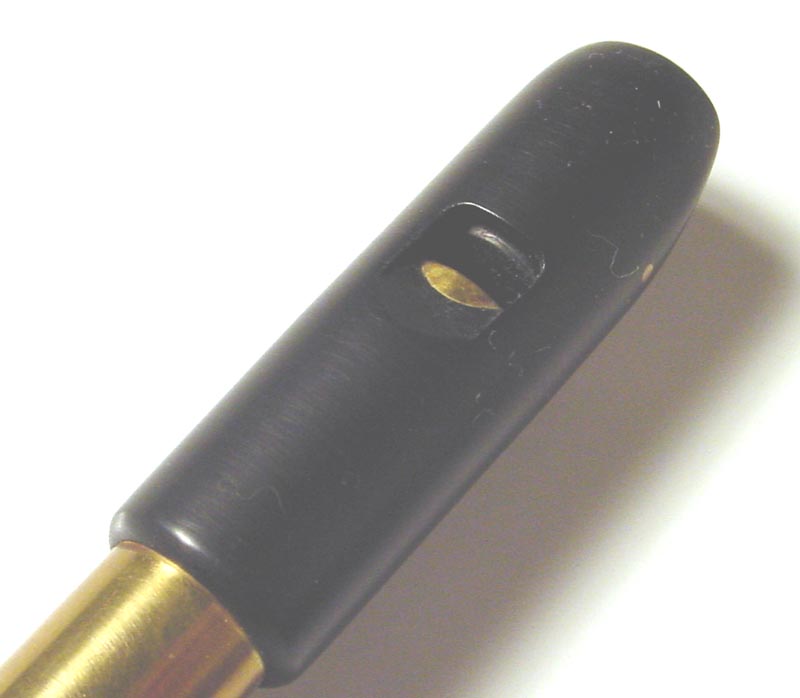
Here’s a close-up of the mouthpiece. This is a pretty neat labium ramp design, and one I haven’t seen before. It appears like the wind is split by the brass part of the tubing that shows through here, but is further channeled by the tradtiional ramp design cut into the acetal head.
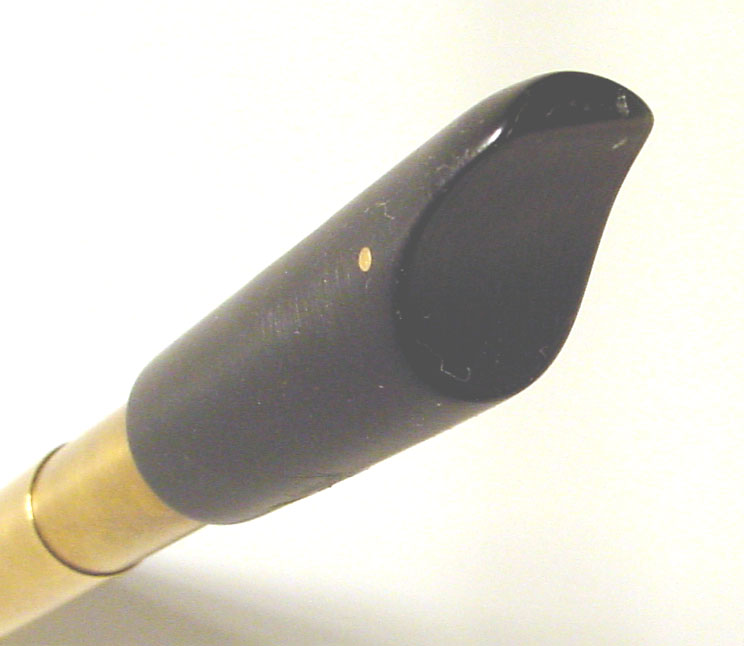
Here’s another angle on the mouthpiece, showing the fipple area. The mouthpiece is held together with brass pins, much like a Syn. Unlike a Syn, they’re cut off flush, and finished cleanly, whereas with Syn whistles, the pin head is left on, so as to allow someone to take apart the head for cleaning. It’s hard to see cleanly, but the windway area is curved, which helps with condensation.
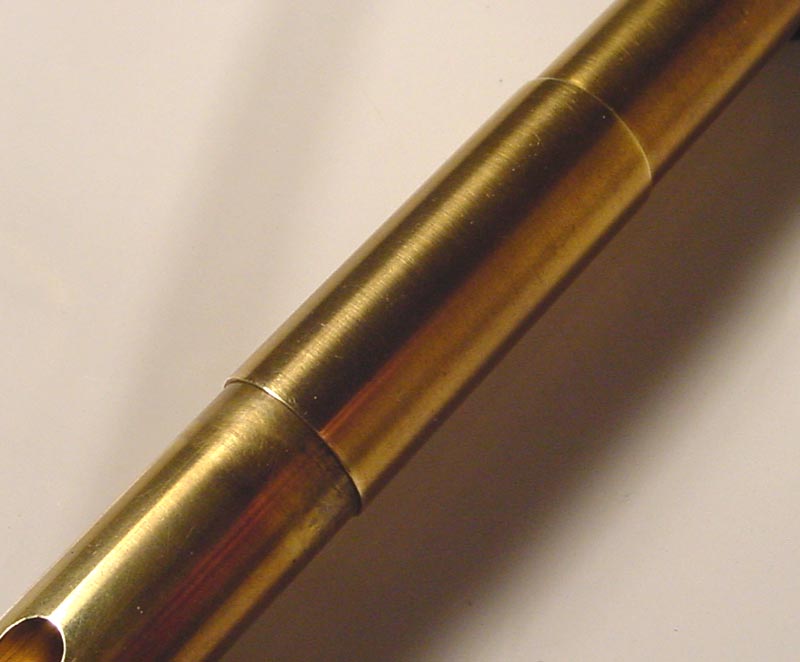
Since the tubing in the head makes up part of the labium ramp, you really couldn’t tune this whistle by moving the head up and down the body like on most plastic or acetal-headed whistles. So, this one has a bona-fide tuning slide. Some whistles have really loose-fitting tuning slide, and others it’s good and tight. Reyburn whistles have a nice tight tuning slide; not too hard to move, but it certainly isn’t going to move on it’s own. I can’t push this slide closed at all when I’m playing the whistle, and I tried. No worries here about your tuning changing in the middle of a tune because you happened to get a little too excited and pushed the whistle a little closed.
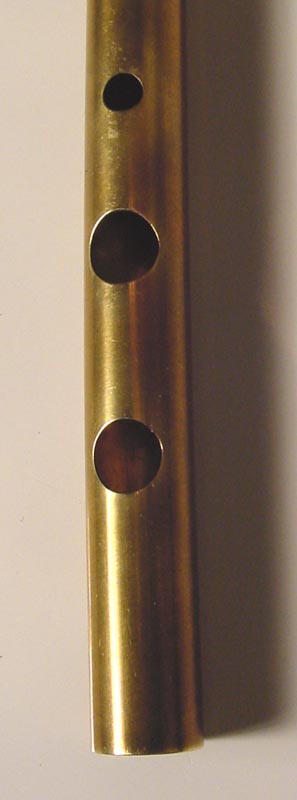
A shot at the end of the whistle, showing the last three holes. This whistle’s had two previous owners. The person that had it before me sent it back to Ronaldo to revoice the second octave it a bit more to their liking. Though Ronaldo did do some work on the holes, you can hardly see the signs. He’s definitely a very precise craftsman!
Playing Characteristics
The D/C set I have has a husky tone. It’s rich and complex. This is definitely not a pure whistle, but one with character. I was impressed with how similar it sounded to my nickel Copeland when I played them back to back for volume comparisons.
Sound clips of the whistle:
Garret Barry’s on the D whistle
Fraher’s Jig on the C whistle
Volume: This whistle was about as loud as my Copeland soprano D. That means it’s on the loud side…the Copeland is the whistle I play at the really loud session I play at on Fridays. This means it’d probably be a little overpowering in a quieter session. It’s definitely overpowering in my car unless the windows are down. If you’re looking for quiet, be sure and let Ronaldo know that’s a feature you require! The C body was more average-volumed; when I recorded these whistles, I had to turn the microphone volume down for the D whistle and back up for the C whistle.
Responsiveness: Nimble. Most soprano D’s play pretty quickly, and this one’s no exception. It doesn’t have a whole lot of start-of-note chiff, so you can play crans and rolls pretty fast and not have to worry about them sounding muddled. On the C whistle, the bell note (C) doesn’t come straight up to speed, so crans don’t sound as crisp and clear as they could. The rest of the whistle’s range is as responsive as the D body.
Tuning: Once warmed tuning is pretty good. As with many whistles, F# takes a bit of push compared to it’s neighbors. C# is spot on. There were no issues in the 2nd octave. I would play this with other musicians with confidence that it wasn’t going to embarrass me.
C-natural: played OXXOOO, C-natural is way too sharp–in the neighborhood of 40 cents. OXXXXO is 30 cents flat or so. Since OXXXOX (top hole and E hole open) is another standard cross-fingering that works on many whistles, I gave it a shot, and it’s spot on. On the C whistle, things are similar, including the alternative fingering for Bb. On A (XOOOOO), you do have to back your breath off a bit so as not to be sharp.
Hole size and placement: The holes are nicely sized, evenly spaced and centered along the whistle. The signs of drillwork on the holes is so miniscule that to mention it at all is nitpicking in the extreme.
Air volume requirements: Average in the first octave, but requires more in the 2nd octave as the breath pressure goes up. I find myself running out of breath a little sooner in the 2nd octave that I’m accustomed to.
Air pressure requirements: Average in the first octave, ramping up as you move up the scale. A little above average in the second octave. Takes just a bit of push to keep it going, which is great for playing in loud areas or when you’re excited. I find that when whistles are too easy to push, I tend to push them way too hard in the second octave under those conditions. Sometimes you just wanna lean into a whistle a bit, and this one takes that nicely, without being on the extreme end of that spectrum.
Clogging: Minimal.
While the whistle got a little damp after extended playing, I didn’t have any issues with it cutting out on me, or getting overly unruly. I still covered the windway exit and blew the thing out every now and then as a matter of habit, but I doubt this one would require any special treatment.
Wind Resistance: Good wind resistance. It’s gusty here in the Dallas area this time of year. I could feel the stronger gusts pulling at the whistle, trying to steal it’s sound, but it still performed well. I think I could easily play this at a renaissance fair other outdoor gathering.
Miscellaneous: I noticed that the D body sounds cleaner when playing the 2nd octave D with the top hole vented, rather than all fingers down. You can play it all down, but it takes a bit more care with breath control.
Summary
Pretty solid whistle. It has a lot of features I really like in a whistle. It’s a bit loud for playing around the house, but with that volume and it’s wind resistance, it would easily become a staple for the various outdoor events I play at.