I’m a newcomer to this forum but have a long path as a musical instrument historian behind me. I can’t find any active discussion of the material covered in the blog post linked to below and am therefore starting a new one. There will be a Part 2 follow-up specifically about the origins of the penny whistle and tin whistle. I’ll also post a link here when it’s online.
Early references to the term “penny whistle” suggest that it may initially have designated a flageolet. Robert Clarke is widely regarded as having invented a derivate “tin whistle” in 1843. However, contemporary sources both attest the label prior to that date and name makers who preceded Clarke in the production of such instruments. The term “penny tin whistle” also gained currency. This is discussed in an essay (Part 2 of the one noted in the preceding message) at:
The full image of Stevenson is actually more interesting than the heavily cropped one included with the article:
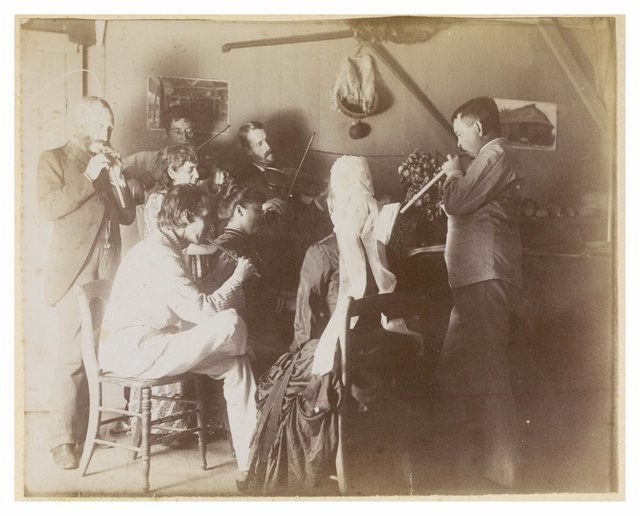
You have to wonder what they were playing
It’s scant, but archaeological evidence suggests that the fipple flute concept is an old one that predates Clarke’s time by far. Clarke’s name is remembered not for inventing the whistle outright, as some suggest - he did not - but for bringing the whistle into mass production (or at least he was the first to succeed at it). This revolution in whistle production was of such a degree that it democratized the instrument in a way never before seen; just about anybody who couldn’t craft a whistle could afford one, and the product was consistent. Were it not for his lead, this website might not even exist.
EDIT: I had forgotten that whistles were well known in Ben Franklin’s time - it seems he was something of a fan - and apparently they were relatively inexpensive even then:
Whistles: A Letter from Benjamin Franklin
Err … drones?
You have to wonder what they were playing
The two guys at the sides might as well be holding sticks and clearly didn’t take any cues from Stevenson about how a whistle is held. It’s also unclear whether the fiddlers both knew what they were doing.
Well, just a bit before Ben´s time we have Samuel Pepys playing Merrily Kiss the Quaker´s Wife for King Charles II and his mistress in chambers for dancing. I would imagine Ben was familiar with The Girl I Left Behind me. Since he was a man who enjoyed his tipple, he would have known To Anacreon in Heaven, which we Colonials know as the Melody of the Stars and Stripes Forever. Another popular air would have been Flow Gently, Sweet Afton.
Bob
Oops, Bob: that should be The Star Spangled Banner.
Didn’t know that Samuel Pepys was a documented whistleplayer too!

Bob
Meh. We know what we mean; but I thought that a little accuracy was a good thing for the sake of our international readership’s elucidation. I tried out TSSB, BTW, and it fits the Ionian mode (D scale on the D whistle) with only a couple of G#s to tackle. If you don’t fear the shrillness, it works well in G, too. The Stars And Stripes Forever? Oy. You’d need a whole band full of whistles and a truckload of half-holing. I’ll leave that to my more enterprising betters.
Didn’t know that Samuel Pepys was a documented whistleplayer too!
Samuel Pepys’s diary includes many references to playing the French flageolet (two thumbholes and four fingerholes), making him the instrument’s most famous 17th-century exponent. There is a useful compilation of relevant snippets at https://flageolets.com/articles/pepys.php and a full list of terser references at https://www.pepysdiary.com/search/?q=flageolet&k=d&o=r. He varied the way he spelled flageolet but never referred to it as a whistle (a word that he used to designate birdsong and the human action with puckered lips, except for a single reference to a “boatswain’s whistle”).
It seems likely that the term penny whistle initially designated the French flageolet and followed to being a synonym for the English flageolet, before acquiring its current sense. However, the first use of the term flageolet designated a willow whistle and the adjective penny was often used to indicate a child’s toy. A reference to an unspecified whistle in an older text cannot simply be taken as evidence of the now familiar six-holes-on-top form.
Not altogether surprising. Now this is utter conjecture on my part, but I’ve always considered the willow whistle - regardless of tonehole number or arrangement - to be the prototype from which all others arise, and the dearth of physical evidence due to more ancient fippled instruments being largely made from such easily-gotten yet ephemeral materials. The only defense I have for this assertion is the continuing folk tradition of making willow whistles to this day. I’m very comfortable with presuming that the tradition goes waaaaay back.
Strange as it sounds to us today, these sharpened fourths weren’t written (and don’t seem to be expected) in The Anacreontic Song, aka To Anacreon in Heaven.
the dearth of physical evidence due to more ancient fippled instruments being largely made from such easily-gotten yet ephemeral materials.
The oldest known examples are mostly bone and they are very old indeed. In fact the oldest known musical instrument is a vulture bone flute (the Hohe Fels flute), estimated around 40000 years old
Not to deny them their considerable due, but aren’t those notched flutes? I’m suspecting that for the longest time, the fipple (as we know and think of it) was more often readily and easily served by making it from wood-and-bark construction.
Just tried it with the unsharpened fourth, and I must say it works quite well in its own way, too.
What I don’t know is whether TSSB started, or was ever done, that way.
[Edit: but checking reminds me that its first published sheet form has the sharpened notes.]
Earlier there was some mention of Robert Louis Stevenson, and a fine photograph (Thank you Mr. Gumby). Stevenson played what has come to be called an English Flageolet. I have a four key example of one in D. Here is a link to a site dedicated to these instruments and a little more info on Stevenson:http://flageolets.com/biographies/stevenson.php
If you purchase one, say through Evilbay, you will most commonly find the mouthpiece missing or much eroded. This can be remedied with a pipe mouthpiece in pseudo amber. Mine is from the brand name Medico. They do require good breath support and control. In spite of a somewhat recorderish style of fingering, a lot of fun.
Bob
There was a whole bunch of instruments that looked like they sat somewhere between the flageolet and the whistle. Especially French whistles of ate 19th century retained shapes more or less rooted in the flageolets. Charles Mathieu in Paris had a whole range of them and related instruments ( my great-grandfather had a Mathieu ocarina that I still have somewhere). Somewhat strange hybrids too, at times, like this one .
Here are a few more (sorry for recycling those images again. And look, extended chimneys, now there’s a novel idea..  ) :
) :


Fipple flutes have a very long history in the Americas. Some of the examples that exist in museums today date
back thousands of years. The best preserved ones were made from ceramics. For example, here is an example of
a double bored, double fipple, flute from Mexico that dates back to the period 300 BCE - 250 CE. There are many
others.
I have often wondered whether the development of the recorder and flageolet in Europe was influenced by the
exposure Europeans had to civilizations in the Americas post Columbus. I know a lot of people claim the opposite,
regarding development of Native American flutes, i..e, that they only came into existence after native Americans
saw Europeans playing flageolets, but there is a mountain of evidence to show that Americans made extensive use
of all kinds of flutes dating back thousands of years. In contrast, there is very little evidence of early fipple flutes
(recorders, flageolets or whistles) in Europe that pre-dates Columbus.
Of course, that could easily be a result of wooden artifacts not surviving. But there are numerous examples of wooden
flutes (rim blown ones) that survived for well over 1000 years in the arid southwestern desert areas of North America,
and many ceramic fipple flutes.
Remains of whistles found in Ireland go back at least a thousand years. Wooden and bone ones from excavations of Viking Dublin at Wood Quay and 12th century ones from Cork.
That sort of thing was pretty much universal. It’s probably also a bit outside a history of tin whistles.
What arouses my curiousity is the preference of tapered vs. straight bores. The keyed flageolets seemed to be predominantly tapered bore instruments, or is this a false judgement? The wooden ones for sale in America in the late 1800´s to early 1900´s were, and I believe Mr. G. has at least one keyed metal flageolet. Am I wrong in remembering the metal one as being taper-bored , Peter?
Bob