Playing Shakuhachi music with a whistle or simple flute

I’m interested in this book on the Shakuhachi & meditation type music:

Blowing Zen: Expanded Edition: One Breath One Mind, Shakuhachi Flute Meditation

http://www.amazon.com/gp/product/1475200587/ref=as_li_ss_tl?ie=UTF8&camp=1789&creative=390957&creativeASIN=1475200587&linkCode=as2&tag=advanwebamazocom

But I don’t want to learn Shakuhachi. so I’m curious if I could play all the notes of a Shakuhachi with my whistle? I googled on this but I get different scales for the Shakuhachi. Some say it’s minor pentatonic, which would be easy on the whistle, I do that on the whistle to emulate my native american flute. Others say it’s major pentatonic. Which is possible too. But I’m not sure.

The shakuhachi usually plays a minor pentatonic scale, usually in D: D F G A c d.

To play that on whistle, you could half-hole the Fnats, or you could transpose up a tone: E G A B d e.

Thanks for confirmation on that. This is what I do for the NAF. I have some NAF backing tracks (Jam Tracks) and the keys fall in line with my whistles. for example Eminor I play on D whistle.

For the shakuhachi, if the base key is in D then I think I could rip the CD to mp3 and use Transcribe to pitch adjust them up a tone to E and then play on the whistle. I think I’ll order the book and give it a try.

Thanks

Or you could play the D pentatonic minor scale on a low C whistle.

But I wonder (and I don’t know): does the music for Shakuhachi really correspond to what we call pentatonic minor? Are there not significant pitch variations in the scale, a different micro-tuning, so to speak, apart from the large amount of expressive note bending used?

Or, now that I think of it, if you get serious about playing shakuhachi music on whistle, you could order a five-hole, minor pentatonic shakuwhistle from a custom maker such as Mr. Bracker.

Not something I’d feel the need for myself; just thinking aloud here.

I’m frankly curious about that. Seems to me that the music and the instrument go pretty much hand-in-hand. I don’t know about you, but if I were to attempt shakuhachi music on any other instrument, I’m pretty sure I would find the results to be less than, well, right, for lack of a better word. There are aspects of shakuhachi playing that are essential to its music and that can’t be truly reproduced on a whistle or transverse flute.


But, nothing ventured, nothing gained, I suppose. :slight_smile:

I can certainly understand that. My interest in this book, which covers many aspects of shakuhachi, is more in the meditative aspect. I like the idea of closing my eyes and relaxing and playing some music on the flute and I need some guidance here. If I could find a book like this for the whistle or traverse flute then I’d probably get that. I’m also a fan of the author’s other books (ToneWay Method - which is about learning to play by ear). So I’m sure this book will be good.

So I guess it’s more about using a tool I already have to go along with the book. My main instrument is violin now so I don’t have the time to learn yet another instrument like shakuhachi. My violin playing is pretty bad and requires all the practice time I can manage. :boggle:

Finally, I have a NAF that I rarely play, since I learned that I could play the same scale on my whistle. the whistle gives me a bigger range and a leading tone below the root. My NAF is Gminor and I prefer the Eminor I can get from the D whistle. Hence I prefer the whistle over the NAF. I never really got into NAF music so playing on a whistle is ok for me. :smiley:

Ive made quite a few bamboo transverse flute with shak tuning, 4 holes up front 1 in back, slightly larger and oval blow hole, You can get a LOT of the shak. elements without the trouble of the rim blown flutes.

for me, to play decently on the rim blown flutes , you cant let your technique get too rusty , or its almost like starting over.
ymmv

The shakuhachi meditation music, in many ways is inextricably connected to the Zen tradition. That doesn’t mean that everybody who plays shakuhachi practices Zen however, the basic principles of Zen are universal and apply well to all endeavors. My guess if you find anybody that is good at something, a baseball player, a tuba player, a writer, you’ll find that they are using some principles that are part of Zen.

There is absolutely no way that you can play Zen shakuhachi music for mediation on a NAF. While the Shakuhachi is a pentatonic instrument, some of the music has little to do with the pentatonic scale. The shakuhachi music’s convention was developed as a way to imitate nature and as a way to heal and provide a pathway for the kundalini among other things. The shakuhachi is capable of performing microtonally and playing 1/4 tones and many of the music ornaments can simply not be played on a NAF.

All that being said, you can apply all the principles of Zen to a NAF just as you can any art. One of the classic books is Zen and the ARt of ARchery. http://www.ideologic.org/files/Eugen_Herrigel_-_Zen_in_the_Art_of_Archery.pdf I liked it much better than Blowing Zen and it can be applied to any endeavor. And it boils down to one basic principle, if you want to succeed or be an expert, stop trying.

Summary. You can’t play shakuhachi music on a naf but you can apply the same principles and create your own music.

Hi, thanks for the information. I downloaded the PDF and will definitely read that. I can see how that Zen concepts could apply to any area in life.

For the meditation part, I’ve tried meditation in the past and my mind always wonders. So I thought that if I tried musical meditation that it might help keep my mind still. The problem is I don’t have any idea of what to play. I’m not sure if you read the same Blowing Zen that I linked to above because there are at least 3 books with this title at Amazon, but if you did read the one by Carl Abbott I’m curious if this could help me to learn to play meditation music?

I understand about the microtones.. from what I’ve read about the bansuri it is designed to allow microtones that are necessary for Hindustani Classical Music. I don’t have a real indian bansuri either though. :wink:

My apologies, I read the other Blowing Zen book and not the one that you posted.

Well, you’ve encountered the most common problem with any form of spiritual practice. Quieting the mind. But I think the flute is a wonderful tool to work on your concentration skills. A meditation is really just focus and being able to put all the problems of the office and worries of tomorrow.

A drum has been used for this purpose for Centuries through many different cultures. Doesn’t make a difference if it is a Bodhran, middle eastern frame drum, native American drum… etc… Cultures use it for trance states. Which is a fancy way of saying a very very focused state. But when I play flute I get into that state too.

A lot of people just play long tones and become very very present to simply the movement of the breath. Just play one note and focus on a very clean, pure attack. Start softly and bring up the volume to a medium volume, and allow the sound to fade into absolute nothingness. Just one note. You’ll find it’s not as easy as it sounds. You can do it with a metronome a drum beat. 8 bars or 16 beats and then continue doing it for longer if you have the lungs.

There is free metronones online if you don’t have one. And a cheap frame drum or native American drum can be bought for very very cheap.

Hi, I just wanted to say thanks for the tips. I have a bodhran and djembe so I can try some meditation with the drum too. The other thing I want to try is using one of the tanpura / tabla apps for the phone (like iTablaPro). I like the droning of the tanpura.

Lots of good ideas. for long tones I can also practice these on violin that would be good practice for me.

I guess I don’t need the book, at least not at first. I’ll see what I can do.

[THREAD REVIVAL - MOD]

Reviving another long dead thread here, but I have to go “hmmmm” over that. Zen practice is characterised by strict discipline and formal exercise. There is a point at which the archer has practised his formal routine of drawing the bow and loosing the arrow so much that he can literally do it with his eyes closed, but he doesn’t simply waltz into the practice hall and loose an arrow at random, hoping it’ll hit the target. The blind archer effect is the outcome of years of disciplined work.

If the OP wants to do meditation, why not do simple zazen? Your mind wanders - well, that’s the nature of the mind. Concentrate.

The shaven-headed man hath spoken :party: .

A Shak tuned Transverse flute is now for sale in instrument exchange :slight_smile:

I am comfortable meditating with a diatonic flute and other western instruments. I can see where a pentatonic scale might ease the jump to a meditative mode for other folks.

Interesting thread.

[And yet another revival. - Mod]

Shakuhachi a peaceful mediative instrument? No doubt. Was it always that way? Be its past questionable padawan! When the samurai were disbanded, and the swords confiscated, they needed a weapon that would appear to not be a weapon.
Ah, Grasshopper you play Shakuhachi very well but why is there blood all over the roots of your flute? Why do you wear a basket over your head when you wander through town? All the better to strike the all powerful nearly silent note!
Go ahead and hate your neighbor, go ahead and cheat a friend.
Do it in the name of heaven, you can justify it in the end.
There won’t be any shakuhachi’s blowing, come the judgement day,
On the bloody morning after… One Tin Grasshopper rides away.

I will refrain from accusations of trolling for now, tbone, and instead venture to inform you. (…but Billy Jack? Seriously? :wink: )

In this case your grasp of the matter is not as one might hope, but that’s going to be true of most people. First of all, there was no confiscation drive by the Japanese government. In a nutshell, the disbanding of the samurai as a class was a process of steps beginning in 1873 and which was only truly wrapped up once and for all by 1947; indeed, prior to 1873 the nation had already been at peace with itself for so long that the samurai had become largely idle militarily, with fewer and fewer being retained. They drifted into nonmartial occupations because their stipends, if any, became increasingly reduced and they had to find other ways to put food on the table, mostly by entering into administration, but also medicine, academics, and the arts. Some even took up farming. I doubt that any ventured full-out into commerce without some major soul-searching, because no matter how wealthy and influential, merchants were at the bottom of the social hierarchy. Be that as it may, this became the norm, but whatever they did for income they still retained samurai status. In other words, they were redundant. Of course a few descended to banditry and the like, but the lot weren’t all going around cutting each other up willy-nilly; there were already very stiff laws against that long beforehand. In the course of the disbanding process, the samurai’s right to wear swords and use them at will among the general public was abolished. That’s a completely different thing from confiscation. Yes, there were “sword hunts” in the past, but those were either between warlords, the winner in war harrying the loser, or in the most famous and sweeping case, to outlaw and remove weapons from the hands of commoners and monks, not samurai. Big picture is the samurai still kept their arms by privilege and displayed them at home, and continued to use them in contexts such as teaching, practice, and demonstration (pursuits that continue to this day); there was no overarching “need” for stealth weapons to substitute for their traditional ones. Splashy video game gore-fest narratives might be another matter, but questionable amusements ain’t history.

Less in question was how the mendicant komusō monk wasn’t always entirely what he seemed; the whole getup was perfect for anonymous spying and surveillance, if a bit obvious, so the shogunate granted them complete travel privileges free of challenge and used them for espionage. It’s also known that lay people dressed up that way as well for covert reasons. Makes sense. Naturally in all things cloak-and-dagger, self defense is a consideration, so the shakuhachi is logical for the purpose (so long as it’s of one-piece construction).

Here’s a komusō in full kit so we can stay marginally on-topic:
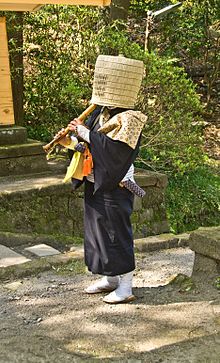
But it’s highly doubtful that samurai would have readily engaged in such deceptions except in great extremity; it would go against their sense of honor. Working in espionage was a ninja’s gig, skulking being unworthy of the samurai’s hereditary profession. If members of samurai families ever took up the shakuhachi as a pastime, there is no doubt that they would also consider its martial potential, but being primarily a defensive weapon it never replaced the sword, the bow, or any other traditional weapon associated with that class. It would have at most been simply a nonstandard weapon of circumstance. If one felt the need for a dedicated defensive weapon just in case, the socially acceptable tessen (a solid iron bar in the general shape of a folded fan, also a working fan with iron ribs that serves as a baton when closed) was more likely because of its unobtrusive appearance and because it was easily tucked through the belt and out of the way, neither of which can be said about the considerably less durable shakuhachi.

And now that I’ve bored you all to death…

“bored you all to death?” I hope that was tapered bore. In a small insignificant way you confirmed my absurd posting, Wikipost master. Just kidding. I did enjoy your post. My post was a bit of truth mixed with humor and your post was a bit of humor mixed with truth and the world is a better place for it too Brutus and you are a noble man and a moderator!
One tin grasshopper tip-toes away.


“Boredom is a pleasing antidote for fear”
― Daphne du Maurier, Rebecca

Well, someone has to be Cliff Clavin around here…

Funny you should bring up Cliff Clavin. I just happen to be one of the 3 people who’ve never been in his kitchen.
I must clear the aire on the Cliff ↔ tbone controversy. I am Not Koko the Chimp.
One more point. Cliff Clavin is not in the Rock and Roll Music Hall of Fame and I is!
The above sentence is true on a technicality. I worked in a recording studio and did some back-up tracks for a band that I never met. 20 years later while flipping through channels on TV I saw the induction of said band into the Rock and Roll Music Hall of Fame. My notes are in there Toot!

What does this have to do with World/Folk Winds?
Where’s a Moderator!

P.S. It goes without saying that I am ashamed to admit that I am fascinated with opened ended 8 hole dong-xiaos.


“Cliff Clavin was a strolling bore.” - Nanu-Nanu
P.S.S. I’ll try to get more on topic