Hi and Welcome.
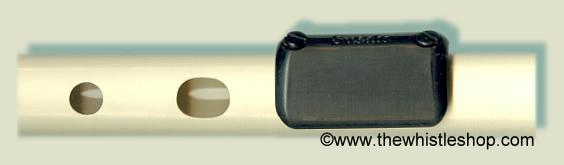
For measurements Center B2 to Center B3 is 1.75 inches.
That’s about 4.5 cm. My variance error is probably 1-1.5 mm. Note I’m using a tape measure which bends and not a power tool that’s why I put a variance.
I believe I am the one who has an Issue with their second octave on low whistles. I got no problem with their high.
I have 3 Low D of Susato. One Kildare with 2 keys, one Kildare unkeyed and 1 Dublin.
I also own an E-F-F# Whistle of theirs.
What’s consistent is all of them are sharp in second octave.
Is it me or is it the whistle?
First testing: Breath manipulation
I lowered the pressure of blowing little by little. Because as one lowers the tone gets flatter little by little.
My result was the tone flip to first octave from its 15 cents sharp second octave, it was its limit.
It is consistent with the other keys as well.
I have discovered also that they modify their products often.
The Low whistle I have has 1 o-ring and has serrated joints.
Then I recently purchased older models.
It still look like the current Kildare but it has 2 O-rings and joints are not serrated.
It is Key of E and Eb.
Second Testing: Comparing the E’s of both model of both.
I can say that the Newer model is tapered tighter than the a little older one which has 2 O-rings.
How did I found out?
Simply by inserting the same finger on the end.
The newer one is tighter that only 2/3 of my pinky got through.
The older one has all my finger in it.
Intonation wise the older one is much reliable in tuning.
Though the C# and D# of 2nd 8ve is flat by 10-15 cents it can be corected by breath or cross fingering of XOO-OOX for C# and OOO-XXO for D#.
Same is true for Eb model with 2 O-rings.
Third Testing: Dublin Comparison
The Dublin is in tune and can be corrected easily. The problem is it has a bigger B2 hole.
Fourth Testing: Jamming
Playing with other instruments using the E.
Result: newer model raised other instrumentalists’ eyebrow,
Older model got through.
Again it is possible that I got a stinky one, but I had 2 kildare low D and ordered at different time. Both are sharp on second octave.
Pulling the joint did not do the trick as it made the lower octave flatter but the second octave is still sharp. I can not pull iut any farther enough as it loosens.
Doing the Rush tweak is not that consistent.
I agree with the flutey sound.
I agree also with the non-begginer choice.
Choosing this as a beginner will make you develop a cough reflex. Mine lasted for 2 weeks. Breath exercises for vocal training and gym sped up my recovery.
Note of disclaimer: I do not intend to defame the maker of the whistles I mentioned. What’s mentioned above is my opinion, and I am expressing it with freedom.
Note of paranoia: I am ear sensitive and intonation freak. 15 cents sharp or flat makes my ear feel the sound of the scratching of a styrofoam and I ear a lot bees freaking out.
It is so sensitive that I am a light sleeper in which sudden motion wakes me up and I can tell the coackroach direction with lights turned off. I also got the ability to tell a person if he is lying just by listening to his voice patterns.
I got this because of the perfect pitch training CD. It has lots of disadvantages. Seriously. To the point of I can not tolerate chit chats and a baby’s cry.
Regards,
Angel

 I’ve alway been meaning to post some sound samples from one of the albums I’ve used it on…not too techy for that but my woman can do it…p’raps I will…
 Yes, I guess I keep discounting the Howard. I didn’t always play the original tube. I made my own bodies to solve that issue. But you are right, that is a big hole. The Howard uses larger holes than average overall. I think the difference is that the Howard hole is still round not elongated like the hole was on my Susato. But I still found both to be playable designs.