A watercraft made of … mushrooms? (← link)
I think it’s a champignon idea.
That’s crimini-al.
A girl in every port-o-bella.
Shii take a little trip?
Don’t enoki if you haven’t tried it.
Sorry to truffle you.
Jeez. Puns all the way up to mycelium.
Big words like that should be hyphae-nated.
If I had, they would’ve said I blewit.
The boat is living mycelium, BTW. Buoyant and watertight, but every time it gets put in the water it sprouts reishis, so I suppose one must weigh the drawbacks and benefits: seaworthiness, or dinner?
The greater implications are compelling, though.
I am certain Katy has a more than passing familiarity with the writings of my buddy Paul Stamets, whom I have nick-named ´St. Paul of the Mushrooms´, the owner of Fungi Perfecti. Paul led me down the ´garden path´ to becoming a part-time shii-take grower, provisioner to the kind of restaurants I can´t afford to eat in. . .
He has been an early and influential proponent of ´myco-ecology.´ He proposed setting up successive sawdust berms colonized by Stropharia to clean up polluted water running off from dairy farms into Puget Sound. This eased a conflict between the dairy farmers and the state ecology board seeking to protect the salmon fishery. Win-win. No pollution and the Farmers got a secondary crop of high protein livestock feed from the mushrooms sprouting from the berms.
Nano, I hope you know you are in an area with many people growing shii-take in the traditional Asian log-culture method.
Bob
It’s news to me, TBH. But I guess I’m not surprised, either. I don’t know if there’s such a thing as an ideal climate for shiitake production, but when I was in Akita, which has a climate somewhat analogous to Minnesota’s (putting aside the rainy season, the typhoon season, and some really big bugs), it wasn’t unusual to come across shiitake log sites during hikes through the satoyama, an economic zone of managed mountain woodland marked by little hamlets. If large-scale shiitake farming exists, these setups would be called modest at best; they suggested cottage industry. The first time I saw a shiitake nursery (don’t know what else to call 'em) I was fascinated because each log sported a lot of impressive-looking mushrooms, it was clearly someone’s doing, and the setups were just sitting out all alone in the forest shade, no fences or signs or anything. You could have walked right up and picked some, but I had no wish to play the Ugly American. There’s a good amount of wooded area in MN as well, so if you can easily cultivate a choice and sought-after mushroom here and profit from it, why not? Plus with log cultivation, not to mention it being out in the open, the overhead is as minimal as you could ask for. Being eco-friendly seals it.
I wasn’t really aware of the concept of mycoecology prior to the article above, but I’m on board now. 
I’ve purchased from that website many times.

When I first bought the house I live in now, I bought their myco-grow product to help my lawn come in, and I must say it worked pretty well.
I was going to give this a try, but checking the website, it’s all out of stock. 
Wanderer, that particular ´block´ of fruiting shii-take started out as a sterilized bag full of enriched alder sawdust as you know. That particular strain was procured from mainland china, where they practice mushroom farming on an astonishing scale. I´ve seen pictures of oyster mushroom farms that stretched to the horizon with lines of tanker trucks with water to maintain the humidity of windrows miles long.
Nano, the log culturists in your area use a strain similar to ´Winter Giant´, which prefers your winters for its resting time. The farmers like your Northern Hardwood forests, particularly oak. In Asia its native host is called the Pausania, sometimes called the ´edible oak´. In Japanese, the Shii Tree. Another acquaintance started a log-farm in Ontario because of the abundance of oak, and again the winters. . .brr.
Once, in a Chinese Restaurant, We chanced into a conversation about mushroom cultivation with a fellow diner as we were both enjoying dishes made with ´the fragrant mushroom´, Dong Ku, (shii-take). He grew up on a mushroom farm on a mountain on Taiwan. The farm was ´pie shaped´ running from the base to an apex near the peak, with impossible switchback roads running up past little ledges beside icy mountain cascades and freshets. They would position ricks of logs there to be continuously sprayed and misted. As the logs fruited they would be hauled down to the fruiting yard and then put in resting sheds. Altogether a brilliant low tech operation with the exception of a battered pickup truck, and a sort of motorcycle (actually a motorized tricycle) with a pickup bed.
Bob
I bought one of those inoculated sawdust things many years ago. I followed the instructions meticulously for many months with no results. Then I tossed it into the yard and a month or so later it began growing shrooms. I guess I just needed to neglect it more.
Speaking of which, it’s been a reasonably wet spring, I need to start looking for morels.
We rationalize staying where we do with an old Norwegian saying: There is no bad weather - only bad clothing. 
The rest is pure payoff.
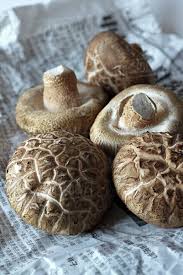
When it comes to these things, I can’t help but look them up. The Japanese use the Chinese-derived name “donko”. “Fragrant” is probably a common epithet, because dong ku, donggu, and donko all use the same kanji (冬菇) which directly translates as “winter mushroom”. That would seem to fit with Akita (and MN, no doubt). It’s been almost thirty years, so memory’s a bit hazy on detail, but it’s highly probable that that’s what I saw being cultivated; I vaguely recall an impression similar to the pic below.
Apparently it’s one of the high-grade varieties of shiitake, but you wouldn’t think so by looking at it.
Now there’s a good word.
When you’re immorel, that’s always a good course of action.
But on a serious note, I never took to the flavor of morels, myself.
A couple of times we’ve had a good crop of puffballs behind the house, but I’ve never taken to the flavour of them. We tried frying up one, and since them have let them be.
I’ve never tried puffballs, but have always been curious. How would you characterize them?
Tough question. It was years ago. As I recall, the taste was not objectionable in moderation, but when one slice is the size of a dinner plate, it’s more than you want to swallow. Maybe in smaller quantities with the right sauce …
Here´s one characterization: https://www.youtube.com/watch?v=Hp8uZ2Kd5GY
Here´s another: https://en.wikipedia.org/wiki/Calvatia_gigantea#/media/File:Giant_Puffball.jpg
 Bob
Bob
I’d characterize puffballs as not so good soccer balls. While I have never eaten one, they do pop up on the edge of a small wooded area on the edge of an village park where I walk. One particularly large specimen tempted a young teen to give it a good kick to minimal effect. I don’t remember what happened to his shoes, but he had a particularly confused look on his face.
And I sometimes wonder if the allure of the morel has much to do with the nature of the hunt. I’ve had a few and they were fine. But I remember being more excited about finding them than eating them. The search and the stalking of one’s food all in the name of a morning’s hike…
I had a large pile of rotting oak in my backyard, under a number of standing maple trees. I did naively try to shake out some spores of a morel before it was cooked to see if I could recreate the forest on a small scale, but it was a no go.
C’mon, I know what they look like; how do they taste? Those hipsters weren’t much help with “kinda mushroomy”, either, then adding it to a curried veggie ragout and declaring it to be “kind of like a flavorless marshmallow”. I won’t be going to those two again if I’m looking for epicurean reviews.
I only saw much in the way of puffballs when I was a kid, and they were all of the small variety; none ever got nearly as big as the ones that seem to get all the press. When they went brown and papery we’d squirt the spores at each other.
For me a sauteed morel tastes like fried walleye, which isn’t a bad thing in itself, but it can be off-putting if what you’re used to is button mushrooms. No doubt it’s why it sometimes gets called “dry land fish”.
I don’t think I’ve ever had either a morel or walleye. In fact, I had to look up walleye. It’s not a word, or a fish, I’m familiar with. I also don’t remember ever coming across morels in the wild, although apparently they are around in the UK if you know where to look.
Probably my favorite mushroom to eat would be the Augustus Agaricus. This is a ´shroom which has a remarkable aroma and flavor of Amaretto. It is quite large. I once found a solitary specimen 18 inches tall and over 7 inches across. I was able, with difficulty, to cultivate one particular strain of them collected from around Bakersfield,CA. They like it Hot. To initiate a fruiting takes several days around 100 degrees fahrenheit. I agree that puffballs can be rather bland, but since they are a relative to the Augustus, I wonder how they might be sauteed in butter with a dash of Amaretto.
I like my morels quite simple. Sauteed in butter with flour, or cornmeal. I find them savory, and use them, When I can get them!, as an addition to sauces.
I once had access to a, I guess you´d call it a compost pile, of several tons of lawn clippings. An acquaintence had a lawn, more like a driving range of several hundred yards down to a small lake. He threw the clippings down a sidehill. Every summer this area had the most remarkable fruiting of Lepiota Rachodes, Shaggy Parasols. I could collect bushels at a time once a week for several weeks each summer. They have a faint aroma of Burgundy, and this inspired a chef friend to serve them in a reduced Burgundy Sauce. Í had many companions who mourned when I could no longer collect these ´shrooms. They do, unfortunately have a close resemblance to the Amanita Pantherina, poisonous, so you do want to be sure of your identification.
Which brings up the unfortunate immigrants from SE Asia who mistake the Amanita Phalloides, Death Cap, for the delicious Paddy Straw ´shrooms so ubiquitous in ´the old country´.
One year we had a huge bloom of Matsutake. An acquaintance gave me a bushel basket full. We ate them until I was sick of ´em. Not my favorite. But they have an elusive aroma reminiscent of the candy ´Red Hots´.
As a cultivator, my mainstays were the Shii-take, The Lion´s Mane, and the Agrocybe Aegerita-the Black Poplar Mushroom called ´Il Pioppino´ by the Sicilians. We tried Nameko, but my buddy was much more successful with those as he used log-culture.
Bob