Review housed at http://www.tinwhistler.com/music/reviews.asp
Serpent Sweet Polly Soprano D whistle
(Review written July 2005)
Preface
Bill Whedon of Serpent Music has been making whistles for in the neighborhood of 3 years now. He eventually was producing a large variety of whistles, and has continually changed and refined his instruments and the models he sells. For instance, there’s the discontinued Earth Echo low D which was formerly the Python. The Sweet Polly which replaces the Brassy Polly, but the old style tunable Brassy Polly is still available, by request. Bill had some health problems (which thankfully he seems to have recovered from) and announced he was discontinuing all of his whistles but the Sunsinger and Sweet Polly. Up until very recently, the Serpent Music website had a lot of discontinued items listed, and I found the task of sorting them all out a bit daunting. Luckily, as I was putting the finishing touches on this review, the website underwent a bit of a redesign, making it a lot easier to navigate and to figure out what’s currently available. The Sweet Polly is available under the old name “Brassy Polly” on the main page. Shannaquay still has some of his older models (Dreadnought, Python, etc) listed, so it might be worth the time to write them as well if they’re listing something you think you might want but Bill doesn’t make any more.
At a Glance
Whistle Reviewed: Sweet Polly Soprano D
Models Available: This model comes in keys of D, Eb and F
Construction: painted CPVC with Delrin fipple and brass accents.
Price at time of review: $25.00 US
Available From: Serpent Music
How Acquired: Acquired secondhand
Appearance/Construction
The Sweet Polly comes in a variety of colors. The person who originally owned the whistle told me it was originally painted in illusion blue-to-purple color-changing paint, and that she added a layer of glitter nail polish. Also, she told me that she didn’t like the unpainted windway glaring white amid all that color, she blackened it in with a permanent marker. The whistle still looks nice, for all that, and people have commented on how neat the coloring is. The whistle itself is fundamentally unchanged: CPVC construction incorporating brass tubing in the tuning slide and mouthpiece, and Delrin for the fipple.
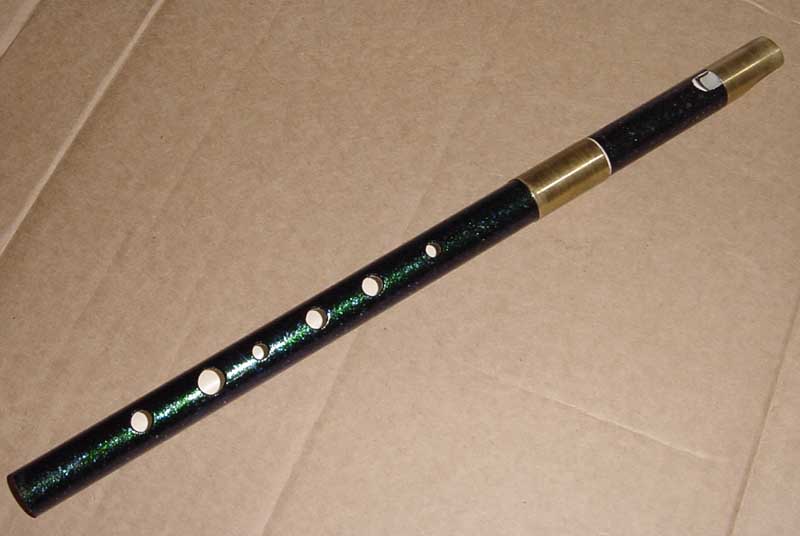
Here’s the full whistle. The little bit of white near the brass tuning slide is the CPVC which shows as you pull the head out of the tuning slide. This is about how much you pull the slide out to be in tune (see tuning section below).
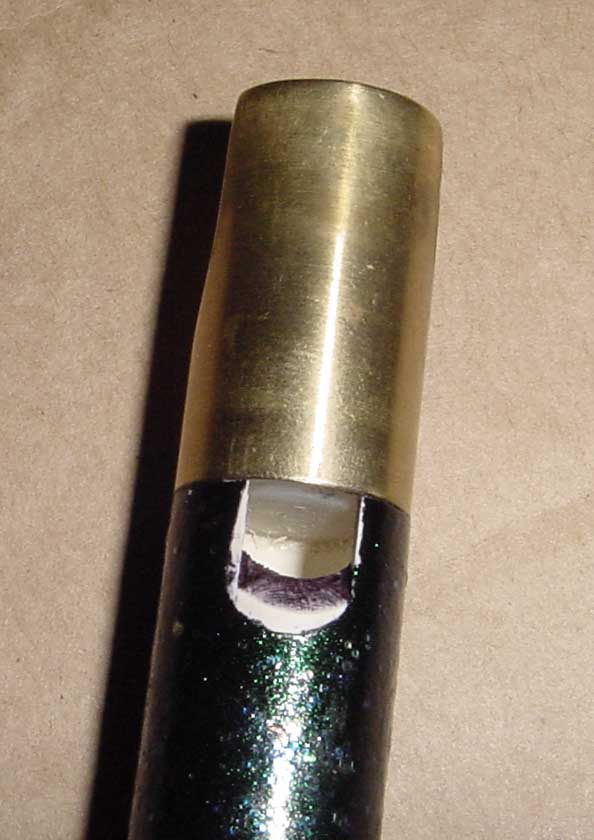
Here’s a close-up of the mouthpiece. The labium ramp here is a little steeper than some whistles, looks like close to a 45 degree angle, and is sort of half-moon shaped.
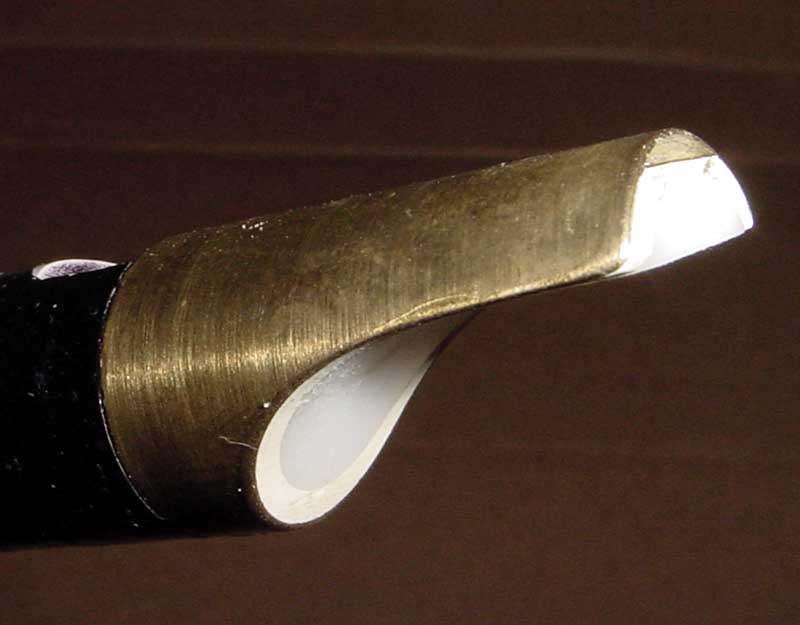
Here’s another angle on the mouthpiece, showing the fipple area. The beak on the Serpent whistles are extra long compared to many other high-end whistles, making them fit comfortably in the mouth more like plastic-headed inexpensive whistles. Some people find it hard to get used to the shorter beaks on most high-enders (like Overton, Greenwood, Copeland, etc), or even the extra-stubby mouthpiece on an Abell or Susato. You won’t have that problem with a Serpent. The windway is curved, with the Delrin fipple serving as the floor and the brass tubing serving as the roof.
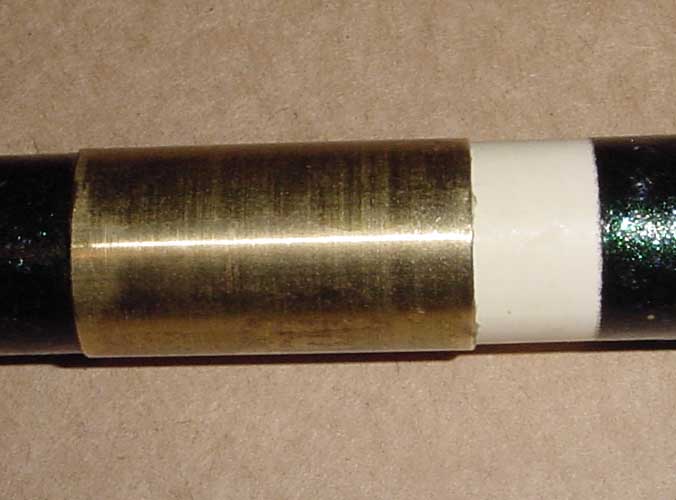
Here’s the tuning slide area, which is basically a sleeve of brass for the PVC to slide into. With the slide pulled out this far, the whistle is quite flat. Bill uses beeswax to help snug up the slide and prevent air loss. It does the job nicely. The only thing I don’t like about beeswax on the slides is that it makes the tuning slide feel a little “gummy” instead of “smooth”. But it does work, and the Serpent Music website mentions that you get some wax with your whistle so that you can keep it maintained. And if I had my choice of between “gummy” and “won’t stay put” or “leaks air”, I’ll choose gummy every time. 
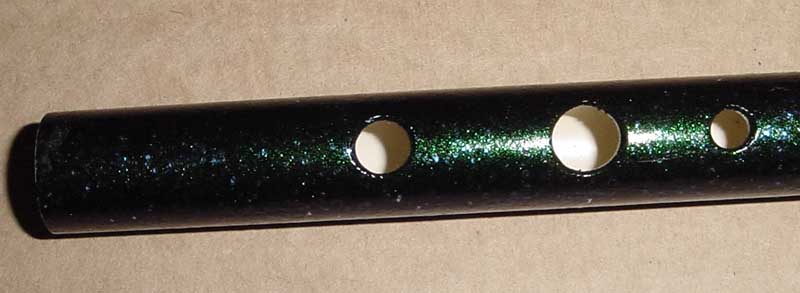
A shot at the end of the whistle, showing the last three holes.
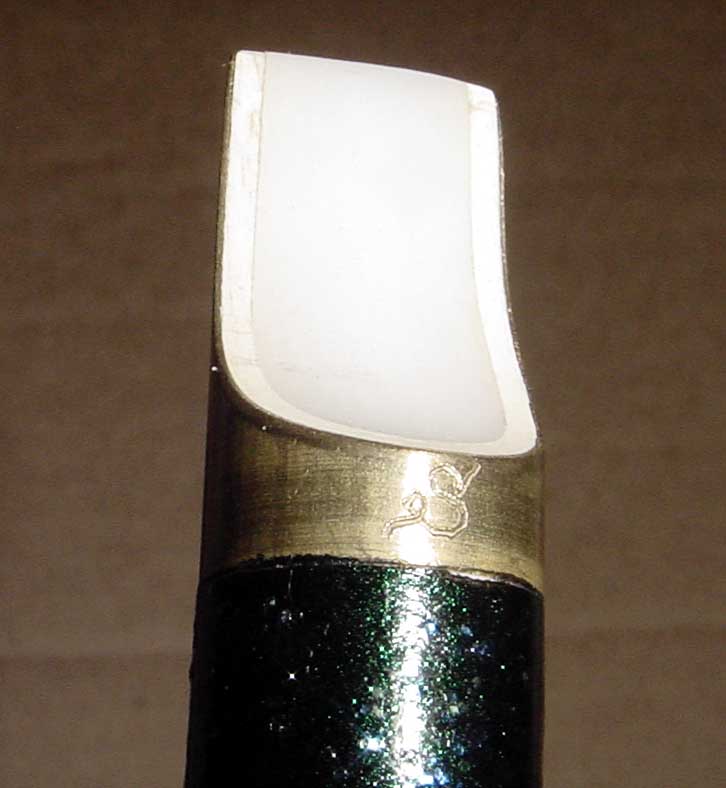
On the backside of the mouthpiece is a stylize “S” engraved into the whistle.
Playing Characteristics
Sound clips of the whistle:
Tar Road to Sligo
Cooley’s
Tone: Strong bottom end, with a little bit of windiness. The hissing windiness increases as you go up into the second octave. Reminds me of a less hissy version of the Jerry Freeman tweaked Shaw I reviewed, with a bit more of a traditional edge to it.
Volume: Louder than average. It’s maybe 20-30% louder than my Sweetone.
Responsiveness: Quick and responsive. Because of the increased back-pressure required (see below), it’s not the easiest whistle to tongue rapidly. But if you’re using the whistle for Irish music, that won’t be much of a consideration.
Tuning: The whistle is in tune across the two octave range. Unfortunately, this is with the tuning slide pushed very nearly all the way in. Thus, you can flatten the whistle, but can’t really make it sharp. As the tuning-slide is a simple construction of thin-walled brass and PVC for the mortise and tenon, I could probably solve this dilemma with a simple pipe-cutter, letting me tune a bit sharper. I’m sure Bill could and probably would do this for you, too, if you had the need. it should be noted that the second octave takes a lot more push than the first, and I probably didn’t give it enough push in my recordings, so the second octave may sound a touch flat on a couple of notes; this whistle will take some getting use to for me.
C-natural: OXXOOO produces a C-natural that’s about 30 cents flat. OXOOOO is pretty close to perfect, however.
Hole size and placement: The Sweet Polly has holes that are on the small-to-medium side. They are nicely rounded, and centered along the body. With the polish-covered-paint it’s hard to tell, but I think that they may be very slightly chamfered as well.
Air volume requirements: Average. This whistle took about as much air as my Sweetone. Maybe a hair more in the 2nd octave, but only a hair.
Air pressure requirements: Medium to high. The Sweet Polly requires a bit of confidence, especially in the second octave. You can’t be shy with this instrument. Open up your throat and push with your diaphragm to bring the 2nd octave into tune. I’d say this is a little higher than a Susato in this regard, but maybe not quite as much as an Alba SE. Unlike a Susato, there’s also a little bit of backpressure with this instrument, which increases in the second octave. So, you have the ability to lean into it a bit. Bill says he likes higher-pressure requirements in an whistle, because it allows for “circular breathing” (like Didgeridoo players use). For the uninitiated, circular breathing is where you are playing a note with air in your mouth while taking a quick breath in with your nose. It lets you play notes continually without having to drop one for a breath. It’s also how Kenny G has the Guinness Book record for playing a note for something like 45 minutes. I’m not sure of the Polly has enough backpressure for circular breathing, but it has some. Because of the air pressure requirement, you can’t really “fade out” notes either; at a certain level of softness of pressure, the whistle cuts off and stops producing music, and just produces the wind noise.
Clogging: The whistle got slightly wet after 15 minutes or so, probably due to the air pressure going through it. Moisture didn’t cut the whistle out, but did make it sound windier until I blew it clean. I probably wouldn’t bother giving this whistle the Duponol treatment unless I was just giving all my whistles the treatment (which I do a couple of times a year).
Wind Resistance: Poor. This whistle will handle a slight breeze, at certain angles. At other angles, even the barest hint of breeze cuts this whistle out. Like the Burke, it doesn’t even really like my air conditioner on full blast in the car. The last few whistles I’ve reviewed have completely upset my theories on wind resistance. Seems like it used to be that louder, high pressure instruments resisted wind better, but that’s not true here (nor true of the Overton I reviewed–whereas a lower-pressure and lower-volume Hoover worked pretty well in the wind). You really can’t know until you try them out, other playing characteristics notwithstanding.
Summary
When I first played this whistle straight from the mailing tube, I didn’t think I was going to like it. The backpressure, windiness in the chiff, tuning gap, and other playing characteristics were really contrary to what I usually like in a whistle, and would also probably intimidate many beginners. But it’s come to grow on me, and I find I do like playing it and it is suited happy, really exuberant playing. It really does have quite a nice traditional sound, and can be played in tune. I find myself going for it occasionally just to play, rather than to evaluate, so I do connect with it on some level. It may not ever be my ideal whistle, but at $25.00, it’s a steal, and I can easily see it being someone’s ideal whistle.
