Have you ever tried it? How’s it?
Hey Lorenzo,
I very much like it! 
If I were to commission a keyed flute I would specify it along with RH touch for the Bb.
The short F that vents to the audience is not common, I have only found it on rather old Viennese and German flutes from the early 1800’s (Which I like very much!). Often this key works in conjuction with a Tromlitz lever with a LH touch. This arrangement seems logical to me, why drill more holes in the pipe than necessary.
Here are two pictures from Rick Wilson’s Classical Flutes page:
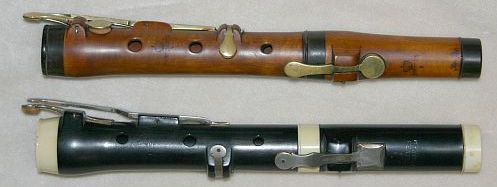
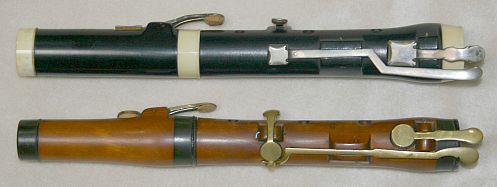
Isn’t it heavy to move two keys with one finger?
It depends on how they are sprung…if everything’s well adjusted it works nicely.
Dominic Allan makes flutes with this two levers for the one F nat hole.
The short key is sprung normally, and the long key has only a very light spring to hold it against a little arm on the cup, so that it would not move loosely when the short key is depressed. - Underneath the short key there is also a small depression in the flute body, so the key can be closer to the body, and easier to slide up on it when going from D to F nat. It is a very ergonomic arrangement, as all of Dominic’s keywork.
Here is a pic from my D. Allan flute:

Although not a problem, I fail to see the interest or the point. Nothing accomplished that I can see. Avoiding a second hole? So what?
an’ a pad
I think that the original question was just about the reversing of the F key, which may have ergonomic implications (for better or worse).
I do like the elegance of the levered keys, though. From a builder’s perspective, you may just as well ask what’s the point of placing another hole. (There’s only so much space on the circumference of the flute, it has to be drilled and, as mentioned, sealed perfectly twice.) A small advantage to the player might be that he now cannot accidentally open the two holes together, although I guess that never really happens in practice.