Requesting help from the whistle makers: Fine tuning the fine tuning

If there are any whistle makers on here that have time to chat, I’m looking for some help with fine tuning the fine tuning of my whistle design.

I’ve been losing my mind attempting to get my whistles in tune for close to 3 years now and I think that I’ve over thought myself into a corner. Can someone come talk some sense into me please?

How do I accurately measure minor tuning adjustments when notes can bend up to ±50c between barely playable and flipping octaves?

I seem to have internalized correcting tuning on the fly by adjusting pressure for each note… to the point where I can’t figure out how not to do so. If I’m self-correcting, then that makes it difficult to judge actual tuning on the whistles.

So far, I’ve gotten several prototypes to sound perfectly in tune for myself, only for them to be unplayable flat in the second octave for my friends.

How do you manage to make an instrument that is in tune for all players and play styles?

I had a university professor whose specialty was Baroque recorder and flute.

Especially on the Baroque flute you’re constantly adjusting to make everything in tune (for example the same tone-hole is used for both F sharp and F natural).

He told me the story of when he went to make a flute he got stymied by the fact that no matter where he drilled the holes he got the same perfect scale!

But I reckon that there’s few trad Irish players who are like that. Many that I’ve seen blow where they blow and leave the fine points of tuning up to the instrument.

For one thing, when you’re playing reels at over 100bpm there simply isn’t time to adjust your blowing to each individual note. The tune is flowing out and you’re blowing on an even stream of breath.

I would try this

  1. get an electronic tuner/tuning app that does a running measurement of the average pitch of every note of the scale, creating a map/chart of all the notes which were played, a chart that remains visible even when you’ve stopped playing.

  2. using this, play some Irish reels up to full speed. Pick tunes that leap over the octaves a lot, say The Hunters House or The Golden Keyboard etc. This will tell you what your whistle is doing in a real-life playing environment.

I blow pretty evenly regardless of whether I’m playing fast or slow, and when I was trying Low D whistles from a large number of makers I discovered that my blowing was evidently “middle of the road” because I got good scales out of nearly all the high-end Low D’s I tried.

However it wasn’t because I was compensating for bad notes: if there was a tuning quirk I’d find it.

About making an instrument that suits all players, I think that’s impossible. There are always going to be players whose blowing approach is an outlier that no maker can anticipate.

1 Like

Well, this is only a guess on my part but it may be that you ended up bringing your ramp down to too fine an edge which can make it almost hyper responsive to your breath pressure on notes. If you have more than one head handy that are behaving the same (or more than whistle) that your willing to try an experiment on you can file back the ramp ever so slightly to thicken that edge up some more and see if that might not help some with the behavior (granted that will somewhat sharpen the overall pitch on everything as you’re enlarging the window, but still). It’s only one small part of how the fipple can be tuned, but it’s one that I’ve found can reflect certain behaviors similar to what you were describing here.

As far as an instrument being in tune for all players and styles that’s only ever going to happen with something electronically generating the tone. You can hand the same conventional whistle to 100 people and get 100 different sounding whistles, particularly since your oral cavity shapes still play a factor to the effective whistle embouchure as with a flute (but to a much more limited degree). I can change how my own whistles effectively play and sound just through keeping more tight pursed lips and a smaller mouth cavity vs relaxed lips and more puffed out cheeks with upper notes (not to mention how diaphragm tension can effect things).

Food for thought and hopefully something useful that helps.

1 Like

That’s completely fair and I’ve had the same experience with making hole size adjustments only to get everything still coming out in tune. It’s honestly been making me feel crazy.

I’ve got an older copy of the TTuner API on my phone that lets me record and averages tuning by note but unfortunately it’s been all over the place (which is probably reality when I’m playing reels at full speed…).

I’m going to call this design good enough then. I was really hoping that I could math my way to something more consistent and precise :confused:

Thanks for the feedback!

Thanks for the feedback, I was really hoping that I could math this out a bit better, but it’s pretty obvious that you’re right. There’s just too much variation in play style.

As far as blade blunting goes, I’ve got that down to an art form now! Over 100 prototypes and I’ve got a voicing that I really like. Blunting the blade really sweetends the lower notes but too much and the high A and B start getting wildly unstable (overly sharp for some reason).

On the bright side, I’ve found a way to manipulate the head geometry to eliminate the octave drift entirely (at least for my play style). Turns out that an extremely subtle bore constriction under the window makes the second octave flatter if it’s too sharp, and larger holes with corrected spacing (or thicker body/tuning slide gap) has the opposite effect. Balancing the two non linearities does a decent job of giving even playability and tuning to the full range.

I think you have touched on a fundamental problem that all whistle makers face, and flute makers even more so. There is not just variability in the way different people blow. There is also variability in the way the same person blows from one day to the next. Also, temperature and humidity change from one day to the next, and these directly affect the tuning of a whistle or flute, even if the player’s blowing remains constant.

For a maker this is an impossible problem to solve when tuning whistles using a tuner or RTTA. By definition, if the whistles you make are precisely in tune, according to your tuner, on the day they leave your workshop, and if the blowing style is held exactly constant, then your whistles will be different to each other, simply by virtue of the fact that the temperature and humidity change from one day to the next. Similarly, if your blowing technique varies from one day to the next, and you tune your whistles based on your tuner, then your whistles will embody the variation in your own blowing technique (ie., they will not be the same as each other).

I’ve struggled with this problem myself and come to the conclusion that what you need is a reference flute/whistle for every particular model you make. I always keep hold of the best instrument I’ve made to date so that I can use it as the reference. If you have yet to make a good instrument, then buy the best instrument you can get your hands on from another maker, and use that as the reference. Then when you are fine tuning your own instruments, on any given day, you simply manipulate their tuning until it matches that of the reference instrument.

If you do this, then you will get consistent tuning and response that matches that of the reference instrument. If you chose a good reference instrument that is liked by good players, then the tuning of your own instruments will also be liked. You simply can not achieve this by using a tuner or RTTA.

If you chose a bad reference instrument, then the tuning behavior of your instruments will likely not be enjoyed by players who are used to a different pattern of tuning and response.

Ultimately, I think, for a maker, consistency is more important than tuning. Without consistency, you can’t have consistently good tuning.

1 Like

There’s one tuning quirk thing I forgot to mention. To me it was inexplicable.

It was when I was buying & trying loads of different Low D whistles, I noticed that some had a very flat “B” in the low octave. For some reason I decided to try playing the whistle with various amounts of the mouthpiece in my mouth.

I found out that my usual way, playing closer to the tip of the mouthpiece, caused the flat B.

Shoving the mouthpiece in my mouth as high as I could, the whole scale came into tune.

That oddity aside, my overall impression from trying as many different makers as I could was that there was a general agreement amongst the good makers as to how to tune whistles, especially regarding the relative tuning of the six fingerholes. I almost never came across a single note on a Low D that I felt needed carving out or taping down.

Instead, where makers varied was in the relative tuning of the octaves.

Still it was a bell-shaped curve, with most good makers being in agreement about octave tuning and a very few outliers with sharp or flat 2nd octaves.

Most of these outliers could still be blown into tune. They weren’t “out of tune”, they were merely unusual.

But one or two had 2nd octaves so sharp or flat that they really couldn’t be blown into tune.

I guess my point is that I didn’t find Low D whistle tuning to be an all-over-the-map anything-goes situation, but a ‘there’s one way to skin the cat’ thing, a situation of broad overall consensus among the good makers. The outliers were few and relatively minute.

1 Like

That makes a ton of sense. My experience with most of the whistles I’ve tried is that the second octave tends to be off for me, but I think that’s due to my tendency to overblown high notes. I originally set out to make my own because the burke whistles I play are close but not quite right for me.

Would you mind fact checking me on this theory/history?:

From my reading and experiments, it seems like the most critical factor is the limitations of a cylindrical tube causing distorted harmonics due to the end effect being different by octave. The tapered bore of older whistles and flutes solved this in one way at the cost of a much weaker low end. Then the tapered flute head proved that a tapered body wasn’t necessary.

I managed to recreate that effect with whistle mouthpiece geometry for a single position of the tuning slide… but as I understand it, the tuning slide gap is where the physics breaks down. That bore expansion as one tube slides over the other creates non-linear effects on inter-octave tuning, specifically in flattening the high notes. So whistle makers have kept the tube as thin as possible to minimize the effect and several have (accidentally or intentionally) balanced out the drift with other mouthpiece geometry changes.

I’m trying to use a thicker body with no reduced OD for the tuning slide and it’s definitely made things challenging. Sliding it in or out at all and it has a non linear effect on the upper octave. I think that I’ve found a way to correct it again with mouthpiece geometry, but it’s been frustrating not being able to get good clean and consistent tuning data. I’ve been wondering if I should figure out how to attach an air compressor and regulator…

What do you mean by tapping down? I’m aware of drilling out and ever under putting to move notes up in one octave or another, but are you suggesting that there is a way to lower pitch of a hole as well?

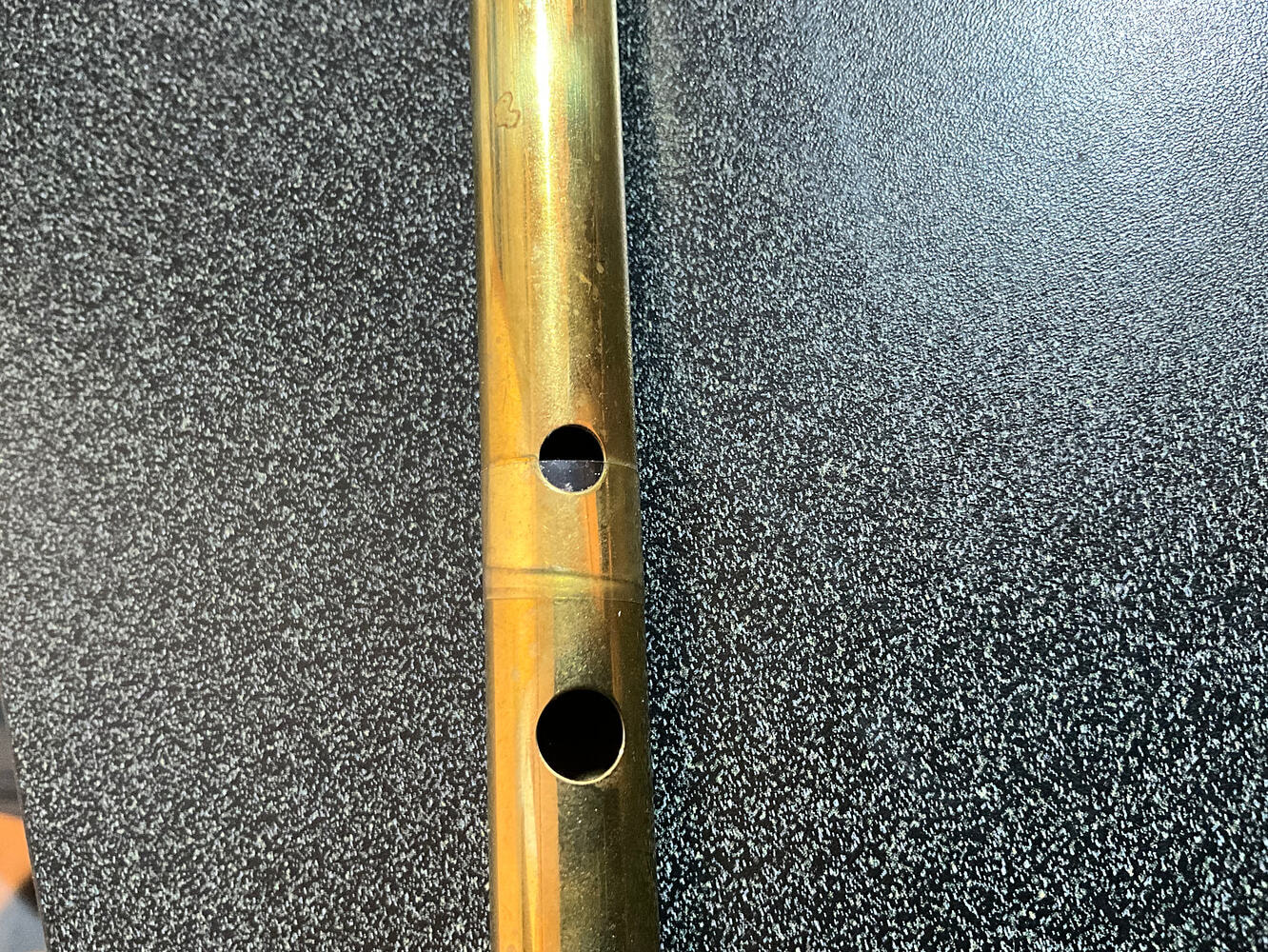
Yes, tape partially covering one edge of the hole.

1 Like

Rather than the end effect, I would attribute it to wanting a smooth variation in breath pressure as you go up the whole scale. That tends to put the lower notes somewhat close to breaking up to the next register, and the higher notes farther away from breaking up. On a plain cylinder, if you blow all notes in both octaves close to breaking up to the next register, the two octaves tend to be closer to the same tuning.

Yes what Michael said about taping holes.

If you have a whistle with a not-quite-right scale, there are two approaches to bring everything into line:

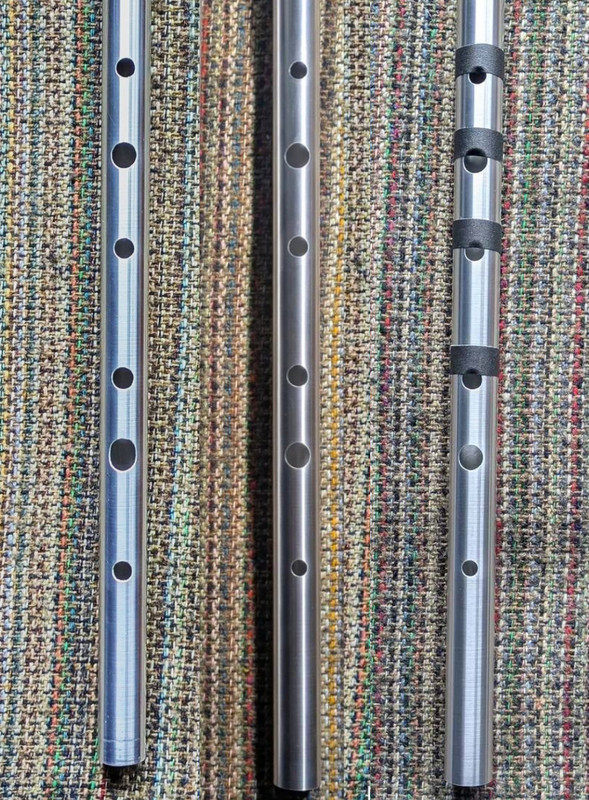
  1. choose the flattest note (or notes) as your baseline pitch, and tape down the other holes to match (whistle at right). Notice putting tape on the side of the hole closest to the mouthpiece, in effect, moves that hole a bit further down the tube, thus flattening the note. (Putting tape on the side of the hole closest to the open bell end of the whistle mutes the volume and clarity of the note while flattening the pitch a lesser amount.)

  2. Choose the sharpest note (or notes) as your baseline pitch and carve out the other holes to match (whistle at left). You carve the edge of the hole closest to the mouthpiece, in effect moving the hole up the tube. (Carving the edge of the hole closest to the open bell end of the whistle increases the volume and clarity of the note while raising the pitch a lesser amount.)

Sometimes the open bell end of the whistle gives Bottom D and Middle D which are flatter than all the finger-hole notes, meaning that you have to chop the bell a bit to bring the D’s up to the baseline pitch of all the other notes.

Sometimes the open bell end of the whistle gives Bottom D and Middle D which are sharper than all the finger-hole notes. You can

  1. Choose the pitch of the finger-hole notes as your baseline pitch, and put an extension on the bottom of the whistle to flatten the D’s to match the rest of the notes, or

  2. Choose the pitch of the bell-note D’s as your baseline pitch, and carve out all the finger-holes to bring them up to the pitch of the D’s.

I should say that all these tuning gymnastics weren’t necessary on any of the good-quality Low D whistles I obtained for testing.

Where they were necessary is when I bought Susatos of every key, including unusual keys such as Db, Ab, Gb, and E natural.

While the Susato Low D, High D, and other common keys had good scales, in these oddball keys Susato evidently hadn’t done enough R&D, and each whistle had a unique out-of-tune scale. Some of them were so off that a combination of carving and taping and chopping had to be done to create a whistle that was usable professionally.

Also I ran into some early Overton Low Whistles with goofy scales, once again the ones made in the more unusual keys. The oddest one evidently demonstrated an attempt to make a lesser reach for the bottom hand, so all three lower-hand holes were made very small and moved higher up the tube. The effected notes, E, F#, and G, were weak and very sharp.

Thanks Richard for the distinction between taping the upper or lower half of a hole.

The C-natural on the Sindt with the top half taped is definitely stronger than when I originally taped the bottom half to allow for an in-tune oxx ooo C-natural.