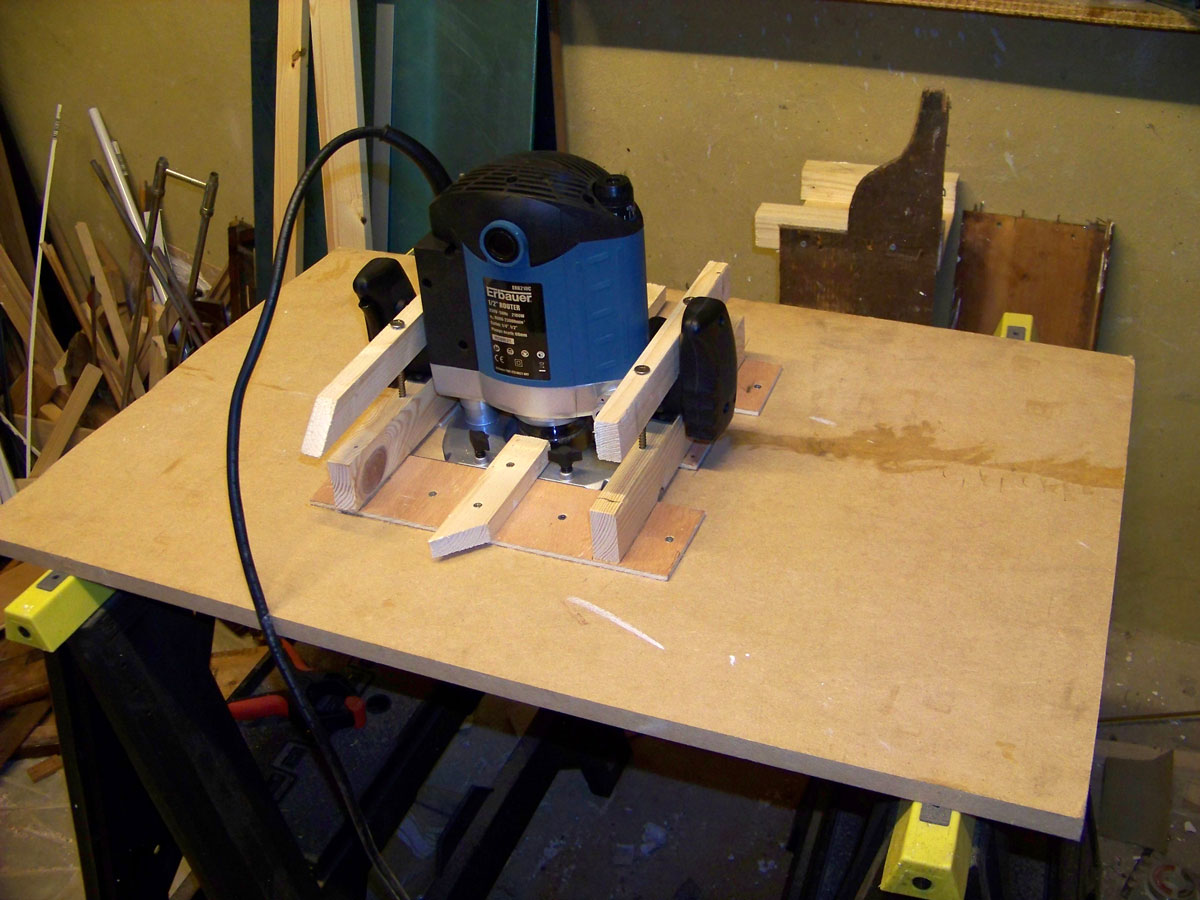
Other than tradition, is there any reason not to try gouging cane slips using a table-mounted router fitted with a 1" core box bit? Seems like you could gouge an awful lot of slips very quickly this way, even if you did just incremental passes with slip-flexing tests in between, aka “the Cane Whisperer thing” (with props to B. Koehler) .
You could also make a few passes afterwards using a scraper, to impart a smooth, burnished finish.
(Safety note: I would/will not attempt this without using push-sticks. I might even rubber-cement the slip to a curved block to prevent it from jumping around.)
My first concern would be heat on the cane. It may or may not matter as I’ve seen some methods on the lunatic fringe such as deep-frying or microwaving slips prior to gouge. I’d say try it out and see how it works for you.
Sounds like a crazy idea to me.
Really crazy - but if you try it, just be very careful, fingers no where near, eye protection, flak jacket… !!!
I do use routers - both hand held and table mounted - but I think they should be avoided if at all possible, especially if a ‘hand tool’ will do the job more quickly, more safely and better!
My creds:
I have never made a uilleann pipe reed or even played the pipes…
But I have made lots of oboe reeds (for myself and others) and gouged even more cane (for a store to sell commercially)
Also I own two of those ‘doo-hickey’ machines* (for oboe) and they work really well**. However they are quite expensive.
\
‘doo-hickey’ machines = gouger
** by well I mean gouging to within 0.01mm of the desired thickness/shape repeatedly and quickly, no need to measure except as a QA check
A DIY/home brew gouger or something similar would probably the way to go unless you make lots of reeds or have lots of money
Some ideas are original and useful, others occur to many people but are immediately discarded as stupid. I’m totally prepared to accept that this might be the latter type of idea.
The thing is, I already have a router with core box bits – I’m not ready to splurge for a purpose-built gouging machine. And cane is just a soft, light kind of wood, so is this really that different from what a router is designed to do?
For sure I’d wear my standard lathe getup (heavy apron, long sleeves, facemask with redundant goggles underneath), and obviously fingers have no business going anywhere near spinning blades.
In some important ways, yes, I believe so. A box bit is great for making shooting boards though!
Besides the work-holding issues you have already identified, the box bit will leave a somewhat poor finish down the centerline in the best of situations - and the setup you describe is far from best-case. An ordinary router table, even a high-quality shop one, would be prone to vibration and issues of precision. Also consider that the cane is full of silica, so sharpening would be a constant issue. Cutting cane, which is extremely fibrous, across the grain would not give a good finish unless the tool was razor sharp and moving at a very high speed. The resulting dust would itself be dangerous. It seems like a safety nightmare, and I don’t see it being any faster or more accurate even if you somehow could get it to work reasonably.
I do know that one or two highland pipe reed manufacturers (and we’re talking real mass production here!) have rotary cutter setups for profiling the outsides of reeds, but I believe those cutters are specialist materials (diamond? ordinary carbide is probably not hard enough) and the jigs and setup look very elaborate indeed. It may make sense in this sort of industrial setting but not in the home workshop, given the challenges and cost.
Note that the inner diameter you are seeking is more likely 2" or more, say 2.25" to 2.75" for most methods.
Lastly I would point out that the hand gouging machines owned by uilleann pipe reedmakers, despite being made expressly for the purpose, are mostly sitting idle on shelves.
If you were to give it a go the best set up would be something like as below with the router above the cane . A guard can be put around the cutter and the cane passed under on either some kind of cradle
O.K., this is sinking in. To summarize what I’ve learned:
First, purpose-built gouging machines are the safest and best approach, not routers. Second, if I were to insist on using a router, a side-cutting cove bit (with specialized jigs to hold/guide the work piece) would be more appropriate since it would cut with the grain, not across it; but even then I’d be asking for a bit-sharpening nightmare due to cane’s high silica content.
Plus it would probably be much more effective at launching nasty slivers of cane back towards my neck than at gouging.
I’m now officially ready to write this off as a harebrained idea, and to be content with my expensive German in-channel gouges. Thanks, guys!
Some pro reed gougers use a single one carat industrial diamond, sharpened and mounted on a high speed shaft fitted with precision bearings. The angle the cutter approaches the cane determines the radius of the cut. The radius is adjustable. The diamond must be re-sharpened and re-balanced after 10,000 slips are gouged. The cane is mounted on a worm-gear fed carraige which passes the slip under the spinning diamond. This controls the speed of gouging and doesn’t over heat the cane. The diamond is set in the edge of a metal donut which has been dynamically balanced for 30,000 RPM. Years ago, I was given a list of suppliers to make such a gouger myself. Sadly, I didn’t follow up. I could have built the thing for less than half the price of a hand gouger. The hand gouger requires constant re-sharpening and the radius must be kept when sharpening. A real pain in the arse. The diamond gougers are still in use by a number reed cane suppliers. It is the same technology used to cut contact lenses so is extremely precise. It takes hours to set the angle, but will reproduce exactly the same slip time after time. Resetting the radius is a pain, but micrometer type adjusters could be added to make that much easier than the shims used on the one I saw. The same guy used another diamond to profile the slips (for bassoon) and yet another which shaped the tails. Took only a minute for a finished slip, ready to tie up and minimal finishing by hand to make a reed. Hand gougers are no where near as user friendly and as Bill says, are often left on the shelf after being tried for a while. An end mill or router is not as precise and won’t give as good a finish to the gouge. The concept is good but in practice the results are best with the precision diamond gouger.
 .
. I’d say try it out and see how it works for you.