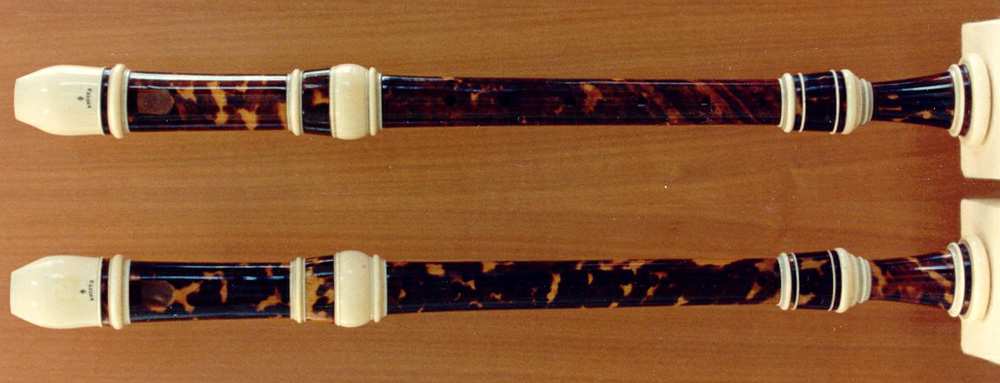
A fifth medieval recorder has been found in a latrine in the old Hanseatic city Elblag (in former times Elbing) southeast from Danzig in Poland (Naumann 1999; Kirnbauer & Young 2000; Kirnbauer 2002). The Elblag Recorder is intact and has been dated to the mid-15th century. Like the Dordrecht, Göttingen and Tartu recorders, the Elblag recorder lacks the beak-shaped mouth-piece characteristic of the modern instrument. As with the other surviving late medieval recorders, the lowest interval of the Elblag recorder seems to have been a semitone. It was thus likely to have been pitched around d’, a tone higher than a modern soprano recorder.
Personally I like the recorder. Looks like a yamaha logo to me.
It’s amazing what some people leave behind in a toilet.
Isn’t it just incredible how the design has changed so little over all these centuries.
I’m fond of the lower pitched recorders too - particularly the bass recorder. The two octave limit does curtail what can be played, but at 3am in the quiet mornings, the low pressure aural landscape that the bass recorder offers is just sublime. Few other wind instruments can be played without disturbing neighbours at this hour.
Lol. There I was thinking you had access to a trust fund and membership at Crufts
If you do some research on the internet, new recorders need some breaking in. It’s excruciating breaking it in for about 20 minutes per day max.
It’s only day 3 so far, and its deep tones are incredible. I just wake up in the mornings like a schoolboy on an inset day clambering to get it out of its case to play in the mornings at 6am
The Mollenhauer is incredible: I’m so used to the Roessler sound, so my ears have needed some adjustment. I notice that the attack speed (on a bass recorder) is superior on the Mollenhauer. Also, it’s vertical bocal design collects much less moisture than my old Roessler or the plastic fantastic cheapo bass I got to replace my Roessler. Still - I’d say the Roesslers are unparalleled for their cost and their sound. They are really worth looking into, if the Mollenhauers come up a bit steep.
The one thing that is really messing me up … is transposing to bass F fingerings from alto G fingerings on the treble clef as well as doing treble clef standard concert C. For years, I’ve been used to playing alto flute … so I read in the key of G. Now, I’m back to doing the bass clef, and reading fingerings in the key of F. I’m messing up new music regularly, and I have to start working on music I already know, otherwise I’ll blunder by a ledger line, and think I’m playing some really wacky new music that is actually less wacky than I’d imagined
Some musicians are really superb at transposing left right and centre clef any way they like. I thought I had it sorted for alto flute and c concert flute … now learning a third transposition has messed me up
I play the alto flute and have never used it as a transposing instrument - I use it to play fiddle music off the original notation. Which means your fingers are doing different things to get the same pitches you would on a standard flute, but so what. (I don’t think I’ve ever even seen a score intended specifically for the alto flute).
Same goes with other pitches and instruments. (I have recorders in C, F, G, D, A and B; C and alto flutes; clarinets in Bb, G, C, Eb and C#; quena in G; border pipes in A; more whistles than I can count. I don’t treat any of them as transposing instruments, nearly all the music I play is either by ear or at written pitch).
It took me a few weeks to get confident about reading a new pitch-to-fingering system at first, but every successive one gets easier. But don’t EVER use transposed music as a crutch when learning - it doesn’t help at all and gets badly in the way of learning to read at pitch.
yes the alto flute plays standard treble clef music beautifully without transposing. Sometimes I like the added transposition, to get to the lowest possible octave - I think the alto flute really shines in its first two octaves.
There’s some fantastic solo alto flute repertoire in sheet music if you want. I have some rather esoteric scores. The worse is probably the Henryk Gorecki scores which are so long that they scroll across a 1.8 metre table. Or maybe the Kokkonen ones, which are hand-written and almost illegible ;(
I do play diatonic instruments as if they were non-transposing too: since I no longer play ensemble, I’m getting lazy and find that I am not as good at transposing as I used to.
Same goes with other pitches and instruments. (I have recorders in C, F, G, D, A and B; C and alto flutes; clarinets in Bb, G, C, Eb and C#; quena in G; border pipes in A; more whistles than I can count. I don’t treat any of them as transposing instruments, nearly all the music I play is either by ear or at written pitch).
That’s…an incredible family of recorders you have…and clarinets! You must be good at playing by ear. I can take ages to work things out by ear. I usually sit with my metronome and work things out first - it’s a bit easier as long as the music isn’t at jig speed oer.
Reading at pitch isn’t a problem…unless it’s in size 6 font and at least 6 ledger lines above treble clef. I get so blinded by the number of ledgers and some scores need a magnifying glass. The worse is a set of Grade 8 anthology for flute - all the flute parts are written in tiny size 6 font, and the piano parts are twice the size!
lol. I know exactly what you’re talking about. Sometimes, when I’m playing the piano, I start playing bass clef when I’m supposed to do treble clef! It sounds so weird when I do that. And then I realize what I’ve been doing and start wondering whether I’ve been getting enough sleep. JK.
I only do recorders in F and C. Never tried one in G. I’ve also heard that an occasional b does exist…
When I have a new instrument or a song that I really enjoy, I also get up early just to play them. I have to put a mute on my recorders tho, 'cause everyone else is asleep! the earliest I ever got up to do that was five. I regretted it later during the day. lol.
B recorders are more common than you’d think. Mine is girly transparent purple with glittery bits. Probably sold as a C descant but they got something wrong and ended up at A=415. I haven’t checked the pitch of other transparent-purple-with-glittery-bits recorders but it might be worth taking a punt on one next time you see one on EBay. It works pretty well, in tune with itself using normal Baroque fingering.
Corgi - you don’t want to transpost rom the treble clef C fingerings for the descant, to bass clef F fingerings, like I started off, after resuming the bass recorder and forgetting how to transpose.
Basically, I’d convert the bass F fingerings into treble clef C fingerings.
Then I’d convert the musical notation, into treble clef reference.
Then I’d apply the treble clef C fingerings, for sounding the correct bass F fingerings, to the treble clef equivalent of the bass clef note.
You can see how clunky and slow that is! I’d be holding a semi-quaver for about 3 seconds, trying to work out what my next fingering was going to be
The easiest way to transpose a bass F recorder to read bass music:
Imagine our bass recorder is a standard descant and use standard descant C fingerings.
Just finger the read note, as if it was treble clef, for 1 ledger line above (exactly 2 notes e.g. ‘f’ is fingered as a ‘c’ note; ‘g’ is fingered as a ‘b’; ‘a’ is fingered as a ‘c’) and finger as if it was a descant.
When I first got my sopranino I knew so little about the differences between it and the descant! I was playing it like a descant and with songs that were meant for the descant! I like recording songs that have parts and then putting them together with Audacity. You can pretty well imagine how weird it sounded!
Now, because of research that I did, I know better. I still can’t quite understand how I managed to make that mistake.lol.
You aren’t 2ft high with leprechaun like features are you lol.
Sopraninos do my ears in. I dread to think of how many wars have been started by the inventor of the gherklein.
I have Audacity but I don’t know how to use it: if I do a video recording, can I add a sound track from another source over it? I.e. if i record an outdoor video, can I sandwich an indoor mic recording to cover it using Audacity, or do I need something else?
if i record an outdoor video, can I sandwich an indoor mic recording to cover it using Audacity
… briefly, No!
Audacity is an audio editing package, you might use it to clean up and balance the audio track, but you’d need video editing software to merge an audio track into a movie … try VirtualDub for a nice piece of freeware