Bill, I thought of e-mailing this, but figured that the info might benefit others here. I know you’ve done work with pearwood, and the pearwood C# set of yours featured on your site sounds wonderful. How does this wood rate stability-wise? I’m still trying to decide how I want my future flat set to be constructed and this seems like it might be a nice option. Thanks!
Hi Corin,
I have mixed feelings about pearwood based on my experience. I doubt that stability will be a problem, but tone might. (I had heard reports to the contrary but the chanters and stocks I’ve made from pearwood have seemed very stable.) It may depend on the grade of pearwood you have - mine is exceptionally nice for pear. On the other hand, the wood seems overly porous or soft, in that it doesn’t seem to perform well unless the bore is sealed with something or other.
I think I got lucky with the C# set, I lubricated the reamer with a wax/solvent based paste wax, and this apparently sealed the bore nicely. That set has always played well, though it’s a bit softer in tone than rosewood or ebony. On subsequent chanters, where I didn’t use paste wax for reaming, things were disappointing until I sealed the bore with treatments of shellac followed by linseed oil. Another maker (who may or may not wish to be named) has recommended using cyanoacrylate glue treatments for pearwood bores.
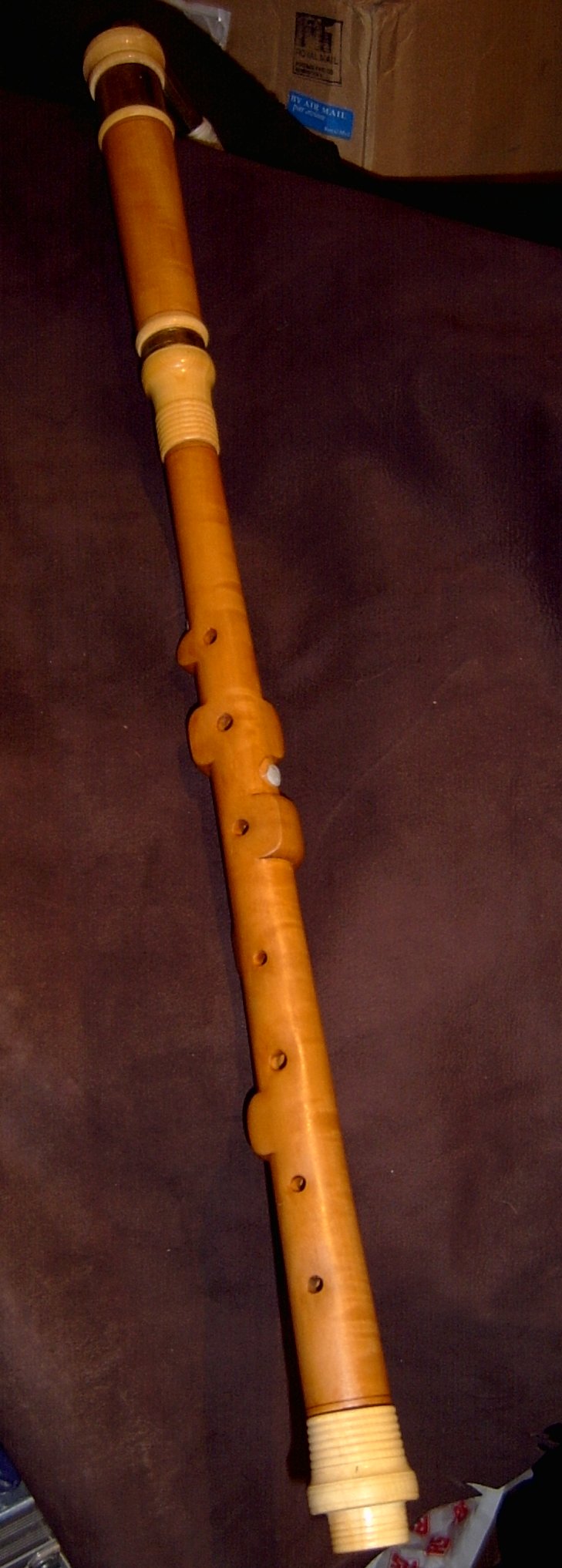
For concert pitch I don’t recommend it, but for flat pitches I think it still has merit as a wood, if you don’t mind the slightly softer, darker (some would say duller) tone. Too bad really, because the pearwood can look gorgeous (see for instance the fiddleback figure above) and I have loads of it…
I don’t know if this has shed much light on your decision - depends perhaps on what you are looking for tonally. If you strongly prefer the ebony C# chanter to the pearwood one on my site (bearing in mind that the two chanters are played by different people), perhaps pearwood is not for you,
Best regards,
Bill
The pearwood is beautiful, that’s for sure. But for tone, my vote is with boxwood. Similar look, but a tad brighter. (my opinion).
What is more common in the really old sets? Boxwood or pearwood?
Thanks Bill,
I was just wondering if the Pearwood was a viable alternative to Boxwood. I’m interested in both the sonic and esthetic aspects.
I think it comes down to personal preference either way.
The mounts on the pearwood chanter above are waxed boxwood - so, totally “blonde”/uncolored. Shellaced boxwood is a bit more yellow, and stained boxwood can range from about the same color as the pearwood (above) to a dark caramel brown.
It probably depends on the bore design and the maker as well - so certainly you’d want to explore the maker’s preferences.
The tonal differences may well be affected by microscopic surface effects (see the recent boxwood thread); it may even depend somewhat on the type of reamer being used.
Personally I think pearwood may look a bit better but, of the two, boxwood (true european boxwood, buxus sempervirens,, that is) seems to be my tonal preference.
Bill