(Decided this one deserves its own thread) Last winter, when I first got into drone reed making, and collecting alternative species, I didn’t have a set of pipes to actually try them out in. Lots of guessing went on. So, this last year, I bought three different sets of B pipes–all from different makers, all different dimensions, all different tones and volumes, and all with different types of reed seats. I found that getting a reed to work inside a drone is a whole lot different than simply making a reed that works right outside the stick. I use to think that the bass reed needed to be pitched around F# (185Hz) to make a nice sounding B (when put in the drone) but then I found that D# (310Hz) works even better.
And thanks to Sam L, I learned that cane reeds can be made to sound VERY nice–depending on how they’re scraped and constructed of course.
Lately, I’ve discovered a new species that looks like cane (and phragmites-which is harder than cane), but doesn’t have the hard varnish on the bark. It’s much softer, but still very stable, and reminds me a lot of elderberry in tone. So, I traded three elder reeds for three of this new variety, and went back and forth with them in my Hunter B set, and couldn’t really tell much difference. I think it’s called Panicum Virgatum (cloud nine) and is a silver/switch grass. It’s growing in clumps all around the ponds at a local winery. You can probably find some at your local nurseries. https://www.youtube.com/watch?v=tJvDBzNY9F8&list=UU6XwuhHnN57lo_VPYLJx1vA
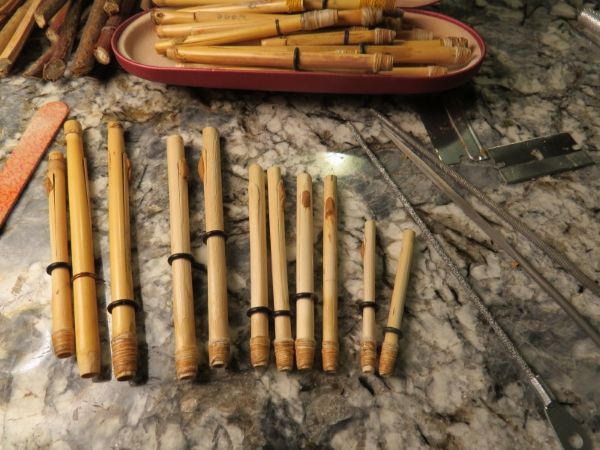
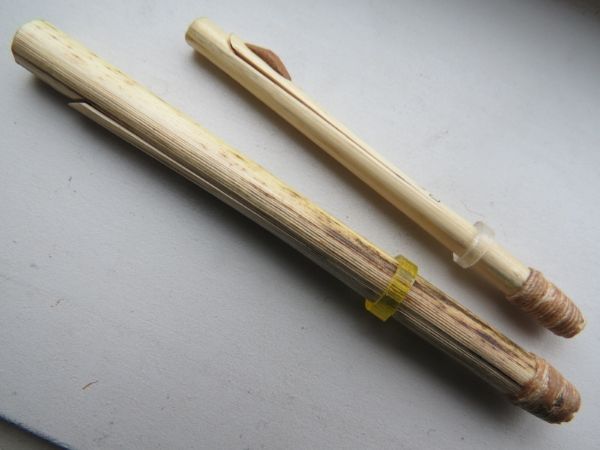
Here’s some finished reeds beside cane reeds on the left. The old cane reeds look shiny and hard beside these lighter colored, softer textured, Cloud Nine reeds. The difference in tone is distinct too–or at least can be depending on how it’s made.
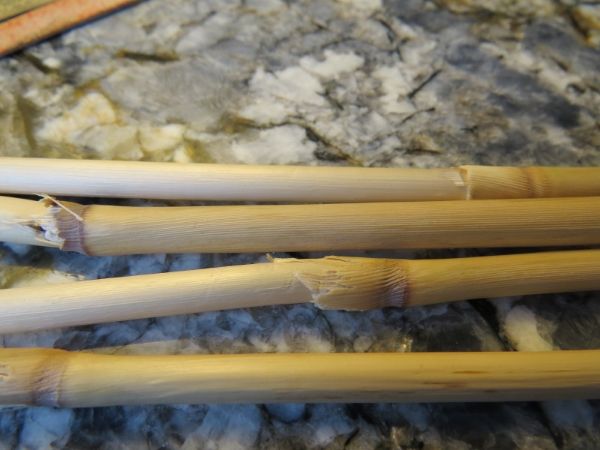
Some dried and cured stems showing the soft texture of the bark:
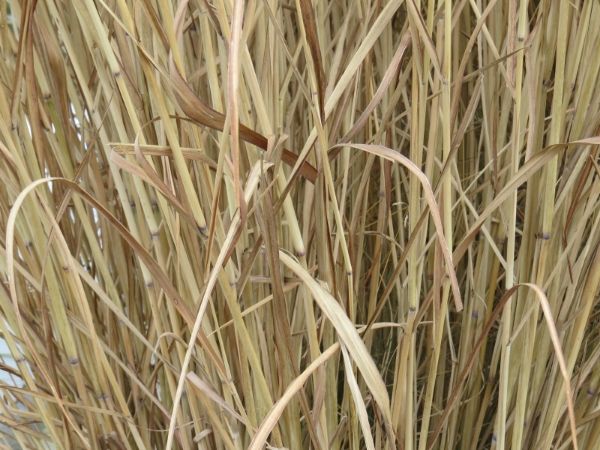
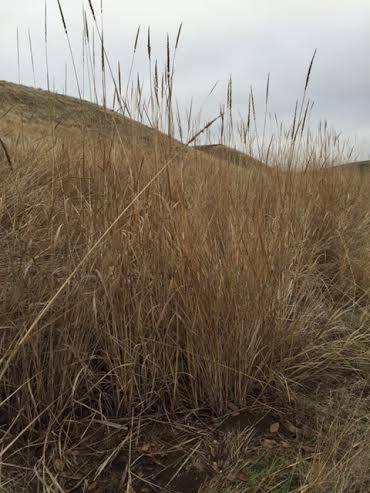
The plant. These stems are all about the size of a pencil and smaller:
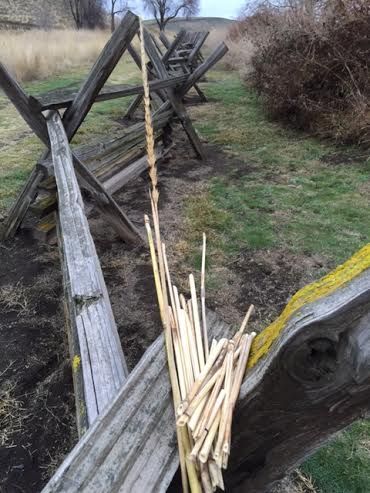
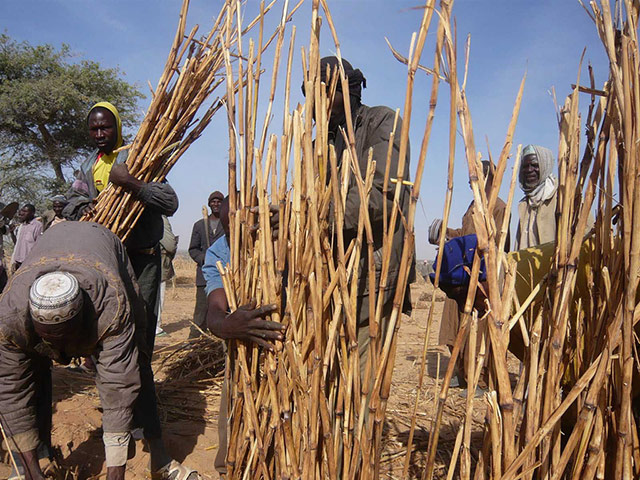
I cut some Wild Ryegrass today. I’ve known it was there, for years, but never thought it big enough to do anything with. Some of it is HUGE!
The stems look like Cloud Nine, hollow and jointed, but I haven’t tried making any reeds from it yet. The biggest here are the size of a pencil…
According to a friend of mine, who is the Ranger at the monument, Wild Rye has been growing here since the Whitman Massacre days in 1840’s. These are 7-9 ft. tall…
It’s really interesting what’s happening in the world of cane-related grasses nowadays. Growing miscanthus as a bio-mass for fuel production is gradually taking over farms with low soil quality, that use to grow tobacco, corn, soybeans, and more. I’ve made reeds from the miscanthus plant. It’s not quite as soft as Cloud Nine, but it’s okay. Like cane, it has a rhizome root as opposed to Cloud Nine which is grown from a seed. I’ve never seen a miscanthus plant as tall and large in diameter as the one at the beginning of this video. Makes me wonder if it is large enough for double reeds. Looks really close to one inch at the base.
arundo donax is now being grown around where I live, in NE Oregon, by the thousands of acres. Related videos follow the one above and show how it is harvested and bailed.
Yes indeed ! I think you should start a thread called "pictures of grass " and hopefully the moderators will make it a sticky.
I mean ,what person who owns a camera doesn’t have loads of photo’s of grass that they are just aching to share with the public. So, come on mods ,if you want this forum buzzing again, "pictures of grass " is the way to go.
Lorenzo wrote : Wild Rye has been growing here since the Whitman Massacre days in 1840’s.
Hence the name of the place: Waiilatpu. The ‘Place of the Rye Grass’.
DAMHIKT!
Bob
edit: I thought WSU had an experimental stand of Arundo growing down somewhere near Wapato. Again, a bio-mass experiment.
You sound like you know more than you’re letting on, Bob! Google arundo donax + Boardman + Coal Plant. Also, Google Prosser + arundo donax + PGE, or even the Port of Morrow County Minutes.
Of the 2 people I know that should know where these farms are located, neither has heard about them. There’s even 25 acres in my own county under testing, and I have no idea where to look. I’m thinking about calling the Co. Extension Agency. There’s no expectation that I’ll find any good stuff, or samples usable for our double reeds, I just want to see what’s going on and see if I can talk some experts into GMO experiments–to develop softer varieties–even though that would not be in their best interest.
I probably know less than I appear to! Now I can’t pull up the google results I was looking at several years ago. Almost all the results reflect the interest the power companies have expressed lately. What I saw was a small scale study by some students to determine the feasibility of growing Arundo in Eastern Washington. Their concern was its ability to winter over. They actually went down into the Sacramento Basin to get some suitable cultivars. They got the use of a field from the WSU Extension Service. I think Prosser is too far south for their test. Unfortunately my memory isn’t that clear. I do remember thinking, Hmm, wonder if I poke around the area if I can find their plot and filch some. . .! Never did though, as someone gave me some variegated arundo to grow at home. I see now that there is some mention of a test plot up Quincy way, which makes more sense for cold weather testing.
Of course Boardman is interested. They got screwed when the timber folks abandoned all that huge poplar plantation in favor of raping Indonesia for their cheap paper pulp.
How did your variegated arundo do? Indoors or out? I go up to Quincy once in a while. The soil is sandy and loamy…good farming land all around. There’s a bassoon player, teaching music at the U in Ellensburg who is growing a plot to see how it winters. She was excited to see how well it’s doing in the WW Valley.
I confess to being a failure. I managed to kill my variegated arundo (I know!) Because it can be invasive I was keeping it in a pot. A friend is a member of the local bamboo soxiety and was going to help me build a lined ‘quarantine’ bed. We had a killing frost. . .Now that I am retired I may try again since it is common nursery stock (!).
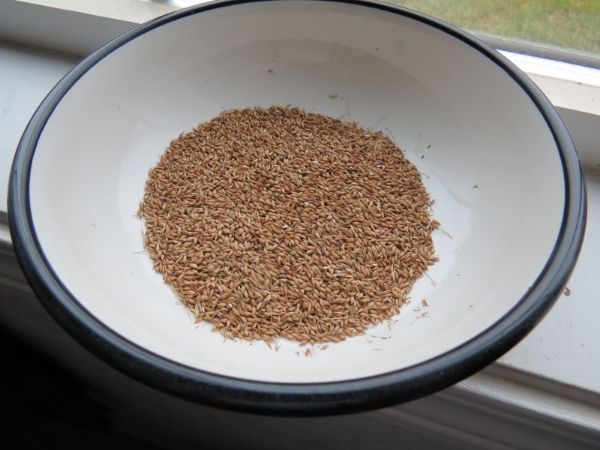
Small wonder Cloud Nine seeds look like regular grass seed. I shall have a nice clump of bunchgrass growing tall by next summer. Will experiment indoors this winter to see how it sprouts, and how much it takes to make a nice bunch. That way I’ll know how much to plant outdoors, and save the rest for my friends!
Because it doesn’t have a rhizome root, this grass is soft stemmed (no hard wax or varnish on bark) and grows as large as 3/8" dia., and 8’ tall. Joints are about 12" apart–sometimes more. It makes the next best sounding reed to elderberry that I’ve heard.
Bob, I was watching a video yesterday and a potted plant appeared in the background window that reminds me of the variegated leaves you had. What do you think?
Hmm. Like the tune…sold my banjar some years ago.
Naw, the leaves are way big. Arundo varigata is quite like the ‘normal’ arundo. Mine were vividly streaked yellow. I have seen some that seemed silvery.
The panicum looks promising, and not being burdened with invasive rhizomes. . .
How wet can the climate be for the Cloud Nine?
Any of these grasses may do well inside. It would be fun to buy some regular arundo donax and try growing it in poor soil, with poor nutrients, and see if it turns out soft.
The leaves in the video are much too broad. The Arundo leaves have a fairly narrow sword shape.
Since the Cloud Nine is a grass, in my estimation it will need significant light. I doubt the Arundo would be shade tolerant either. Have a sun room or augment the light with lamps for indoors, I would think.
As to the hardness of Arundo, I really have no idea. Some plants and trees take up silica, and become hard in that fashion. Sometimes Arundo will grow in brackish/salt lagoons, and this could have an effect on its hardness. Some years ago I bought some garden screens originating in SE Asia. They were made of ‘reeds’ that were much too long to be phragmites and to all appearances were Arundo. They were waxy and clearly not bamboo. They were fairly soft, a little thin walled and had significant salt residue. I could make usable drones from the material.
Cloud Nine is one particular variety of panicum virgatum, a.k.a. switchgrass. Do you know that your samples are that variety? Is it likely that any switchgrass will give the same results?
Pretty sure. If you looked at the video in the OP, and read the description, you can see the clump these reeds came from. The stems are 8-10’ tall, golden colored in the fall/winter, and look like all the pictures online that are available. Cloud Nine, according to my local nursery wholesaler (where this grass came from) is the only switch grass that fits the description: “Panicum virgatum ‘Cloud Nine’ - Tall Switch Grass.” All others listed on their website are short with different colors. I haven’t seen any of the shorter stems around, so don’t know if they are big enough for bass reeds, or how they compare in texture and tone. Click on the Grasses box and scroll down near the bottom…
Typically, Varigated Arundo Donax has very short tube lengths between the nodes. I have not found it to be useful in making reeds. I never tried it for drone cane. As I harvest drone cane that is growing straight up from the rhysomes, rather than using branches from larger tubes.
Wild Ryegrass is proving to be one of my favorites! Ran them in my Hunter B set for quite a while this morning, and all I can say is I’m very impressed.