I have just received a very marvellous new Sam Murray flute in African Blackwood from McNeela Music. A gorgeous instrument it is. The care and maintenance guide that comes with the flute has this to say about oiling:
“Blackwood flutes should not be oiled as the timber is naturally full of oil. If the bore is heavily oiled it will expand, while the exterior, in dry conditions, will shrink. The is the cause of expansion cracks.”
The flute has come from Ireland to me here in Melbourne, Australia, where it is really dry and hot. While I have the greatest respect for what McNeela says, should I lightly oil the bore given our vast difference in climate?
As to the type of oil, I obtained some Aisyn oil, as recommended by Windward Flutes on their website. It’s a very fine, high grade synthetic wood conditioner, used by many orchestral players. I have not yet dared to apply it. I have read copious volumes about types of oil, but also interested to hear peoples’ experience with oil for Blackwood.
The topic of oiling woodwinds seems to be able to cause fisticuffs in pubs, so I am keen to hear what people have to say. My query is specifically about African Blackwood, not oiling in general.
You mention that this is a new flute, so presumably is covered by some sort of warranty? If so, I suggest you need to be careful not to void that warranty (at least in the warranty period). If the supplier says “don’t oil it”, and you do, does the supplier consider that a voiding of the warranty?
I’m not convinced that “Blackwood…is naturally full of oil”. I reckon it’s naturally well-packed with a resin, probably one designed by Mother Nature to render the stuff distasteful to bugs.* That does tend to make the wood fairly water-resistant, and oil-resistant for that matter. I’ve weighed flutes before and after oiling. Cocuswood and boxwood will accept quite a bit of oil, while blackwood only accepts a few grams. I don’t know if that has been absorbed by the wood, or adsorbed onto the surface. But I figure it does no harm, and may do some good, so I routinely soak my flutes in oil twice before they leave here. And recommend players oil them regularly. I’m unaware of any problems with “expansion cracks”.
Possibly a more important consideration for you is that (I imagine) your flute has a metal lined head and barrel. In Australia’s dry climate, this can cause issues as the wood shrinks but the metal doesn’t. You might want to consider humidifying your flute, ideally to the average humidity of wherever Sam was when he made it.
(There may not be much regional variation in average humidity in Ireland. Sudden flashback to riding north from Limerick to Gort and back down the coast to Listowel on bicycles, getting rained on every day! Today’s weather outlook - damp.)
*It sure makes it distasteful to me. I once had the dust extraction fail, in a non-conspicuous way, and got to breath a lot of blackwood dust until I worked out something was amiss. I came down with a condition referred to as “snivelling conjuctivitis” Very attractive! Needless to say, some bug has learned to deal with whatever this stuff is - we occasionally come across one of its holes.
(I imagine) your flute has a metal lined head and barrel
On A Murray flute? Not likely. Apart from the tuning slide ofcourse.
Sam Murray advocated an approach of ‘benign neglect’ for his blackwood flutes when I collected mine from him (he did say you needed to oil the hell out of a boxwood one). I did lightly oil it the odd time while I had it, perhaps once a year or every eight or nine months, but that was perhaps more for the aesthetics of it than anything else.
Since you appear concerned about dry and hot climate causing cracks - keeping the flute stored and hydrated at a relative humidity b/n 40-60% will prevent dramatic changes in the wood (which has been the primary reason my flutes cracked during dry months). Since storing them like this, I have had no problem with cracks. Oiling by itself never seemed to prevent cracking, at least with the flutes I have.
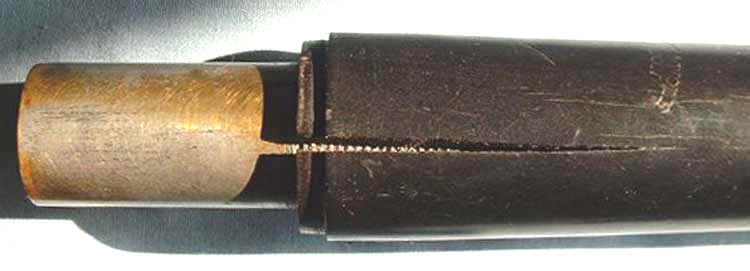
Ah, that’s interesting, and perhaps marks a change from earlier practice? Do we know if Sam’s tuning slides are buffered in any way (e.g. cork) where they join the wood? If not, that still represents a risk in a drier climate. Here’s an example of a partially lined flute (by Gerock) with a correspondingly partial crack.
Heh heh, I like the concept of ‘benign neglect’ - “some things are better left alone”. Don’t let that run to not drying out after playing. I still reckon that is probably the most important thing in preventing damage.
Now, it bugs me that we don’t know how much untreated blackwood absorbs water, so I’m embarking on an experiment to find out. I’ve taken an unlined head, freshly reamed and turned yesterday, plugged one end, filled it with water, and clamped it vertically in a flask-holder attached to a retort stand. I’ve set a timer to remind me to empty it in an hour’s time. It weighed 52.4gms empty. I’ll be back…
And I am. (Back.) An hour older, and hopefully a fraction wiser.
Drained out the head, and mopped it out thoroughly. Now weighs 52.6gms, a gain of 0.2gms, representing a weight gain of about 0.4%. But has this soaked in, or is it just adhered to the surface? The bore feels moist to the touch. I’ve left the empty head in the retort stand clamp on the workbench to air, and set the timer for another hour. See you then…
My understanding is that the flute is new, by the hand of Sam Murray, or his workshop. This is the description at McNeela Music:
"It’s rare to have a Sam Murray for sale and they are not readily available with usually up to a four month waiting list however we have a very limited amount in stock at the moment.
Sam Murray, the renowned but elusive flute maker from Belfast has been honing his craft for almost fifty years. We are extremely lucky to be able to offer this stunning flute in the key of D."
I don’t think it is a branded instrument, for several reasons. It’s an incredibly good flute, clearly the work of a true master craftsman. Stunning is a good description. The maker’s stamp on the barrel is Murray with a crown. I trust McNeela. I think Paraic has a long standing business relationship with Sam.
If it’s not by Murray, whoever made it is a world class first rate maker!
And back again, after the head had an hour to air.
Now weighs in at 52.5, suggesting that it had absorbed a very small amount of water - around 0.1gms. But keep in mind that 0.1gms is the limit to the measuring power of my little jewelry scales, so we can’t make many assumptions so far. But it should be encouraging to the ‘benign neglect’ camp!
(Owners of cocus, boxwood and other flute timbers are reminded that this definitely doesn’t apply to your flutes!)
So, pressing on, I’ve refilled the head and set the timer for three hours, to simulate a solid three hour session…
Benign Neglect might be safe in a climate with stable humidity, but not in one with seasonal variations. I’m sure it depends on the wood and the flute design, as well. Consider your situation, and just be sensible.
Here in Colorado, USA, we have hot, dry Summers, and randomly cold Winters with central heating. I’ve been monitoring humidity inside my house for the past couple of years. I have noticed that the humidity is relatively constant 40-60% across the Spring and Summer. Winter months are the real problem, as humidity sometimes drops to extremely low levels, as in 10-15% for weeks at a time.
When I had a Mopane flute, I noticed that if I failed to keep it humidified, the rings would become loose and fall off - obviously a sign that the wood had shrunk. Daily practice was insufficient to keep the flute humidified.
I have an antique cocus flute with no cracks at all, which is sort of remarkable. I’m guessing that the wood is unusually stable, or the lining has some clearance to the head, or it spent it’s 150 year life in a stable climate (unlikely), or something.
Given my experience with seasonal fluctuations in humidity in my house, I’m very careful to keep my flute humidified in the colder seasons, but I’m not so worried during the mild Spring & the dry-ish Summer months.
Regarding oil. I don’t feel that the Cocus flute absorbs much oil, but I do apply a non-hardening oil on occasion. The Mopane flute seemed to be more porous (to both oil or water, I think), so I did oil it more frequently.
Both. Wood is constantly absorbing and losing moisture to the atmosphere, and that means it swells and shrinks as the seasons change. I don’t think oiling matters much here, but the presence of metal liners can be an issue if the humidity drops too low for too long.
But in the flute situation we also go to a session and fill it with water over the period of several hours, and that’s where I expect to see the most radical change. And that’s where a film of oil in theory assists by slowing down the ingress of moisture.
Now those 3 hours have passed and gone, and it reached 52.8gms, a total gain of 0.4gms since starting. A 0.8% increase in weight.
I aired the head for another hour and it went back to 52.7gms. I’ll air it overnight and see if it returns to where we started.
There is another theory which suggests that flutes absorb water not so much from that which condenses inside them, but more from the water vapor itself. I might go on to have a play with that theory.
I’d like to know whether an experiment using a tapered bore body section would produce the same results as an unlined head.
The reason I suspect there may be a difference is because I think water enters and leaves wood most easily/quickly via the end
grain.
An unlined head, being cylindrical and with a bore aligned with the grain doesn’t really expose much, if any, end grain,
aside from at the socket, which may not even get wet while playing. In contrast, a body section with a conical bore must expose
some end grain on the bore surface itself, because the grain runs parallel and the surface of the bore does not. I expect this to
make some difference in the rate at which moisture is absorbed and lost over the short term (when playing and shortly afterwards,
especially if the flute is not swabbed out).
In long run, with long term changes in humidity during storage, I suspect moisture to find its way in and out via all surfaces regardless
of oiling, and this will almost inevitably cause problems for any section of the flute that has a metal liner. In my experience, it is extremely
rare to find an antique flute that has not cracked if it had a tuning slide, regardless of whether its head was fully or partially lined. Partial
lining sometimes just prevents the crack from reaching all the way to the embouchure. French flutes that have metal lined sockets often
have cracks there too (so much for protecting the socket using a liner!). Older baroque flutes without tuning slides are usually not cracked.
The main point, I think is that wood needs the freedom to move.
How much of an oil film is actually retained to slow down ingress of moisture? That’s the big question, I would think.
I imagine most of us who oil our flutes don’t do it all that often. At least not as often as we swab out the moisture if we’re playing on a regular basis. I can’t believe there’s much if any oil left on the wood fibers exposed right at the surface of the bore, with constant damp swabbing and the polishing effect of the swabbing material. Even if a hint of oil remains in the cellular structure of the wood just below the surface, there should be much more surface area exposed and basically oil-free after all that constant damp scrubbing of the bore.
Disclaimer, I’m not a flute maker or wood biologist but I’ve done some woodworking and I’m loosely familiar with moisture effects on wood. I’m just a little skeptical that much oil is retained in a flute bore that’s being scrubbed daily with a damp cloth. Not unless it’s being oiled more often than most of probably oil our flutes.
Maybe the primary benefit of oiling is slowing down moisture transfer at the exposed end-grain of the embouchure, tone holes, and tenons? Oil isn’t physically removed by regular swabbing in those areas. They’ll get damp, but the surface oil isn’t going anywhere.