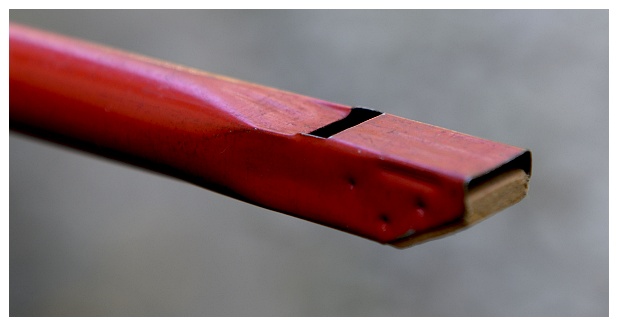
I’m not sure why you are saying that is a difference Terry. I mean, it is a difference, but not really much of a difference acoustically. The 15.7 mm I am talking about is also at the top of the full-length body cone, given that the squared off section is no longer a cone.
As far as I can tell, the main difference acoustically is just the length of the non-tapered section. On the Sweetone it is shorter, and can be used to tune. On the original it is longer and can not be used to tune. I haven’t had a close look at the new ones, so I have no idea what is going on with them. It looks identical to the original in the pictures and videos I’ve seen. And it seems to sound the same too. Just a plated finish instead of painted.
I do have originals and sweetones, and my personal preference is for the originals, but only once I’ve tweaked them by adjusting the windway and blade angle, which is a tricky process that can have all kinds of effects on the way the whistle plays.
I guess my problem is ignoring the obvious. When I look at my Sweetone, it’s so obviously a full length cone. And a bold one at that. It starts in the plastic head socket, and drives all the way down to the tiny hole at the foot.
It’s clearly not a cylinder whistle (eg a Generation), and it’s not a conical flute-style whistle with a substantial cylindrical upper body, a bold taper down through the finger holes, and then a bold terminal flare. It’s a clear, bold cone from top to bottom.
And you can see from the mode of construction, they have no room to move. They start with long, narrow trapezoid of thin sheet metal, roll it into a cone and secure it with a seam. With that form of construction, you can’t flatten out the top end to form a cylinder. And you can’t flare out the foot. All you can make is a cone.
And we sense the problems this bore presents. Tuning and performance suffer. A single cone is not an answer.
I went playing today on the waterfront in nearby Batemans Bay with my box player friend. I played my home made wooden whistle with the classic flute-style bore - cylindrical top body, conical through the finger holes and terminal flare below. I exalted in its power and tuning. I find nothing to exhalt in my Clarke Sweetone.
Strange, I find Clarkes to have vastly superior tuning to most of the whistles I’ve played. Better than Generation, Feadog, Susato, Waltons, Dixon, etc. I’d put their tuning about at the same level as a Sweetheart/Morneaux whistle - i.e., they’re very good.
Now, granted, I don’t have any whistles with flute-like tapered bores like you describe (unless Morneaux has that - not sure if it does). Maybe Clarkes would have even better intonation if they were like that. And Clarkes still have nowhere near as good intonation as my Colin Goldie whistle - so they’re definitely not perfect. Also, it’s possible I got lucky and have unusually in-tune Clarkes.
All this to say, I think they’re very good with tuning (at least the ones I own), but not perfect. Much better than pretty much any cheap cylindrical whistle. And I can only think this must be because they have a tapered bore that gets rid of those flat notes in the second octave. I have no better explanation.
I think the first thing to realize is that the subject of the original post, which is the Clarke Recalibrated whistle is the same design as the Original Clarke whistle. The Sweetone is a different design.
The Original Clarkes are made entirely from a single sheet of metal, both head and body. But as I have pointed out, they are very definitely not a full length cone. The squared off section at the head makes the upper part of the bore acoustically non-conical, before transitioning to a lower section that is conical, like the body of the Sweetone.
I agree with Cyberknight that the tuning of my Clarke Originals is actually quite good. I like how they play, once I’ve tweaked the windway, which is non-trivial. But they have the problem of being inherently non-tunable, being made of a single sheet of metal.
The Sweetone design does have a short section of bore, inside the plastic head, that is cylindrical, but the way it is attached to the body means that it isn’t tunable either, as you point out. Its cylindrical section is also shorter than the non-conical section of the Original. Maybe this accounts for some tuning differences. I have a Sweetone too, but I don’t really like it, so I don’t play it.
I do think that the relatively unexplored region of the design space is a whistle that has a non-tapering, and tunable, head, a conical body, and larger tone holes. I’d really like to get my hands on a Copeland whistle to examine its design more closely, and to see the extent to which it meets these requirements, but they are rare and very expensive now.
One day I’ll just try to make one myself, probably from wood initially. Making a reamer for a high D whistle shouldn’t be much work compared to making them for flutes, and there may be readily available telescoping, thin-walled, brass tubing for a slide in roughly suitable sizes.
Paddler - while untunable, they warm up quickly and my older ones (which I no longer own) and my new recalibrated one, have great tuning. Heck, I don’t ever tune my tunable whistles, either, since I’m usually playing with at least one concertina player and often someone on box. Honestly, I only move the slide on my flute in the most unusual of situations, because I prefer to roll out/in on the headjoint until the flute warms up.
Maybe I’m a freak, but I find the need to tune flutes and whistles to be highly overrated! LOL.
My own experience with whistles is that they mostly come to me with the head in the wrong place (i.e., out of tune). On the cheap ones I heat the head, move it, etc. On more expensive tunable ones I set the slide to the position that puts it in tune for me. Then after that, like you, I rarely move the tuning slide, and if I do move it, its by a tiny amount.
I do tweak the tuning slide on my flutes, mostly dependent on the temperature I’m playing in and what I’m trying to be in tune with. A tuning slide readjustment is much more noticeable, visually, on a large instrument like a flute than a small one like a high D whistle.
I do enjoy the tone and playing characteristics (breath requirements and back pressure) of my tweaked Clarke Original, and I think some of that is tied to the conical body bore. I could do without the seam on the back, right where my thumb rests, though.
Man, I don’t understand how y’all can play without tuning the instrument. I constantly need to tune my flutes and whistles depending on the temperature of the venue. If I don’t, I’m going to be painfully out of tune. If I’m the only whistle player, this might not be too noticeable, but if there’s another one, it’ll sound awful (at least to me) if I don’t match the same pitch.
Maybe it’s just that I play primarily in Boston, where sessions have widely disparate temperatures. In the winter, places are heated at very different rates. And if there are people coming and going from a pub, cold air comes in, and I have to retune mid-session. In the summer, there’s the problem of A/C inconsistency - I’ve played in venues with basically no A/C at all, while others (such as pubs) often blast it. All told, temperature in venues can vary from about 60 to 70 degrees in the winter, and about 70 to 80 degrees in the summer. This 10-degree temperature difference can make a very noticeable difference in the tuning of woodwinds (about 20 cents, I believe), depending on what venue you happen to be in.
And if you never tune your flute or whistle, even when the season/weather changes, you have even more pitch variance. If the coldest session you go to in the winter is 60 degrees and the warmest in the summer is 80 degrees, that’s almost a 35-cent difference - fairly massive.
I suppose if I were better at the flute, I’d be able to adjust the pitch using my embouchure. But this isn’t really possible on whistle, so making use of the tuning slide is my only option.
Perhaps I’m just really picky about things being in tune?
I’m confused - wouldn’t it be more important to tune your flute/whistle if you’re playing alongside a box? Box-players can’t tune their instruments, so you’ll have to tune if you want to match their pitch. And although their tuning is affected by temperature/humidity, my understanding is that they’re far less affected by it than flutes, whistles, and fiddles are. On a hot summer day, woodwinds and strings will all go fairly sharp, but boxes won’t as much (at least, that’s my understanding). So wouldn’t it be especially important to tune to them?
I wasn’t saying that I don’t tune mine at all, just not by that much and not that often.
The not that often part is because I play a lot more by myself than with others. This is mostly a function of where I live. I like the instrument to be well in tune with itself. If the tuning slide is adjusted so that it is well in tune with itself, then the instrument will remain well in tune with itself across a wide range of temperatures. But of course, it will be at a different pitch in different temperatures.
If I’m playing with recordings etc, then I have to tune to that. But when I do that I’m nearly always indoors at home, in which case the temperature is fairly constant. Hence, not a large movement of the slide.
Also, when I say not by a lot, I’m really talking about the range of movement relative to the maximum range of the tuning slide. And here I’m talking mostly about flutes. Our flutes, even the modern ones, are mostly based on the design of antiques which have tuning slides sized to attempt to allow them to play over a very wide range of pitch standards. This doesn’t actually work very well, because the instrument loses its internal tuning, but for some reason, we keep making flutes with these excessively long tuning slide ranges even though we have a single pitch standard. I was really just saying that when I adjust my tuning slide to adapt for temperature, I end up using only a fairly small part of its range.
I think all of this is consistent with what you are saying Cyberknight. If I were doing nearly all my playing in sessions in different venues across town and through the full range of seasons, I’d be using my tuning slide a lot. But I probably still wouldn’t be using close to the full range of slide movement that most flutes allow. That, I think is an artifact of the way we re-use and slowly evolve our flute designs. The same logic applies to whistles, but being higher pitched, the range of movement needed in a tuning slide is not very large in physical distance.
But I certainly believe that instruments need to be tunable!
Oh, and just a side note on the effect of temperature on tuning, stringed instruments go flatter with increasing temperature, whereas woodwind instruments go sharper. It is a bit beside the point, but aside from that detail, I agree with your reasoning.
I’m also a big fan of tuning slides, though the only time I really use them is when I’m playing with a recording that isn’t quite in tune.
This morning it’s a cool 24°C, down from the 30°C I was playing yesterday. That should be about 18 cents flatter, which is close to what I measure on my tuner – about 10-15 cents flatter than yesterday.
On the flute, that’s an easy adjustment. I can easily go 20 cents sharper while still keeping a strong tone, and I can go 15-20 cents flatter while still keeping a strong tone as well.
Now is where things get interesting. I tried out my whistles to see where they were, and I found I can bend the pitch about the same. I can go from 10 cents flat down to 25 cents flat, up to 15 cents sharp. I have the same pitch variability on a whistle as on a flute! (And the tone is still good. I can bend the pitch even further, but then the tone suffers.)
So I can easily adjust between yesterday and today without moving my tuning slide, just by blowing slightly differently. And I find that tends to be pretty instinctual, as I just lock on to another instrument and play like it. As long as I’m reasonably in tune at a mid-range temperature, I can adjust to other temperatures pretty easily.
As far as being in-tune with itself, I have about 15 cents adjustability in either direction in the upper octave, so that’s pretty good too. I’ve never tried a tapered whistle, but I don’t have a flat second octave on my two high D’s, which are cylindrical. The high A and B are naturally maybe 12 cents flatter than the rest of the second octave, but I can blow them in-tune pretty easily.
And I’m not playing some high-end whistle either. I have a c. 1988 Generation on which I tweaked the blade slightly, and I have a Dixon Trad from 2021. Both of these are more like the classic easy-blowing, “chirpy” whistles, which might be why I can bend the pitch this way.
My situation is similar to whistling guitars. I can roll the flute in/out and with embouchure adjustment, which after nearly 30 years of playing I can do instinctually, I just so rarely need to actually adjust a slide. I do break out the tuner from time to time to very that I don’t need to tune, but it tends to be my fellow session mates that need to tune or I self correct without moving the slide and I am good to go. With my whistles, when being played they all warm up quickly and while I may not be in time for the first half the A part I can adjust with my breath and be close enough until it’s warmed up. It works for me.
I get the weather stuff. My temperature range in KC is up to 105 F in summer and -10 F in winter depending on the year. Humidity from bone dry with heating on winter to daily 55% in summer or more. Diplomats used to get special pay rates due to summer tropic weather and winter frigid weather.
Times I’ve tuned in the past few years include and outdoor gig when it was in the sun and 104 degrees, a gig in an unheated barn at 42 degrees and one session where the heating was out and it was around 50 inside.
So I have tuned a few times recently, but it’s so rare I remember it.
As for playing with boxes…the three players I play with weekly all have in tune instruments. Well, 2 of 3 do but the third is a known entity and it’s hard to tell if he’s actually out of tune or just a half step behind the rest of the session. Plus, why tune to him when the other fixed tuned instruments are inherently spot on? I just adjust to the good box players with my embouchure and we are good to go.
Indeed! But I was under the impression (maybe I’m wrong about this) that humidity causes them to go very sharp. Since heat and humidity tend to go together (at least in northeastern USA), I thought violins tended to be sharp when it’s hot out.
I think this might be a very whistle-specific thing. I do have some whistles that have a fair amount of pitch variability based on breath control. But my favorite whistles don’t tend to have this quality.
Colin Goldie whistles in particular need to be tuned, I think. They have naturally sharp second octaves, and if you try to blow them flat, you drop octaves. Over-blow them, and your second octave will be too sharp in comparison to the first. So you kind of have to tune them if you want to vary the pitch.
I have a few other whistles with similar characteristics. I like this quality, because I hate having to “push” the second octave, and I like it when the two octaves require as little difference in breath pressure as possible - it’s just a preference of mine.
I think perhaps my impression of cylindrical whistles having flat second octaves is partially due to the way I play. I think the fact that I like blowing the second octave as lightly as possible makes me view many whistles as flat when other people wouldn’t consider them to be.
Definitely. Without deliberate compensation at the head end (or a really narrow window), you can’t get both in-tune octaves and even breath pressure/volume across the octaves out of a cylindrical whistle.
Yes, increases in humidity cause the wood to expand and string tension to increase, which is the opposite effect to increases in temperature, which causes the strings to expand and tension to decrease. How this balances out depends on your location. For example, where I live, the humidity, especially indoors, is lower in summer than in winter, whereas where you live it is the opposite.
Of course, 3d printers are made mostly in China, so you would not only be supporting local makers, but also big business and poor factory workers globally!
I hope you all don’t mind me pulling this thread up again, but I’m a long time Clarke player who actually started out with the Original and book+CD package a looong time ago.
However, for live performances, I don’t use the Original but prefer the Sweetone or MEG because they need less air, especially for overblowing. I just stumbled on the recalibrated Clarke whistles, and on their website, Clarke’s claims that the design goal was to reduce the amount of air needed, specifically also mentioning overblowing.
I have watched some YouTube vids about the new whistles, but they all only talk about the sound and the look. I couldn’t find anyone commenting on the amount of air in comparison to the Original or to the plastic mouthpiece on the Sweetone or MEG, despite this allegedly being a major design consideration for Clarke.
So could anyone owning both an Original and the recalibrated version please elaborate on the air needed to play in comparison? Maybe even in comparison to the plastic mouthpiece ones?
I have been using my Clarke Recalibrated for a while now. I feel it needs less air than the previous version, and it sounds a bit less breathy, while retaining the Clarke distinctive timbre. Overall, there is an improvement of the voicing, and I guess it comes from two things. First, the block is made of walnut instead of the old soft wood. Second, the window is a bit flatter on its upper side, which gives a thinner stream of air on the blade.
Overall, the Clarke Recalibrated is VERY nice to play !
If Clarke’s were anywhere serious about making a better, more efficient whistle. They’d re-tool and produce a whistle with a well formed windway. It’s not that it can’t be done. And it really makes a world of difference.