Traditional issues aside, do you think recent developments in moisture control like Ross systems (Highland pipers will know what this is) could allow for mouth blown uilleann pipes?
Jack
Traditional issues aside, do you think recent developments in moisture control like Ross systems (Highland pipers will know what this is) could allow for mouth blown uilleann pipes?
Jack
If they were mouth-blown pipes, they wouldn’t be “uilleann” pipes.
I don’t disagree with you.
What got me thinking is the picture on the latest issue of The Voice.
http://www.euspba.org/voice.htm
The magazine describes the pipe as a custom built Highland-uilleann hybrid, circa 1960. Uilleann-like chanter, common stock drones. I would love to hear this thing.
My guess is that they would resemble the GHB more in tone and volume than UP. I am guessing here, but considering the size of the drones and their subsequent bores, the chanter would need a reed capable of playing ‘over’ their volume… that, and the fact that they are mouth blown would suggest a reed that would stand up to considerablw moister issues.
IMHO…
I’m not finding anything at that link…are you referring to the elderly gent playing the pipes?

This is the image being referred to.
Patrick Francis Meagher c.1960 playing his own custon built uilleann/highland bagpipe. Its just a copy of a Brian Boru bagpipe that Henry Stark had made in London.They were made in the key of E as opposed to the traditional key of A.
If they were mouth blown, they really wouldn’t be Uilleann anything.
In the photo, there are 3 drones.
I had always thought that Boru pipes consisted of 2 drones… ?
But I digress, and agree with Joseph - they aren’t uilleann anything.
The two drone pipes are the traditional Irish Warpipes. Brian Boru bagpipes have three drones into one main stock such as the uilleann pipes. The pipes later evolved into having three separate drones like the GHB pipes but instead of having one bass drone, and two tenor drones, the pipes had one bass, one baritone, and one tenor. I agree with guys..they are not uilleann pipes but Stark took the concept of putting all three drones into one main stock, but without the elbow..the pipes are not uilleann..which is Gaelic for elbow.
Hmmm…
you might want to check this out:
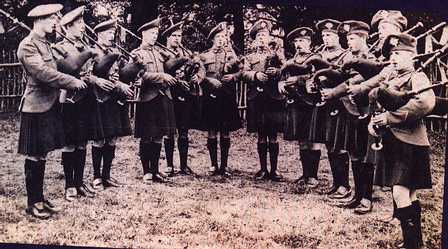
The caption says:
The pipers seen during the Great War and
are playing the Brian Boru two drone war pipes. The Irish War Pipes (seen above) or Brian Boru Pipes (i.e., two drone) were on Ordnance issue until the early 1960`s. There was a mix of two drone and Scottish three drone Pipes from about 1945 and 1946.
The first time that the Irish Regimental Pipers were accepted at the Piping school in Edinburgh they had to use the three drone pipes, this was about 1946. Most of the Pipers all came from Ulster and had their own pipes because they played in Civilian bands; they also used the three drone pipes.
They do look to me to be a merry bunch. 
Personally when play GHBs sometimes I prefer 2 Drones it has more Bass this way and takes less air.
What I want to do is plug in a Scottish or Northumbrian D chanter into a set of UPs.
I believe that the info in the caption is incorrect. Two drone bagpipes are Irish Warpipes. I cant tell from the pic, but they might be playing Brian Boru Chanters. This instrument was designed by William O’Duane and Henry Starck in 1908 and replaced the earlier Dungannon Bagpipes.
The chanter, based on the Highland pattern was made longer and the tone hole arrangement altered to leave the lower hand little finger free to operate the downward extension keywork. The top ‘a’ tone hole was moved to the front and covered by a key, the top ‘g’ retuned to ‘g#’ was moved to the back. Further keywork was added to give semitones as required, the basic scale of the chanter being that of ‘A major’ as the lower g was also retuned to g#. The open style fingering coupled with alterations to the tuning meant it was not really a practical proposition for the dedicated highland piper. The Brian Boru Irish System Chanter could be supplied with keywork arranged to suit natural fingering in any key signature with several different versions available including one with a thumb hole for the minor third. Up to fourteen keys could be fitted making it fully chromatic from low E to high c#. The drone system used was that of the Dungannon Pipes of Tenor, Baritone and Bass which could be in either a common stock or three separate stocks.
Chris Bayley has some great info on Brian Boru Bagpipes, and Irish Warpipes.
Just to (hopefully) clarify a couple of points. O’Duane had little or nothing to do with the Brian Boru pipes, as far as anyone knows. They were Starck’s project. The two worked together on the earlier Dungannon pipes, whose only thing in common with Boru pipes was the use of keys and their maker (Starck). Otherwise the pitch and set up of their chanters seems very different. The Boru pipes were not really in the “key of E”. They were intended to offer chromatic playing possibilities and their lowest note was E, reached through lower keys. The drone set up was A tenor, E baritone and A bass, which, if anything suggests A tonality, as on the Highland pipes. Which leads me to my next point. Someone above mentions “traditional Irish warpipes”. Ancient mouthblown Irish piping seems to have “died” somewhere in the 1700’s (see Breathnach). The exact nature of the instrument(s) used and playing style is anyone’s guess, and yes, something similar to the Scottish Highland pipes is a good one. Which is why revivalists in the early 20th century simply took the Scottish Highland bagpipe and chucked one of the drones. Presto, there’s your Irish warpipe. But its a bit of a stretch to view it as the product of an unbroken Irish piping tradition, since the name, the actual playing of it and the two-drone distinction (if we can call it that) from the Highland bagpipe is traceable to a definite group of individuals and point in time in the 20th century. Not to take away anything from Irish GHBpipers or pipeband playing. They’ve been at it a long time now and there certainly IS a tradition of bagpipe playing in Ireland, if not “traditional Irish warpiping”, if you get my drift. Its just that it goes back a hundred years instead of hundreds. And it should be mentioned that Field Marshall Montgomery is one of the best in the world. Sorry for being long winded, but we’re like that. Other thoughts?
I have to disagree with you Free Tinker..How can " revivalists take a third drone from a Highalnd bagpipe and make Irish Warpipes?..The warpipe is what it was..an instrument for WAR..The Irish used the Two Droned warpipe to pipe their Army into Battle. It is clear that the bagpipe existed in Ireland long before Scotland. The bagpipe is believed to have made its way to Scotland with the Dalradians upon their exodus from County Antrim across the Irish Sea at about 470 A.D., when Prince Fergus MacErc lead his clan in the invasion of the lands of the Picts at present Argyle. The difference in the Scottish and Irish bagpipe is their name and the number of drones. The Scottish refer to their bagpipe as “the Great Highland Bagpipe,” which today (an ancient bagpipe preserved from the battlefield of Culloden, 1746, has but a bass and a tenor drone) has three drones: one bass and two tenor. The Irish call theirs “the Great Irish Warpipe,” which has two drones: one bass and one tenor. In Gaelic the bagpipe is called “Piob Mor.” The warpipe continued in future Irish regiments of the British army, with the Royal Irish Rangers being the high-profile Irish regiment and was played up until the mid 1960’s when they officially turned over to the Three droned bagpipes of today.
Another point I would like to add is that the Irish didn’t use the warpipe as a instrument rather than a tool for battle. They used the bagpipe to scare and intimidate their enemy. The Irish long ago figured out that the bagpipes are not a instrument… so they gave them to the Scottish..which havent caught on yet..LOL!!..J/k guys
IRTradRU?, you’re on the ball there
mouth blown uilleann pipes
Elbow blown bagpipes operated by the mouth???
Come on now … thats me arse…Really…
Mouth blown anything are not, and will never be, by default, uilleann anything.
Uile = elbow
Get your self a decent auld practice set made by a good aul skin and away you go.
Pump and play, there is no other way.
JD
If anyone has a copy of Fransis O’Neill’s “Irish Folk Music, a Fasinating Hobby” published in 1910, you can see a photo of an altered GHB two droner, with the piper in the Gaelic Revival version of a “Leine” (pronounced Len-ya) the Irish shirt that was made of linen, and from this Gaelic word for “shirt” and because it was made from flax, and very common in the 1500s (and earlier),the English derived the word: linen. The head-ware of this Piper, captioned “The Piper of the O’Neill” is a rounded bullet topped metal helmet with wings, (trade mark on Gauloise Bleu cigarettes). Funny as heck, except for the evidence from ancient Gaul (Celtic France). The Wagnerian Viking helmet with horns being a 19th century Romantic invention, the real Vik-ing helmet was a simple metal cone shaped helmet, with or without nose guard, ala the Bayeux Tapestry (circa 1080 A.D.) This Romantic period, dating back to the publication of “Wurther” in 1768, and probably still with us, later day, “Celtic Twilight”/“New Age"people, was an across the board movement of art, literature, and music. It affected people all over Europe, including Ireland. Hence the confubulation of “Ancient” elements drawn from medieval carvings on buildings, archelogical finds, real oral “literature” turned into inventions by Lady Gregory, Yeats, Lady Wilde (Oscar’s Mother)etc. These “Ancient"elements, of course, included those potent symbols, the Harp and the Bagpipe. Now in the old annals, the Gaelic word, cuisle, (vein, hollow stem, pipe) was used to denote a musical instrument, long before the introduction of the Germanic word, Pipe. What was this instrument? A whistle, a reed pipe and/or a hornpipe? We don’t know exactly. Was a BAG put on it? We don’t know that either! In Brendan Breathnach’s “Folk Music and Dances of Ireland” Published in 1971, by The Talbot Press, there is on page 6 a carving from Clonmacnoise (10th century) a piper playing two short ,and one long pipe, with the mouth, like the modern Sardinian laudneddas players do (the pipers of SARDA use circular breathing). On page 74, there the two drone bagpipe(2 drones spread apart in separate stocks), in a cartoon-like “pig playing the pipes” illustration from a 16th century MS, from the Royal Irish Academy, and right opposite, the wood block print of a piper leading a raid, from Derrick’s “Image of Ireland” 1581, on page75. This is the two drones in a common stock, with a long chanter that so influenced the “Brian Boru” Pipes (there’s the” Brian Boru” Harp on the money and the beer label, never mind). BTW: The “Boru” in Brian Boru, means Brian of the cattle tributes, Ard Ri of Leinster, who died at Clontarf (field of the bulls) the battle against the Danes of Dublin, 1080 something-( I can’t remember have to look that one up). The long chanter of this pipe and the slight suggestion of a detachable bell with a key, really fired up the imagination, and why not? Grist for the Mill; and the mill doesn’t work without the Grist. Just don’t say that there is any one type of bagpipe that the Irish played, and just like the rest of Europe there was alot of mixing of cultural elements going on in Ireland. That the Irish played Pipes is very evident, what sub-varieties, what they were called, and when did they first appear, is lost to us, When they disappeared is not such a happy record of history. From Cromwell (1655) on to the end of the “Penal Period” (O’Connell’s Catholic Emancipation, 1829)cultural repression was part of the heavy political repression. Pipes and piping survived, however, and what will historians of the future make of us? Sean Folsom
P.S. Eric, a Piper on this forum, sent me the following in an email:
The Battle of Clontarf was in 1014 A. D. Brian Borumha (older Irish spelling) was from the Munster/Thomond area of S.W. Ireland.
He drew tribute from Leinster (cows were a basic unit of value, that and the grass for the cows). Recommended reading: “Brian Boru, King of Ireland” Author: Roger Chatterton Newman, Published 1983. Thanks Eric! S.F.
I like the Kells style clipart of the guy on the horse, though that is off topic. 
Sorry to quote a long one . . . I’m lazy. My comment is . . . they’re all Scotti. I love your use of history; that’s great.