As Feadoggie noted here, /viewtopic.php?p=1062379#p1062379, the height of the windway exit has a dramatic effect on how a whistle plays. (The theory says that what matters is the ratio of windway exit height to the length of the window, fipple to lip.)
But how do you accurately measure the windway height on an assembled whistle? I can easily measure the entrance height with vernier calipers, but I can’t get calipers into the window to measure the exit. Any suggestions?
Depends on your design probably. What matters most is how the air jet hits the edge of the labium, how that edge is shaped, the exit edge of the plug, the depth of the window, etc. It’s more about how the whistle sounds and plays than how things measure up. But since you asked… maybe it depends on your whistle design.
Really small calipers? 3D laser scanner?
Most of the whistles I make follow the format of the Thin Weasel whistles. I only got serious about whistle making after I read Glenn’s article in on making wistles in Woodwind Quarterly. Glenn’s whistles, like many others, use three parts for the mouthpiece. The head tube, the plug and an outer collar that forms the windway ceiling. The head tube is cut to form the windway. The plug is inserted into the head tube forming the windway floor. So the wall of the head tube determines the height of the windway all along the length of the windway. That’s easy to measure before you assemble the parts. And the height can be varied by turning more or less material off of the head tube.
I also have made whistles with broached windways as you might see on a recorder. It’s a two piece head with just the head tube and the plug. On those I cut a voicing window first and then broach the windway out of the head tube wall from the inside with a modified file. Yes, on those I can really only get the calipers on the entrance to the windway. So that’s what would get measured. But the voicing on those has more to do with adjusting exit edges of the ceiling and the plug to direct the jet properly. I do not make a lot of those whistles. Mack Hoover makes some nice whistles in that manner.
I also make a design where the labium and windway is formed by a slit tube inserted into the head tube. It is also a three piece design and not unlike the MK low whistle. The voicing window is cut into the head tube and the head tube forms the windway ceiling. The slit tube is inserted into the head tube and it forms the windway walls. The plug is inserted into the slit tube to form the floor. The wall of the insert determines the windway height all along its length. Its easily measured prior to construction.
My fourth method was inspired mostly by the Susato whistles. Burke and Impempe and other whistles use a variation of this design method. This is a four piece head with the head tube, the plug, the outer mouthpiece collar and a windway insert. On this design the head tube ends with a bevel that forms the labium. Then a three piece structure is mated over and up to the edge of the head tube. The outer collar forms the windway ceiling and voicing window, the insert forms the windway walls and the plug forms the windway floor. So the windway height is determined by the wall of the windway insert. It’s easy to measure prior to construction. This design can be simplified into a three piece design if you cut the windway down into the plug but I find that it is harder to execute consistently. But the depth of the cut would determine the windway height.
You’ll notice that I don’t talk about sloping windways or non-parallel windway walls. You can generally still measure the windway height on those arrangements prior to construction as well.
Of course the above only applies to whistles you are making yourself. If you are measuring a purchased whistle it’s more difficult. Then you may have to resort to using arithmetic and geometry to get a measurement from measurements on the outside of the whistle. You know, measure what you can and figure out the rest.
Tunborough, You can very accurately measure the exit of a windway by using a pin gauge. These are available in sets with intervals of .001" and are most likely available in metric sizes too.
I started out making whistles similar to what you describe. I did not not have a lathe back then and only used a drill press to make the parts. Had to start by grinding my own drills from flat wood drills. Then centering a wood V block on the drill press, clamping the cpvc, set the belts/pulleys to the slowest speed, use a spray bottle with a soap/water solution to cool the cpvc and eliminate the oder/fumes. The small amount of dish soap caused the solution to stay on the cpvc better than just water. It made a real nice looking head without the outside cut. Eventually I bought a lathe.
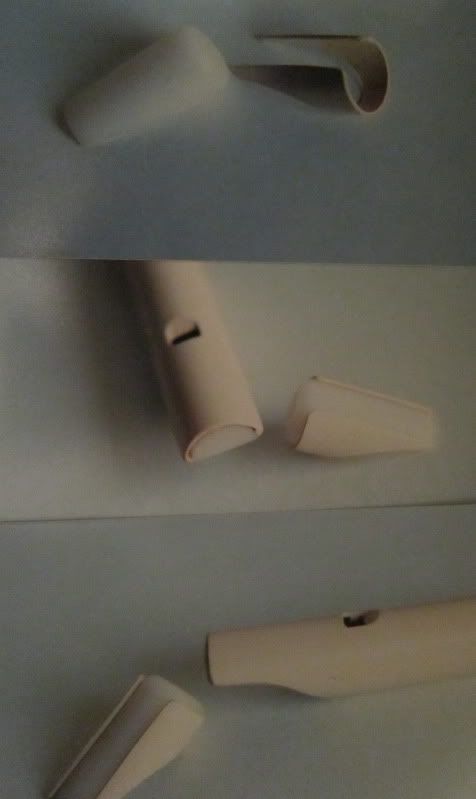
Looking at the second picture shows the wind way entrance wider than the window. I experimented with a tapered from the sides wind way. I have since found that a taper between the roof and floor are much more effective.