I wouldn go into Leather vs VINYL, since most prefer leather, but tight budget+being fan of John Mcsherry+being vegan, naturaly points me to Vinyl. We heard some good things (airtight, leak proof & easier playing with high pressure sets…) & they last apr. 5 years. But I didn’t found much about DOUBLE LAYER type. Advantages are better feel, more solid bag which can hold up the chanter, so you can focus on playing more ect… (there must be some more since Paddy Keenan use them). Any tips for making them, would be great. THANKS!
I have 3 questions bellow (written in blue): Most people recommend »Marine« stuff - the one with solid woven polyester cloth bonded on the back (NOT nylon mesh lining or fuzzy back). Kevin L. Rietmann mentioned he prefers standard vinyl, since it glues better. I gues it depends which glue you use. Paddy Keenan like to use very stiff vinyl.
Sooooo… it gets confusing here - What type of Vinyl YOU found to work the best for DOUBLE layer vinyl bags - I gues for learning curve it doesn’t matter???
For Glue the 3M Marine 5200 is known as best - mybe extra wait with “slow cure” is worth. Uilliam suggested german Renia Syntic which in his words is very strong also – he use a single coat too! Others use BARGE cement – 2 or 3 coats.
I gues all 3 will do!? HOW much glue apr. you need for a double layer bag, since I first need to glue both layers together & then to glue the seam???
Making the Bag: I heard a story how Paddy Keenan’s bag exploded , so I think I will put rivets or hand stich it after gluing. I was told to make bag like this: draw the shape+repeat with mirror line, cut out, put it on another piece of Vinyl &trace it again, but with a border of 1,5 or 2 Inch around. Cut this 2nd piece. Put the glue to both pieces & glue them »face to face« with fabric meshing together (using rubber hammer). Optionaly clamp them. When dry fold the bag and glue 2 mirror parts of bottom layer 1,5 inch seam together (rought it 1st with steel wool&clean with acetone). Then to use rubber mallet (joint well) & again I can use clamps+plywood. After a week it is ready for “tying in” the stocks. For this, the best is to cut circle holes (smaller than stocks since Vinyl is a bit elastic) & tie in like in leather bags.
So my last question is: Which type of seam worked the best with double layer Vinyl bags for YOU? Traditional kind »saddle-stitched«, David Daye wrap-around seam - which I don’t understand or something else ???
I am leaning toward the »saddle stiched«, as I prefer the look, but mybe I will replace stiching with strong copper rivets.
DID I MISS SOMETHING IMPORTANT??? If Yes, please share it. Thanks, Best AA
My experience with 3M 5200 is that if it is properly cured, the material bonded will fail before the bond itself. That is, the material will tear away from itself rather than fail along the glue bond. Personally I’d not use the rivet idea.
My bags are double layer naughahide, stitched with a leather seam. With the stitching who cares what glue you use, there’s no way that’s going to burst. I used DAP Weldwood and let it sit overnight with boards and cinder blocks on top anyway. Seems to work. Guys say the 5200 stuff will do away with the need for stitching but the stitching only takes me a couple more hours so why not? I tried the 5200 once and screwed it up. Left a spare tube out in the garage and a year later it had solidified in the cold so watch out there too.
My friend Eric has been using them for a long time with success. He wrote a great tutorial on our club’s website. I started with a David Daye vinyl bag when I first started playing and it worked well enough for me.
Here’s a huge bag I made a couple of years ago. Truth be told most any set could be powered with something half the size there, I was on a bigger-is-better kick I guess. Made a 4 ft long pipe case too. That’s two layers of naug and a sewn leather seam. Think it took me a couple evenings. So you could sew a normal bag up in one evening, after gluing the vinyl together anyway.
Was apparently on an orange kick too. I picked out that color so every time I’d look at the bag I’d want to puke, and it’d force me to sew a cover for the thing. Never have bothered but at least I did recently make a bag cover for its twin that goes with my flat pipes. Thought it was Cameron tartan but someone corrected me on that score. You know, Scotland, bagpipes, all that good stuff.
A friend pointed out that an orange pipe bag does have the advantage of being instantly recognizable if it’s stolen, too…that, and you’re not in danger of being “accidentally” shot by Dick Ch@ney…
I’m curious, and may have missed something obvious. It seems counter-intuitive to glue, then stitch, threatening a leak from the piercing of the material, with the exception of the characteristics of the naugahide. Was the glue wet enough to bond with the thread; glue line above the sown line; or something else?
Really wish I had a pic of the huge bag I made in the 90s. If you saw it now, you’d think it was something done with Photoshop. Like, a whole bolt of vinyl was used up. Just fecking ridiculous. Might as well fire up an air compressor.
The glue was totally dry when I began stitching. The area around the stitches was all glued up, yes, but the stitches hold the air in, not the glue. Yes, doesn’t sound like it would work, but it does. I’ve never bothered to season things. One of my bags does leak a tiny bit. It’s difficult to sew through the curves, too. Sometimes I’d wind up missing the vinyl and have to back up a bit.
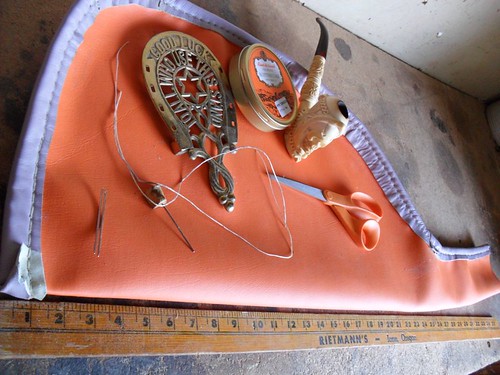
One of the needles shown has a flat-topped chunk of boxwood set on its top, which is what I use to drive the holes in the fabric before beginning to sew. I pound on the top with a hammer, driving the needle into the vinyl/leather and into a block of waste wood underneath. Most bagmakers use drills for this, though.
All I can add here is I started out with a stitched vinyl (or something generic) bag. After working the bellows extremely hard for about six months someone pointed out all the air was escaping through the stitch’s holes. The bag then spent a few days in the workshop of Leon Rowsome who was supposed to fix the problem. The day I got the bag back I took a class in Henrietta st. where I was told I would never get anywhere beyond working the bellows if I didn’t get a bag that would hold the air. The day after that Dan O Dowd fitted a glued vinyl bag but only after blowing it up and standing on the inflated bag to show it would keep the air in.
THANKS everyone for help. Especialy thanks very much Kevin! - the sewn style was my 1st idea, as I prefer the look, but seeing all Vinyl bags made with wide glued seam so… Still don’t understand few things - so if you can explain please. THANKS
So you used standard Vinyl, 2 layers glued back to back, so the shiny top is outside & inside?
Did you use the Leather seam, since the Vinyl seam would tear? When you stiched it, did you had to go through 6 layers of material with the needle?
Did you stiched with prewaxed thread? Also I am not sure how big glowers needle should be in comparison to thread?
I think if stiching would leak, the liquid silicone can make it leak proof.
But your glued Vinyl seam doesn’t look 1 or 2" like is usual, but narrow - like on leather bags? Is it the same width as the leather strip on the top, so they cover eachother?
Why not? I read somewhere that Michael Mcharg said, riveted bags are usualy more airtight than sewn.
Yes, the 2 layers of naugahide have their woven surfaces glued together, so it’s shiny on both outside and inside. I figured leather would be better for the seam since, as you guessed, it would be less likely to tear. The needles go through 6 layers, yes. It’s easier than you’d think. Sometimes you have to push the needle through a bit, but it’s no big deal. Light leather in a single layer would be easy enough to drive through by hand all the time but bags like that aren’t stiff enough to hold up the chanter, making you expend effort to play the pipes, which won’t do. I got the thread I use from Tandy Leather, a US company; it’s thick nylon that is prewaxed thoroughly, great stuff for the job.
 Never have bothered but at least I did recently make a bag cover for its twin that goes with my flat pipes. Thought it was Cameron tartan but someone corrected me on that score. You know, Scotland, bagpipes, all that good stuff.