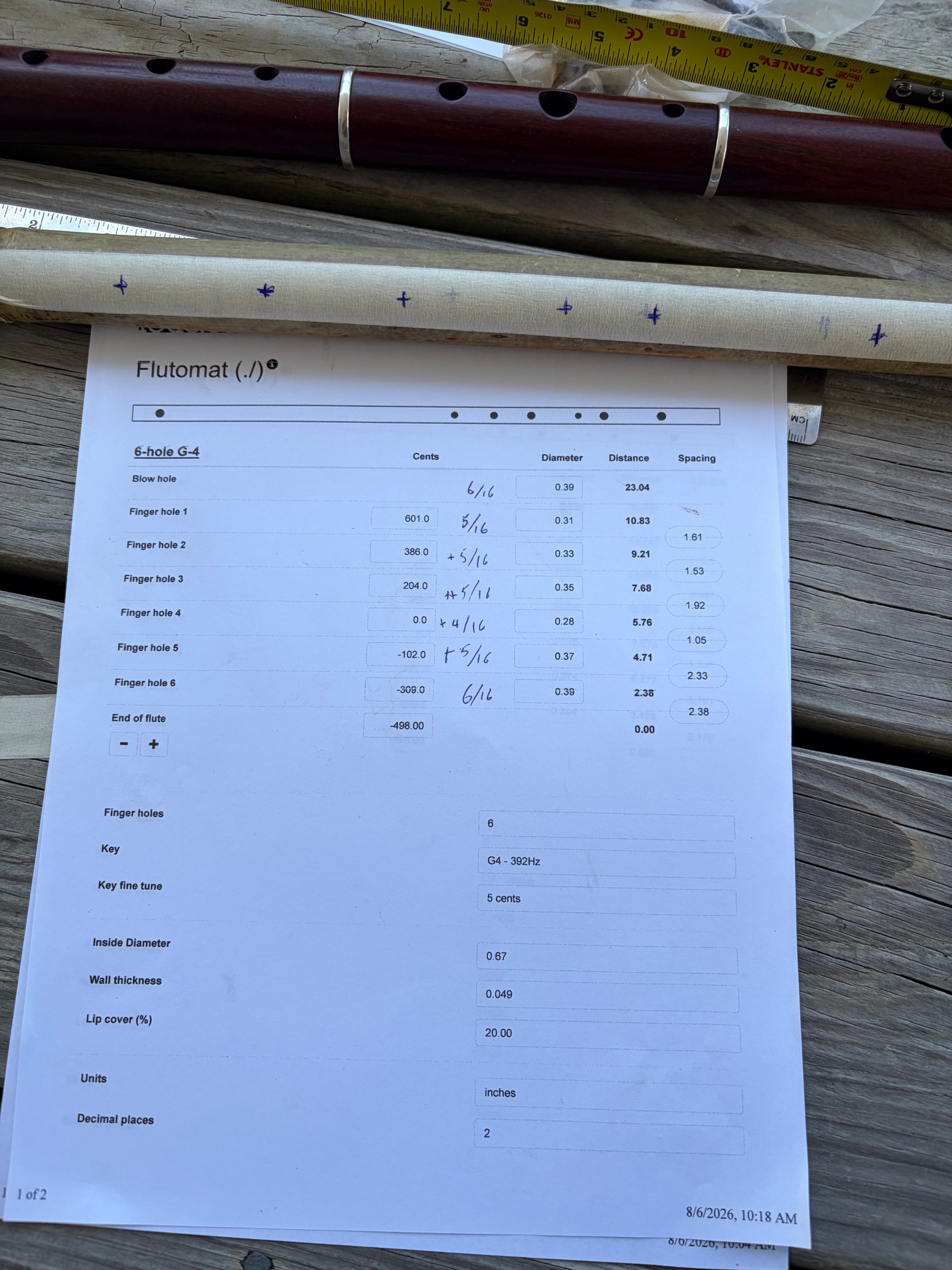
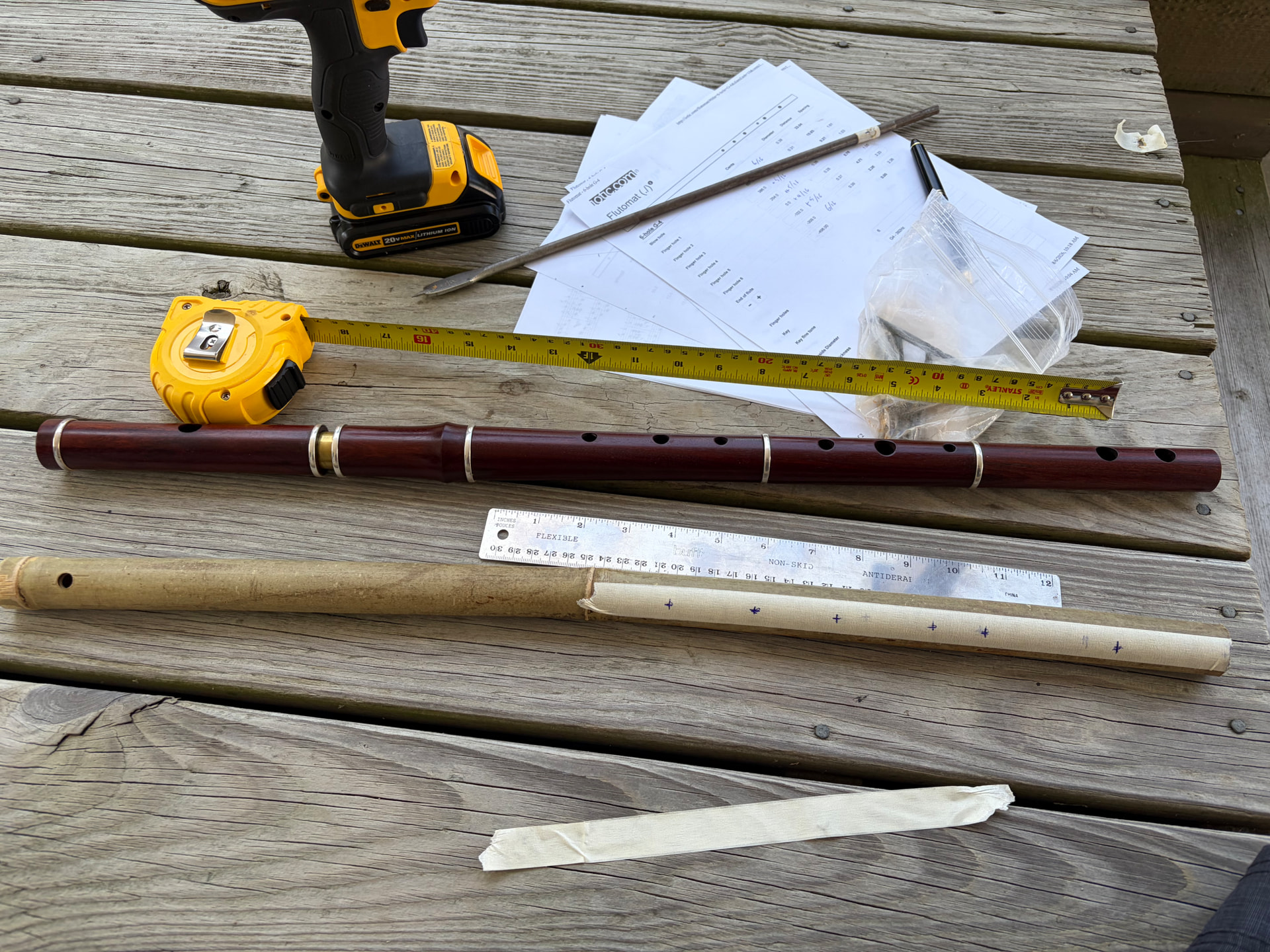
I’ve had a nice, sturdy piece of bamboo about 5.5 foot long staring at me for a couple of months now, begging to become a flute. I input my numbers into Flutomat, and it seemed that even with my large hands a D flute was not practical. (In retrospect, this should have been a sign that I was not using the tool correctly)
A flute in G seemed more doable, leaving me with a good sized chunk of bamboo should I want to make another. (Or screw up my first attempt, which is more likely)
Well, I seem to have screwed it up. I measured the wood, cut it to length, cleaned up the node in the middle, determined the position of the embouchure hole, and carefully drilled and sanded the hole.
Time to play my first note…
C - Soft, and a little flat but definitely a C. First harmonic, a very sharp B. (Flatter C?) Second harmonic, a flat G. Next, a flat C.
I’ve obviously put garbage into the Flutomat, but I think I can salvage this, and get that D flute I had originally planned.
The flute as it stands is similar in proportion to my Travis King D flute, though with a more or less cylindrical bore.
Can anyone help me discover my error before I start cutting tone holes? No doubt after trying so many variables on Flutomat I inadvertently missed a key variable, leaving me in an unexpected key.
Flutomat is applying the “key of G” to the XXXOOO note, not XXXXXX. I don’t know enough about Flutomat to know how you got there, or how to correct that misinterpretation.
If that was in the documentation, I certainly missed it. I don’t understand it, but it agrees with the pitches I have so far.
I purposely cut the blank a little long so that I had some wiggle room to get to the desired pitch. it’s looking like I should be able to trim it down to a D if I don’t mess up the other calculations.
But not today… I’ve already made my quota of mistakes for the day, and I still have a rehearsal to attend this evening.
It’s not very obvious, but if you click the red “i” by the logo it explains the reason. Quote:
“N.B. I mostly play the North Indian bansuri style of flute, with large finger holes and key note played with three finger holes closed. Western folk flutes tend to use six fingers down (a perfect fourth down, or fifth up) as the key note. So what I call a C flute, others will think of as a G flute, etc. This may be worth considering when viewing the following examples.”
Got it. Does this mean that the note 000 000 is a C-natural or a C#? I’ve got a feeling this is something I don’t want to mess up
I have enlarged the embouchure hole to the recommended 10mm and the pitches are… better, but not great. (Probably because I guessed at the position of the “stopper” node… I can elongate the embouchure hole in the right direction, but that will likely give the tiniest of improvement) I’m not cutting any tone holes until I get a good fundamental D, and recalculate the rest from there.
I think it’s calculating for C#5 for all open fingering. If you click the “Frequencies” checkbox, it shows you predicted frequency for the fingering that first opens that hole and it lists 554.7 Hz.
My understanding is that Bansuri players half hole the top hole when playing the solfege. The frequencies also seem to suggest flutomat is calculating with just intonation which I believe is typical for that instrument.
I had the calculator set to mm, and it was not lining up with the same points when set to inches.
As it turns out, Flutomat sets end of flute at 456.1 mm, but when switched to cm it’s 52.09! The latter is correct when compared to inches.
This sounds like wise advice.
[EDIT] Except for the fact that my “nice flute” has a conical bore, tapering 4.3mm from the start of the upper joint to the end of the flute. I should not be surprised that some of the measurements are as much as 1.5cm different from the calculator.
Then when I compare to my 19th Century small-hole flute, it’s a whole different story.
As @david_h points out, your other flute probably has tapered sections of the bore, which your bamboo won’t match. Additionally, it probably has different wall thickness and bore diameter, so a straight copy probably won’t work. Bamboo is very irregular, so I’ve found a purely analytical approach rarely works.
When I make a bamboo flute, my method is to first make the embouchure, then trim the foot of the bore until it plays at the fundamental note I’m looking for.
From there, if I were using using flutomat, I’d adjust the embouchure diameter and/or lip cover % until flutomat predicts the same note I’m getting, for the same length of bore.
This gives the other tone hole locations the best chance at being correct. I then burn out the foot-most hole in the smallest diameter I can, gradually increasing the diameter until the first note matches (let the flute cool down between burning, and blow out any hot air or smoke which will change the pitch).
Once the first hole is close to being in tune in the first octave, I’d check it against the flutomat prediction and see if it’s under-predicting or over-predicting. Whatever error I get is used in adjusting the next hole up the bore.
That looks correct. The numbers in the Cents column point to a diatonic scale from the bottom note as you open the holes, with a B that’s a hair flat of ET.