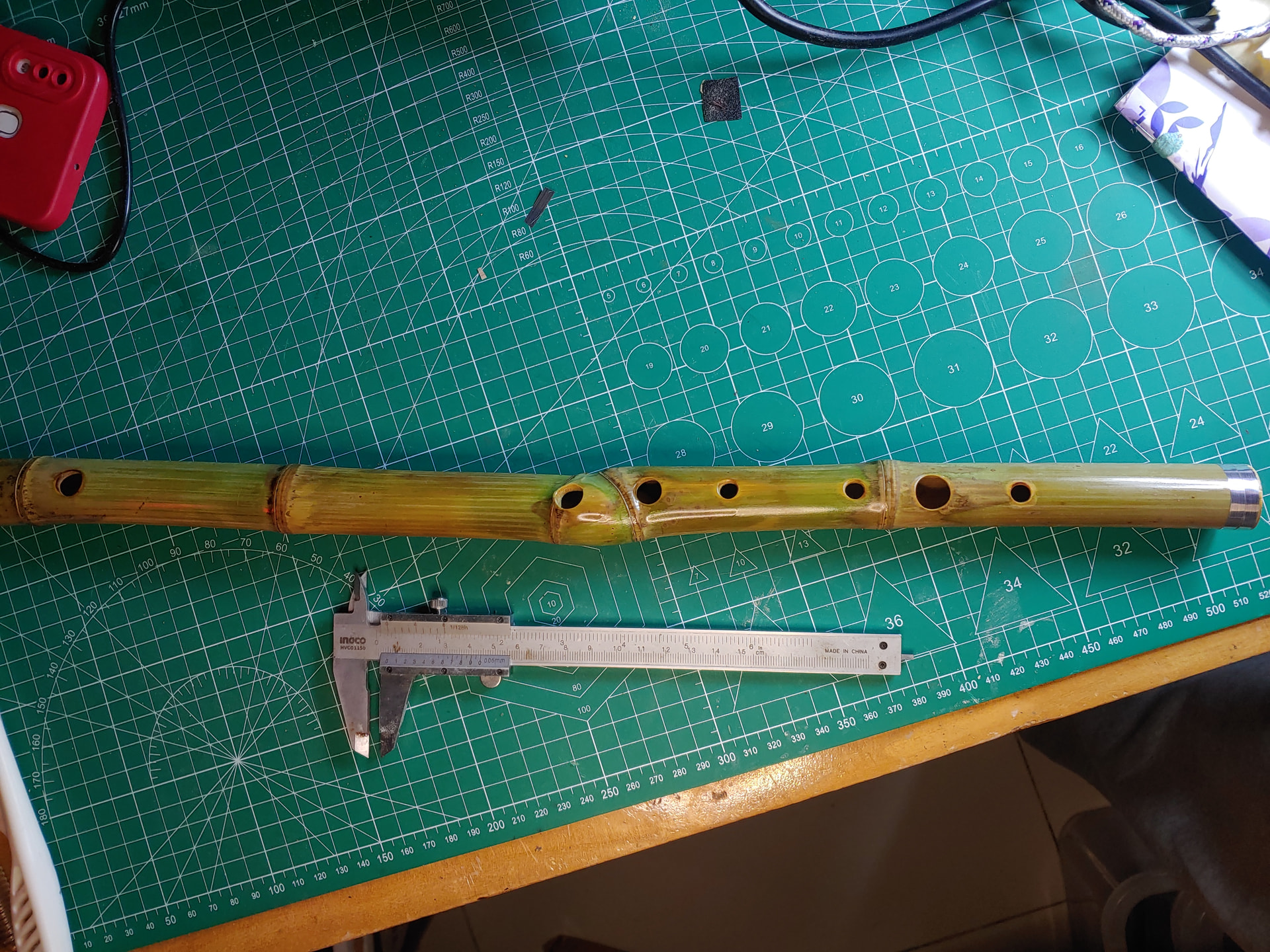
How did you go about measuring the taper along the inner bore? If you are only measuring at the ends then it’s possible that you are being misled. I have a LOT of experience with this!
I make bamboo flutes of various kinds (when I can find the time) and I’ve messed about with selecting species that have enough natural taper to allow for a semi-Boehm style taper at the head, but it is very rare to find any that have a meaningful taper running their length that is sufficient to make a “conical” bore. Plus, it is quite normal to have some slight constriction near the nodes, making it difficult (more like impossible) actually measure the bore diameters along the length of the stalk. Also, it is normal to find bamboo that narrows along the length of the stalk, but on the inside it more resembles a step-bore than a taper. So at the fat end you have what is basically a cylinder in between the two nodes. As you travel along the stalk (going from fat to more narrow) you have another cylinder between the nodes, but it might be a hair narrower than the first. Likewise for the next section. Here is a very crude sketch that is a bit exaggerated to illustrate what I mean (hard to draw with a mouse).
Lots of bamboo present this way, and you will not get a genuine taper without serious bore manipulation. You can sand out the inner nodes pretty aggressively to try to give access with measuring tools, but short of some type of high-tech laser measuring device you can’t get a proper survey of a bamboo bore. I usually profile a bore using t-gauges, but that won’t work, at least not well. Not only is the bore organic and irregular, but the slight constriction of the nodes means that you might get a t-gauge inserted to the point you want to measure, but you can’t get it back out again past the constriction point. So judging whether you have a true taper isn’t feasible that way.
A step-bore can be very effective, however, but the nature of these steps in a stalk of bamboo are organic/random and therefore difficult to use effectively. I’ve made step-bored wooden flutes where I can precisely control the location and degree of the steps, and even then taking advantage of it for tuning purposes is tricky. However, it can and does work when you hit the bullseye, but hitting that bullseye with stalk of bamboo seems like a long shot. The other tricky bit judging from your photo is that some of your finger holes are landing on the nodes where the walls are probably a lot thicker, creating a serious chimney depth. Larger holes and undercutting will help you, but I’m guessing you have to work a bit harder to get them balanced.
Also, the bamboo species that you are using is pretty far from being ideal, which you undoubtedly know already. Optimally, you would want a species that gives you greater inter-nodal distances and (if possible) thinner walls. Unless you live in a bamboo-rich environment this can be problematic. I have a bamboo xiao from a maker in Taiwan (the talented Winson Liao) and it is a fabulous flute. I was talking about this flute with one of his students (who loaned me the flute) who had visited Winson. I was remarking on how well this flute turned out and he commented that it all comes down to bamboo selection. Winson has a license to harvest all types of bamboo that are indigenous to his area, so he gets to cull vast amount of these canes, only choosing those that will lend themselves to making a good flute. For every one he selects he probably discards dozens. This is my own experience. Only a tiny fraction of bamboo stalks have flute potential if you are wanting a fully realized instrument that plays in tune through two octaves. It’s easy to make a “hippy” bamboo flute with a big, sweet voice that will play the first octave in tune–you can do that with all sorts of bamboo. But you are clearly going for something more sophisticated.
The final option is bore manipulation. I’m actually experimenting with a type of epoxy gel that would allow me to make minor tweaks to bamboo bores to optimize them since I don’t have the luxury of unlimited bamboo harvesting.