I’m not sure I understand the question. They’d have to consult what they know about whistles and whistle-like flutes to make that determination, they wouldn’t simply look at the instrument. Same with any instrument, an “F” horn is only an “F” horn by convention, not by anything inherent to the instrument.
I guess I meant it seems like a unique instrument, so it’s odd that there’d be any convention one way or the other. But I’m probably overthinking this. It’s just weird to see a whistle being described as “in C” in a concert-pitch sense.
I sometimes wondered, these would have been rarer than your run if the mill high whistle at the time to begin with but were many of the ones that did exist lost because of their size? The small whistles can linger unnoticed in the back of a drawer or the bottom of a shoebox for ages while these long ones get in the way or get damaged and get thrown out, perhaps?
That particular make isn’t uncommon, by the way.
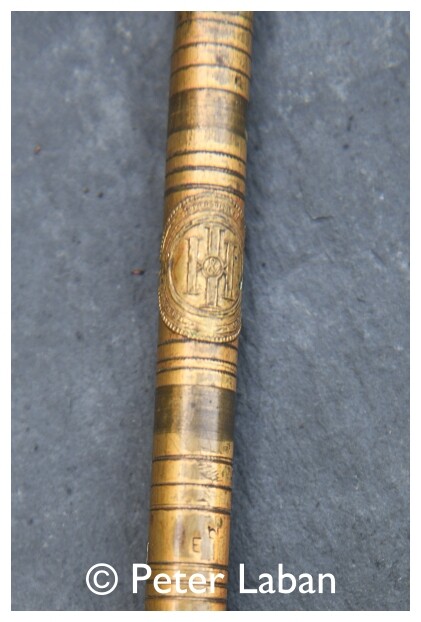
Wouldn’t it be the opposite? I thought smaller bore whistles were naturally slightly higher pitched, which meant they had to be longer to make up for it.
Narrow bore equals longer bore to maintain the same pitch.
Yes, the end correction is a function of the bore diameter, so as the bore diameter increases, the end correction increases. Which basically means that for a given length whistle, increasing the bore diameter flattens the pitch. Hence, for a given pitch, a narrow bore whistle will be slightly longer than a wide bore whistle.
But in this case, the length of the whistle is quite likely determined by the reference pitch it is made to play at. The date estimates for that whistle’s manufacture overlap a period when reference pitches climbed as high as A=450 hz. High pitch was common in Britain, so it might well be a D whistle, but at a higher reference pitch than today’s A=440 hz standard. Hence, it would be slightly shorter and slightly higher pitched than today’s low D whistles.
And the image does look like this whistle is stamped with a “D” above the maker’s mark, so in our nomenclature, it is a low D whistle, and very much like today’s designs.
The “in C” nomenclature is extremely confusing, and in my opinion unhelpful. It is really about how music is notated for an instrument, rather than being a feature of the instrument itself, so it makes little sense to use it as a way of describing an instrument like this in isolation.
1 Like
One can find British instruments as high as A460 from the later C19th and whilst there was no “standard”, the nearest thing to one from c1860-c1920 was Old Philharmonic Pitch A452.4, also adopted as the official pitch for the British armed forces ensembles. High Pitch wasn’t just “common”, it was the norm in GB. The vast majority of earlier (C19th and early C20th) tin whistles from British manufacturers, including Generation, are HP.