I only just discovered this on “Youtube” - it may have been mentioned here before, but a mere 183 “views” since the end of last year when it was posted would suggest otherwise.
https://youtu.be/eUnWL_cE31Q
Have a look.
It’s at least 184 views now. Thanks Kenny.
Best wishes.
Steve
Great stuff! Thanks for sharing.
Eric
Mighty, thanks Kenny. Only had time so far for a quick look, but a few thoughts:
- who undertakes to make a list of the tunes and their start times to save the rest of us the trouble? And perhaps post them to the Youtube notes for those who follow?
- sounds to me they are playing a little on the sharp side. The tuning slides are not much extended. Are they doing that purposefully to emulate the times?
- Interesting that McKenna had picked up a US-made flute and that’s what Liam is playing. It’s certainly pulling its weight.
It has been posted and discussed here before but Hammy talked about that flute : McKenna’s flute
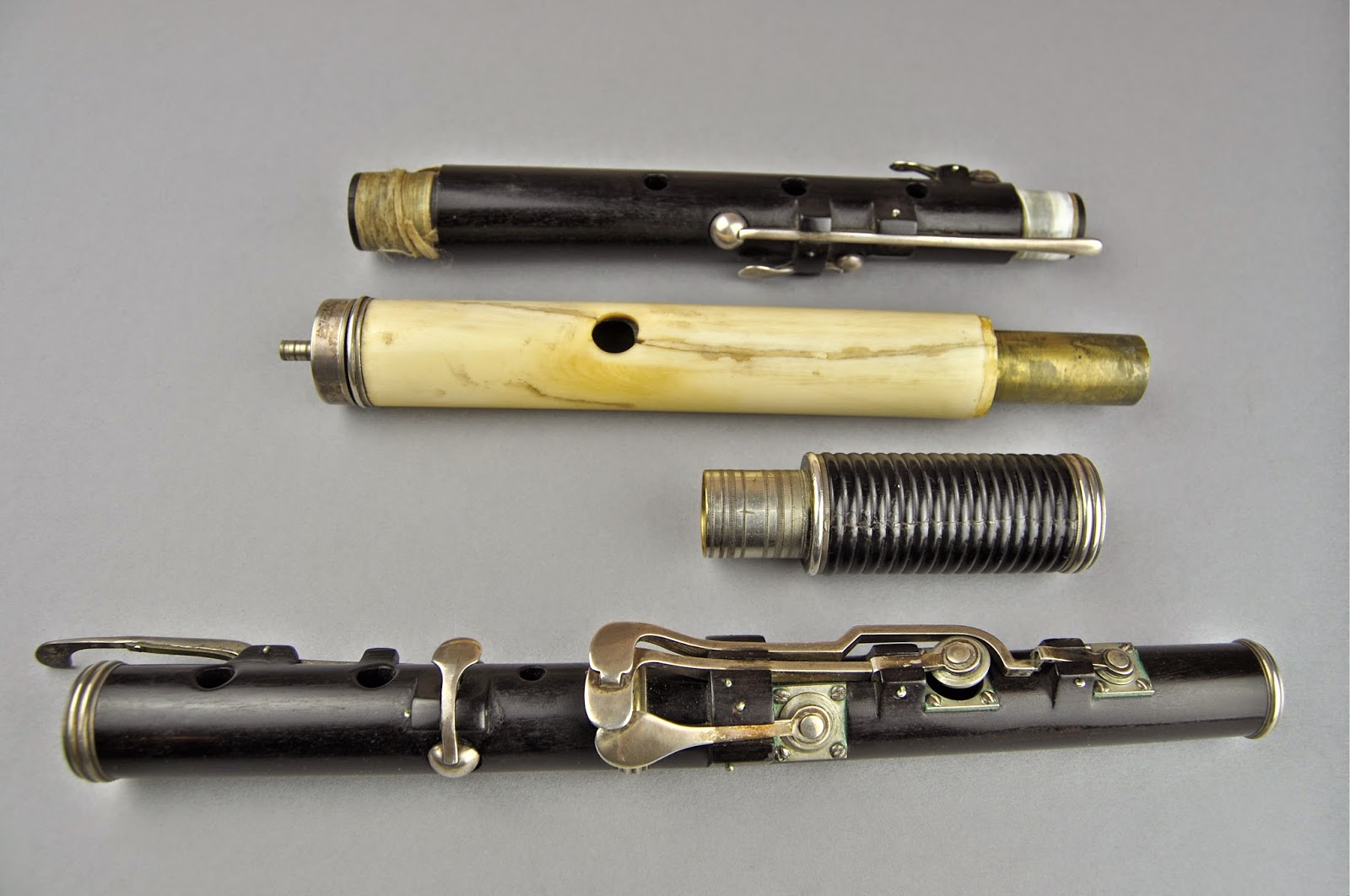
Hmmm, that’s a very English-looking flute. I’d have been inclined to think it was a flute “made for the trade” (ie unstamped) and exported to the US. Even if we found similar examples stamped with the US company name, it doesn’t necessarily prove they made it. It just confirms they got around to having a stamp made! Hard to know how to go about proving where it was made. I wonder if any of the keys are stamped underneath?
The cap is bothering me - where have I seen that design before? Monzani? Anyone?
Hmmm. Do we think the keys look like silver, but the cap and barrel slide cover look like Nickel Silver? What about the rings?
In the article accompanying the photo above, Jon Cornia postulates that the flute might have been made by Asa Hopkins from Fluteville in Litchfield, CT, USA.
Best wishes.
Steve
And it may well have been. I’m just surprised how “English” it looks, particularly the saltspoon keys. This is more what I expect of a US made flute (this one an Asa Hopkins restored by Patrick Olwell):
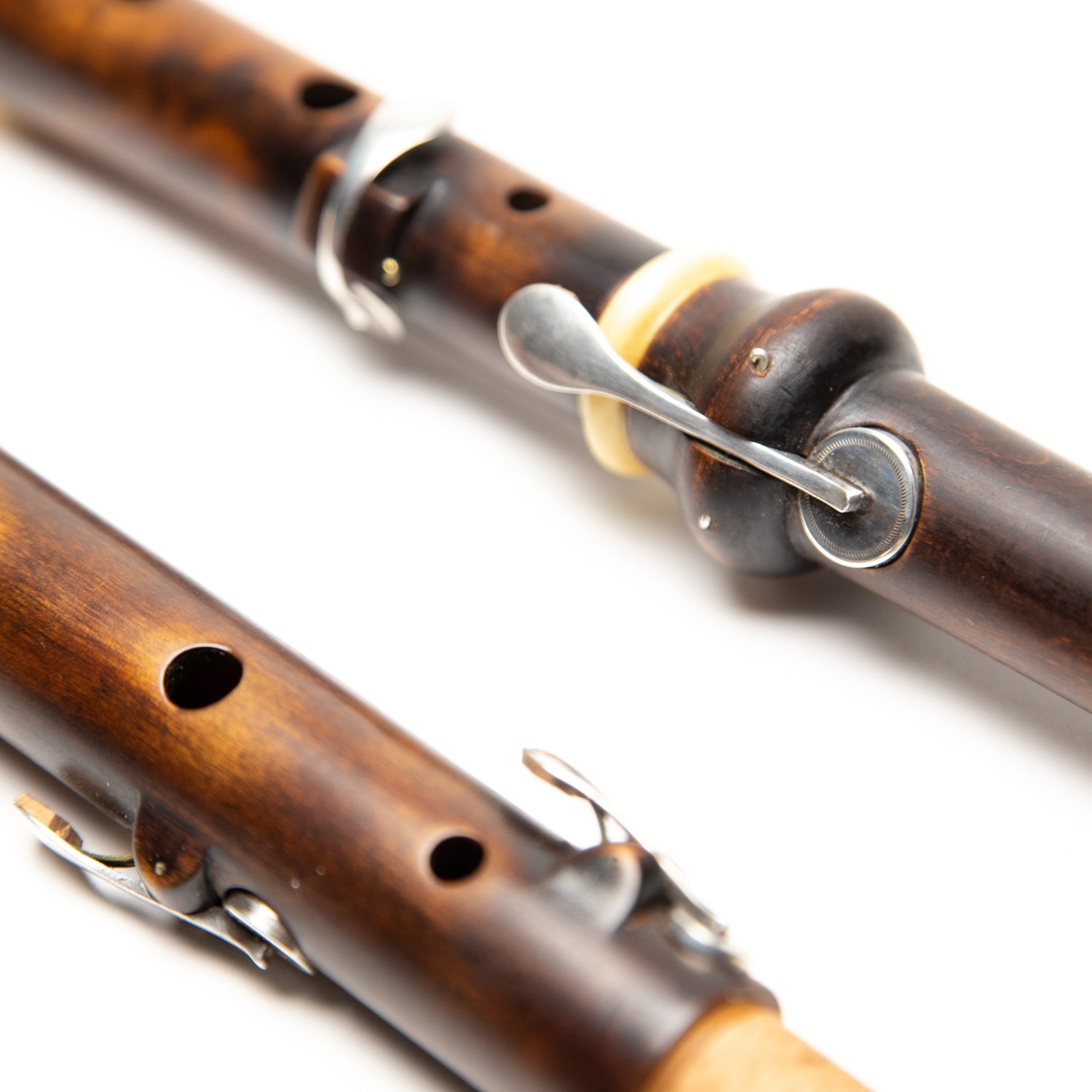
Note the flattened tops to the keycups. I have seen other Asa Hopkins-marked flutes with saltspoon keys, but again, do we know if he made them or if he imported and stamped them? As I’ve harped on about before, much more work needed on US-made flutes!
Lovely playing! I play the 2nd barndance in the “Ballroom Favorite” set a ton, heard it at a session in Belfast a while ago appended to the end of another set of tunes from McKenna’s recordings, “Up and Away” and “The Merry Girl” (sometimes I’ve heard them called “John McKenna’s polkas”). Anyway, the first two I’ve heard played a decent bit, but I have so far never run into someone else who knows that 2nd “Ballroom Favorite” tune, and it’s a pity because it’s wonderful.
Got the Buck from the Mountain CDs at Custy’s when it came out, any flute player who doesn’t have a copy should get one immediately, or at the very least listen to the tracks online.
Terry, there are a lot of American made flutes that look like McKenna’s, and a lot really were made over here, not imported.
I agree that, at least superficially, they do look quite English, but when you get into the details they are recognizably American.
I think some of the similarities may stem from the fact that some of the early American makers, such as John Firth and Edward Riley,
for example, actually were English and emigrated to America after having been exposed to English flute making. Flute making in
America was a large and thriving industry, in parallel to that in Britain and elsewhere.
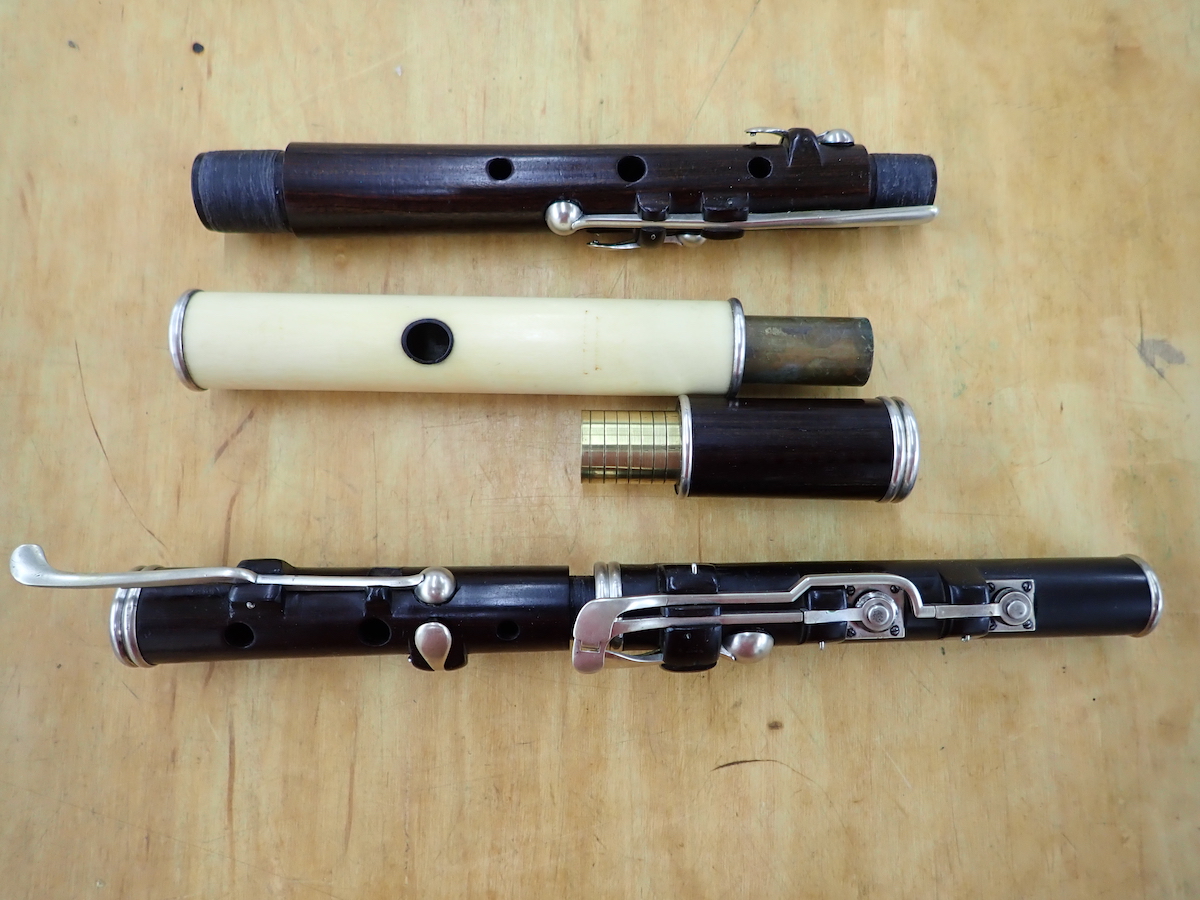
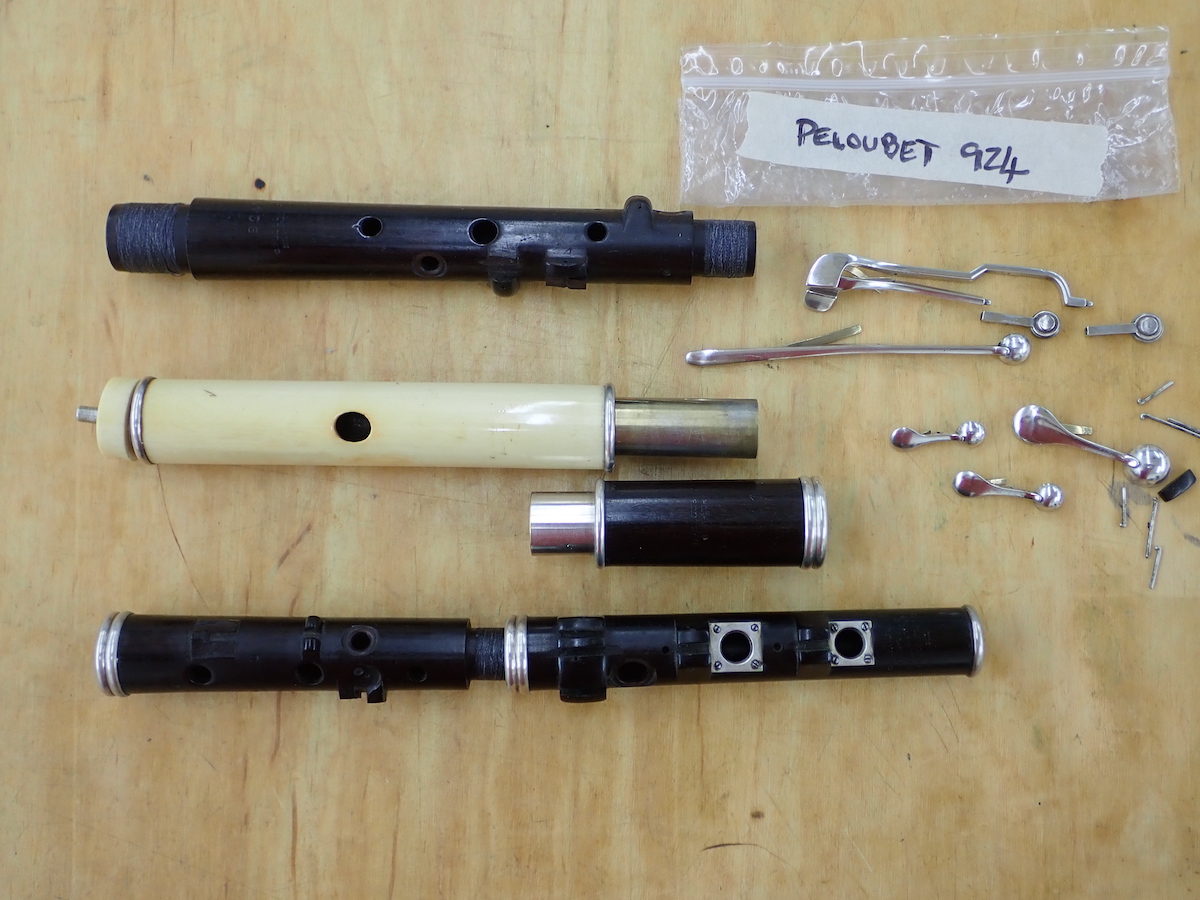
I am currently working on two American flutes made by Chabrier Peloubet, in his factory in Bloomfield, New Jersey, USA. Note, this
is very close to New York, where McKenna lived, and where Peloubet also had business property. Both these flutes
look quite similar to McKenna’s flute. I’ve attached a picture of each of them (taken this evening). The first one in particular shares
quite a few details, as well as some general similarities, with the McKenna flute. I could easily see McKenna’s flute having been made
by Peloubet, but there were other makers around the same region and era who also made very similar looking flutes.
And thank you Kenny! I love following the links you post! How do you come up with all this stuff? 
There are some more details about the first of those Peloubet flutes here:
http://jonathanwalpole.com/c-peloubet-8-key
You can read a lot more detail about Peloubet, his flutes, and the scale of his business, here:
http://jonathanwalpole.com/wp-content/uploads/2019/01/PeloubetArticle.pdf
And this article contains some background information about several of the other well known American flute makers of the time:
Very good, Paddler. I haven’t had a chance to dip deeply into those resources, but I think that more than answers my quibbles about the bodies looking so English.
Where do you think the ivory heads came from? I know a lot of period German flutes had ivory heads, but not that many English ones. Not that many pachyderms roaming the suburbs of London in those days? But not that many in Germany or the US either. And whoever got the idea that the ideal starting point for a longish straight cylindrical head would be the curved tooth of a creature from the other side of the planet? I guess the density (and the fineness) is the attraction, 1.8 to 1.9 compared to 1 for boxwood, 1 to 1.2 for cocus. Should we be revisiting ivory (or at least the substitutes!)? Is it the density or the fineness? In a metal lined head, it’s hard to imagine it’s the density. If it’s the fineness should we be revisiting ivory (substitute) lined embouchure holes? (Is no antique ivory billiard ball safe from these fiends?)
And the jet blackness of the body in your image and the video? We are familiar with the dark-stained cocus often used by English makers in the day, but this looks darker. Indian Ebony, African Blackwood? You get some free with every shipment of elephant tusks?
Sigh, I still remember coming across a Scottish bagpipe maker in his own shop in London in 1974. I pointed to the gorgeous rings on an instrument on display and said where do you get those from? And he reached into a drawer and pulled out an elephant tusk…
And note that the double rings are all on the sockets, not the other section ends. Additional anti-splitting support for the thin wood of the sockets?
Terry, I would submit there is no overwhelming evidence this is elephant ivory. Many of the German Ivory head pieces were wrought from Marine Ivory. The Germans had a lively trade in marine mammals for lamp oil, and had a particular fondness for narwhal tusks, in addition to walrus, for ivory. It almost goes without saying the New England States had a lively whaling industry, and associated exploitation of other marine mammals.
Bob
That would certainly get it a lot closer to home than elephant ivory, an seanduine. I wonder how we could tell the difference? On a quick look, I appear to only have one flute with ivory head here - a German 8-key with Cocobolo body. (Interestingly, the lower end of the head has the double rings we saw on Paddler’s flute, whereas the rest of the rings on this flute are more typical German.)
The head feels heavy, it’s extremely fine - I can’t make out any grain pattern under the zoom microscope at full gain (4.5 with 10X/20 eyepieces, so a magnification of 45), but certainly no pores either, so I don’t think it’s bone. It is of course cracked, and even the edges of the crack look perfect! The material of the head matches the ivory bands on my Bilton boxwood flute in colour and fineness.
Looking at it with the naked eye, you can make out some mild patterns that suggest it was originally curved, i.e. they don’t follow the bore. But maybe that doesn’t tell us anything useful?
Ah, I did turn up another ivory head, also on a German flute. This one even more dramatically cracked, right through the embouchure and opened up full length by about 1.5mm. But otherwise similar to the other head in weight, fineness and colour (yellowed).
I don’t think we should read too much into the blackness of the wood in the photographs of McKenna’s flute, or my Peloubet flutes.
My Peloubet flutes look very different under different light conditions. In bright sunny conditions you can see some lovely red
hues and figure in the cocuswood, and they don’t look very black at all. But indoors under artificial light they look almost black.
I think it all depends on the light and how the camera captures it. This may also be the case for McKenna’s flute. Hammy does
mention that it was made of cocuswood. High quality, cocuswood with nice color and figure is quite a common feature on many
high class American antique flutes.
As for the ivory heads, they were much more common on American flutes than British flutes. I currently have at least a half dozen
ivory headed American flutes in various states of repair, one ivory headed French flute, a couple of ivory headed German flutes,
and two almost identical ivory headed flutes labelled “Clementi London” which I suspect to be American made flutes with fake stamps
(design features, style, etc date much later than the end of Clementi’s business, and are quite different to other Clementi flutes I’ve
owned or seen) … but that is a whole other story. The lower quality American flutes, typically with 1 - 4 keys, often used Ivory for rings,
so there must have been a ready supply of whatever kind of ivory they were using. It seems to me that around 50% of the antique
American flutes I’ve seen use ivory for some part or other. A quick scroll down the American flutes on the following link illustrates this.
“Cites identification guide for ivory and ivory substitutes”
Hmmm, let’s see. Types of ivories: Elephant and Mammoth, Walrus, Sperm Whale and Killer Whale, Narwhal, Hippopotamus, Wart Hog…
Wart Hog? Who’s going to want a flute with an embouchure made of Wart Hog Dentine?
This short article talks about the use of elephant ivory in America in the 1800s, and its link to
the slave trade (ivory came in on slave ships) and export of cotton (most of the world’s cotton
came from America, and it was a very popular import in Africa). Later, with the opening of the
Suez canal, America’s ivory came from India.
https://americanhistory.si.edu/elephants-and-us/ivory-manufactured-luxury-0
If you dig into the earlier links I sent about Peloubet, you will see that the 1850 census lists
him as spending $800 per year on raw materials (listed as wood, metal and ivory). In today’s
terms that is well over $30,000 for his raw materials. And as far as I can tell, he was relatively
small-scale compared to other flute making centers in America, such as those in Fluteville (see
link below).
http://jonathanwalpole.com/wp-content/uploads/2019/01/Hopkins-from-Flutist-Quarterly-Summer-2015.pdf
Here is another interesting piece of information to go with the above. Hopefully, this hasn’t strayed too far from the original post, but it is at least still tangentially related to McKenna’s flute … 
So, the American History article above claims that the Connecticut River Valley was the center of the American elephant ivory trade, with huge
volumes entering America at that location. Interesting, Fluteville was located right there (Litchfield, Connecticut) at the same time, so it is not
surprising that they had easy access to a lot of elephant ivory.
Apparently, the many “…ville” place names in that location sprang up at the start of the Industrial Revolution in America, mostly named after their rich founders, but occasionally, as in
the case of Fluteville, they were named for the product they produced. These “factory villages” were basically Americas answers to Britain’s “satanic mills”, and were, in contrast, designed
to provide nice living conditions and good wages for their workers. The article below has a brief discussion of these Connecticut “factory villages” (although I have to add that I suspect the
“ville” suffix more likely came from the French word for “town”, which is “ville”, so it doesn’t necessarily mean “village” as we use the term).
https://www.ctexplored.org/the-american-factory-village-made-in-connecticut/
So, putting all this together, we had town in Connecticut established specifically to house the factory and its workers whose primary purpose was to make flutes using industrialized methods.
This was co-located with the center for importing elephant ivory into America, and this (ivory import) was a huge business, initially built on the trading and transportation infrastructure of
the slave trade. Initial production of musical instruments was stimulated initially by outright trade embargoes and later by very high tariffs on musical instrument imports to America, all of
which grew out of the 1812 war between America and Britain. So, all in all, it is not surprising that we find a lot of American flutes with ivory heads and rings, that appear to have been
mass-produced in a similar way and style to those we see from England … but which are not imports from England.
The differences in pitch and tuning between British and American flutes also has an interesting background based in the way concert pitch evolved in the separate locations. It is
almost by chance that we enjoy American flutes with decent A=440 hz tuning. Apparently, while Britain was racing upwards through pitch standards peaking at British High Pitch,
Americans (being anti-British at the time) opted for the French diapason normal standard (A=435 hz). However, that French standard was initially specified at a temperature of 59 degrees F.
American flute makers found that, at more normal temperatures, their flutes played at a higher pitch. In fact A = 435 at 59 degrees ends up being very close to A=440 at 70 degrees.
Lucky us! 
Fascinating stuff Paddler! As an owner of a Firth & Pond 8 key (circa 1860), which plays great, I love learning more about American flutes.
Eric