Low D whistle plans or dimensions?

After 50 or more years of playing Irish flute, I’ve had to give it away because of increasing discomfort from the playing position. Old hands are stiffening up.

But it’s not tragic, as I have gone back to playing my earlier instrument, the D whistle. The treble D whistle. And enjoying how comfortable and effortless it is.

But every now and then I wonder, should I be having a go at the Low D? To enjoy the flute range, rather than the higher treble D whistle range.

There’s only one thing stopping me finding out. I don’t have one. In fact, I don’t think I’ve ever held one! So, easily fixed, you suggest. Just buy one. But which one?

Turns out you just can’t go into a shop here in Australia and try a few out! And the only be times I’ve bought an instrument without trying it have been complete fails!

And wouldn’t I feel like a complete goose if I bought one, sight unseen, from an overseas supplier, and then found I didn’t like it. Or worse, I couldn’t play it. What do I do with it now? And I’m still left wondering if I’d chosen a different one, would it have been right for me?

OK, you add helpfully, c’mon, you are a flutemaker, aren’t you? So make one.

That approach attracts me more. I’ve made 5 treble D whistles so far, and enjoyed both process and outcomes. So I imagine making a low D would be fun too.

But where do I start? As I said, I don’t think I’ve ever held one, and that doesn’t sound like a good starting point!

I don’t think I have to make the perfect low whistle to answer the questions can I play it, and would I enjoy playing it. I’ve never perfected playing using piper’s hold, which seems essential, so overcoming that would be my primary goal.

And as long as it plays reasonably well, I can get to the point where I can test out some tunes and play it with other musicians to see how it fits in, or fails to.

So, enough of the background, here’s the question. Are there any decent plans available for making a low D whistle? Anyone made them and were happy?

Or is anyone in a position to provide me with enough information to rough out an instrument? I’d need essentially the bore diameter, wall thickness and hole positions, the rest I can probably determine. I should make it clear that I’m not intending to make these commercially, just make something to try out on.

Or, perhaps some you established Low D whistle players have a much better suggestion as to how I should proceed? I’m listening!
My first thought is that Guido Gonzato of Low Tech whistle fame has his plans available, just jump to the “plans” section and scroll down to the low D. The "Low-Tech" Whistle: How to make a PVC whistle. I made an F whistle using the plans, though (since I was using PVC) I found the PVC I had to be too thick to make the crisp-sounding whistle I wanted.

However, I don’t think anything is wrong with the plans, as I know they’re generally highly-regarded, so that might be a good starting point for dimensions.

I’d never heard of the low-tech whistle site before–that’s pretty cool. Lots of useful info there. I loved the “Art of tuning” section. Definitely good info to act as a point of departure. Finger hole sizes and placements will have to be tweaked if one is using thin-walled aluminum tubing instead of PVC, but that is generally just a matter of scooting the holes down the bore a bit.

I agree that Guido Gonzato is a good place to start. One of the great things about his design is how easy it is to tweak the window length to get the balance between octaves where you want it.

One disadvantage of the Gonzato head design for low whistles is that wider PVC pipe bores tend to have thicker walls, and this leads to a windway that’s higher than you might want for air efficiency.

If I had access to a number of well-made flute bodies (ahem), I’d be tempted to make my first target a whistle head for one of them. I’m not sure how easily the Low-Tech design would adapt to this, but it could be a great time-saver.

I think that in lieu of using PVC, Terry might use Delrin for the whistle head, that way he can machine it as precisely as desired without relying on a standard thickness. Terry, I think you make Delrin flutes upon occasion?

Thanks, Whistling Guitar. I had come across this site in the run up to posting my query, but with absolutely no experience with Low D whistles had no way to evaluate what I was seeing!

I guess I’d Iike people’s views on two things from that site…

The Low D drawing calls for 22mm bore tubing. Quite a bit more than a D flute of the same pitch, maximum 19mm. Can anyone advise the approximate bore diameters of their low D whistles?

And the 5th fingerhole is given as 12mm. That again is larger than I am used to on the flute, although I use pretty severe undercutting on the large hole flutes to keep it to 10mm. I wondered how difficult it is to seal a 12mm hole using piper’s hold. Can anyone advise the approximate diameter of their 5th fingerhole?

I happen to have a treble recorder here at the moment for its annual service, so I thought it might be fun to try it’s head on a keyless Prattens Perfected I have in stock. Just needed a layer of thick thread on top of the corked tenon to make recorder head fit flute body. It did work, although because the head is much shorter than it would need to be, the tuning was too high and inaccurate.

The head bore of the treble was about 19mm, which is the same as the flute head. Much less than the bore of the whistle on the website, 22mm. I imagine a 22mm bore whistle head would do some weird things if fitted to the Prattens body!

Yes, and I also used Delrin for the several treble D whistle heads I’ve made. So, that certainly is an option if I go ahead. Or I could use the PVC tubing but turn it down to ideal if too thick.

I guess it begs the question though, what would be a good windway height for a Low D whistle?

And windway width and window length? He gives 12 to 14mm for the width and 8mm for the length. A lot more than the treble whistle dimensions I am used to. But I guess we expect that.

I don’t have my MK low D handy at the moment, so I can’t say what the windway height is, but I remember that the bore was 21mm, and the 5th tonehole was 11mm. Slightly smaller, though not much!

Sounds near enough to me, thanks WhistlingGuitar! I noticed that the Hans Bracket data seems to support a bore diameter around 22, 23 mm.

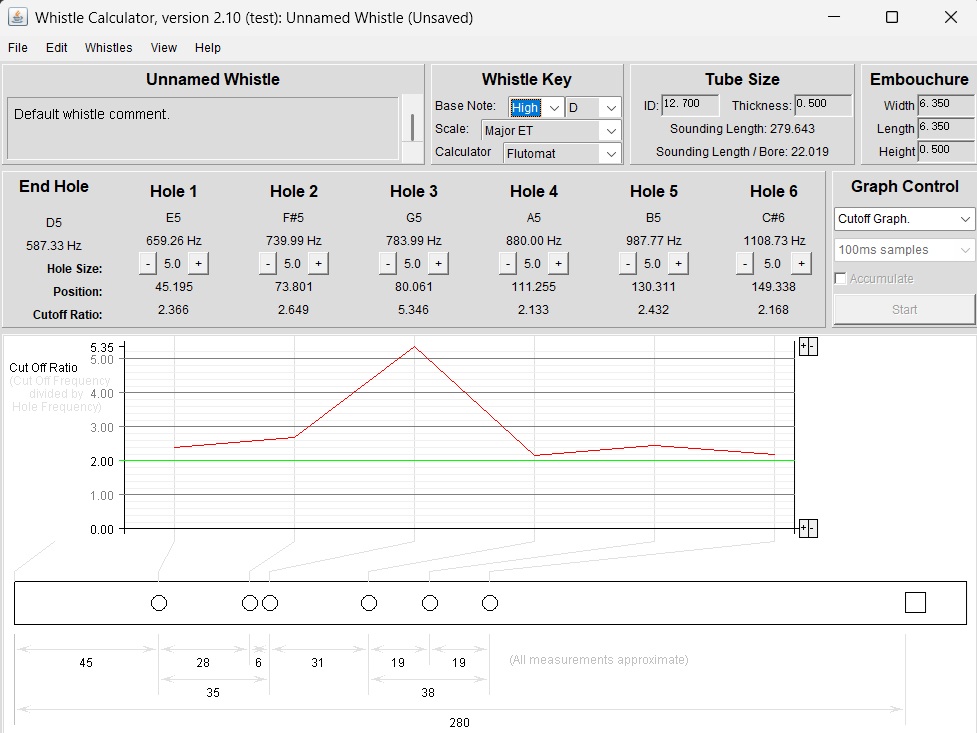
Here is a whistle calculator app:

needs JAVA enviroment.

In the absence of a really good whistle to copy from or at least to use as a point of departure (or in the absence of reliable measurements), I think experimentation is the only way. A lot of my own experiments with flutes and whistles involved taking data from a flute in one key and then scaling the dimensions up or down to make a higher or lower flute/whistle. But not all measurements scale up or down the same way.

So if I have a high D whistle with a 12mm bore and a windway that is 6mm wide and 1mm high (for example), then if I attempt a low D using a 20mm bore (which is the perfect size I think, in terms of good aspect ratio), I would scale the width of the windway to match, but I’d probably leave the height of the windway at 1mm. Same with the window itself. I’d widen it in proportion to the bore, but I wouldn’t scale the length quite the same.

I don’t know how helpful this is (since I don’t actually have any hard data to share for a low D whistle) but I tend to lean into the experimentation part because I find that it helps me understand the various design factors better. So I might make a dozen Delrin whistle heads, simply trying all manner of variations to see what I like best. But this process is aimed at refining a design that I mean to market, so I’ll take the rather slow road of experimentation, whereas your stated goal is not commercial but personal: if you just want to make yourself a solid, playable whistle without all the fuss, then this approach would be very cumbersome!

Do you have any whistle playing friends who might loan you a couple of decent examples to check out? Plans are great, but I’ve never found that they compare to being able to examine a good sample.

Terry, I sent you a PM with all the data you need to make yourself a good one.

I didn’t want to post it all to the forum because its mined from an existing instrument and I don’t want to publish the maker’s data that widely, at least not in that level of detail.

Wow, is that still in use? I wrote that ages ago.

How are people finding it? Any bugs? Niggles? Requests? I am now retired, so I may find time to modify it to suit your needs…..

(I know that it tries to do too many things without a clear GUI)

I found it here: Tin Whistle Calculator download | SourceForge.net

It’s still a handy tool for whistle makers, but maybe you could add parameters about head sizes as discussed above, the “embouchure“ part in the app seems to be for flutes only.

1 Like

Not locally. One of the downsides of living in a secluded coastal village is the paucity of low D whistles!

Thanks, Paddler that looks like it will be a good place to start. My next challenge will be finding some appropriately sized tubing. Again, our little coastal community isn’t well endowed with tubing suppliers. I might have to venture further afield!

Terry I found myself in that position around 20 years ago. After being a keen flutist for decades hand and wrist pain brought my fluteplaying days to an end.

I’ve documented here on these pages my lengthy quest to find a Low D whistle that could replace the flute. Bottom line, there isn’t one.

Oh yes I’ve found what I feel is the best Low D out there, a Colin Goldie. And if I were in your shoes, a skilled instrument maker wanting to build a top-notch Low D, I would acquire a Goldie and examine it and play it at length and let it teach me how to make a great Low D.

Because I think there’s more to a musical instrument than specs. Even Goldies built to the same specs have subtle differences.

Since I found that even the very best Low D Whistle simply can’t do what flutes do, I’ve acquired a Vertical Flute, something I’ve needed for 20 years.

This flute, the "Selkie”, has a rounded blow-hole which a transverse flute player can play intuitively, getting every nuance of breath-control and tone-colour of a top-notch Irish flute.

The ergonomics are those of any vertically-held instrument: no hand cramping! no wrist pain! no neck and shoulder pain! Actually the ergonomics are better than a Low D Whistle due to a slimmer tube and more comfortably-spaced finger-holes.

My beloved Colin Goldie Low D Whistle is the end-product of over a decade of trying dozens of makes of Low D’s but after getting the Selkie the Low D Whistle has had little face-time.

1 Like

Theobald Boehm wrote that if he hadn’t needed to worry about the third register, the bore diameter of his flutes would have been 20 mm.

Yes! I had read that in his book, and when I made my Essential Flute in the key of D (a wooden flute with a Boehm taper in the head) I used a 20mm bore instead of 19, since for most players the third octave is not hugely important.

1 Like