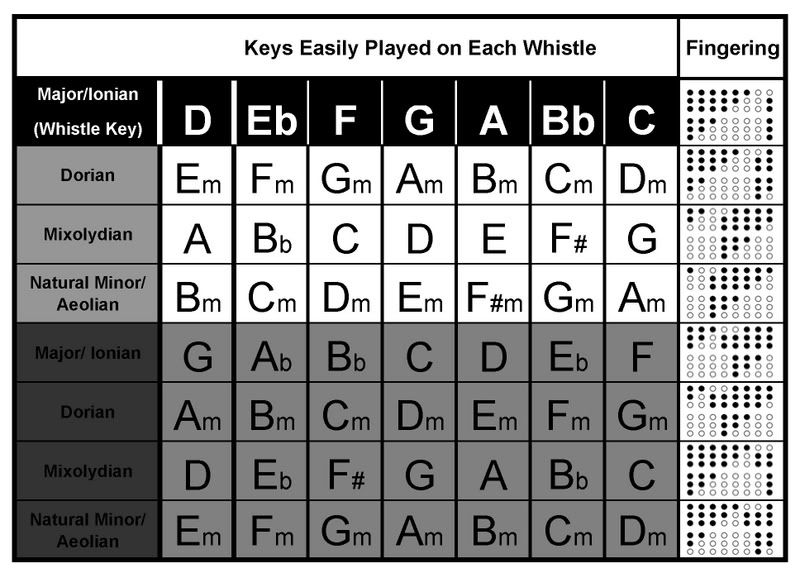
I know from past interactions that some of you here are well acquainted with music theory. Several years back I had created a small chart as a quick reference for myself to help remember the keys playable on different whistles. I should state (though I’m sure it will soon become obvious) that my music theory is very basic at best.
What I was aiming for was to create a chart that would illustrate what keys (pertaining to Irish music) are playable on common whistles; that is D, Eb, F, G, A, and Bb (all of these except for A can be had in a Generation or other commercially available brand). For the sake of a simple chart I did not include keys such as C# or B that can be had in a Susato or Burke (for example) but are less common. I also did not include any scales that require half-holing or cross-fingering beyond the common Cnat.
I think that the Dorian row in this chart is a little redundant and misleading by adding the “m” after the key to indicate “minor”. In other words, saying E Dorian is sensible enough and saying Em Dorian is either incorrect or redundant. Could someone maybe shed some light on this for me.
This isn’t of great importance as it’s not something I even use anymore but another topic on the board got me thinking about it again. I organized the chart in a way that made sense to me as a whistle player but if you have trouble reading it then let me know. Basically the black boxes across the top represent the whistle key. The boxes underneath them in the same column represent other keys that can be played on that whistle. The darker ones on the lower half indicate the second major key (and related modal scales) playable on that whistle thanks to the Cnat cross fingering.
Thanks in advance for your insight. If you are interested in using this chart for yourself please feel free to (though I’d recommend staying tuned to check it’s accuracy).
Cheers,
Johnny