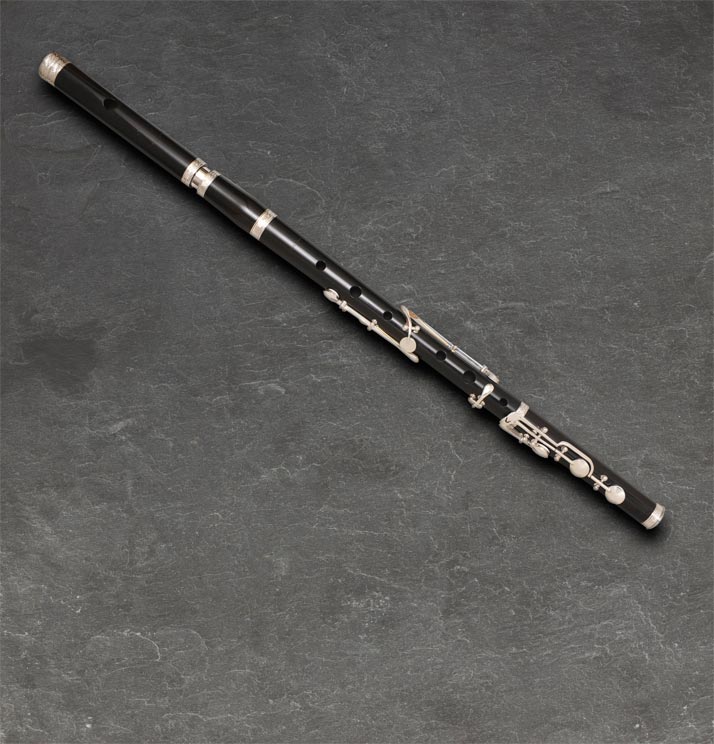
Hey yall. I am finally putting in an order for a flute, and I want some keys. I am just starting off with two, as that is all I can afford at the moment: Bb and G#. I am wondering if these keys need any special modifications for my grip. Is there a long or short Bb key? Same with G# or any other keys that would probably need specifications because I want key blocks for future keys as well.
Thanks!
Hi,
Long Bb key is uncommon, I have ever seen this one on a Sébastien Villoing’s flute (a flutemaker who lives in Paris). Here is his website : http://www.flutesvilloing.fr/
There are certainly other flutemakers who offer this kind of key.
I have never heard about a long G# key, but perhaps it exists.
All the best
Some makers offer a bottom index finger Bb key, with the touch where that for a Cnat key would be.
there is no long G# on irish flutes, to the best of my knowledge. No reason you can’t reach it.
There is a long Bb–it has a right hand touch, as mentioned in an earlier post in this thread. If my experience is any indication, FWIW, the Bb is pretty easy to halfhole.
Also a note not so much used.
If it were me the second key would be a short F natural. That works fine with piper’s grip.
You might consider the G # and the F natural.
And usually there are decent cross-fingerings as well…
You haven’t seen mine!
No reason you can’t reach it.
Lack of fingers!
Given that Cnat, Bb & G# all have reasonably usable cross-fingerings on most flutes, the first keys to contemplate adding, IMO ( and regardless of how you hold the flute) should be Fnat and Eb, which do not have viable cross-fingerings, plus Eb is particularly awkward to half-hole.
Did you see this one?
https://forums.chiffandfipple.com/t/fs-hamilton-6-key-blackwood-flute/86664/1
Thanks for the advice guys. I will have to rethink my key options.
Having and correctly using an Eb key also has other non-essential (in trad) but helpful benefits in improving strength of tone and intonation of certain other notes and opens up the lower 3rd 8ve significantly compared to a keyless flute.
FWIW, though, my overall advice would be (and has often/always been), don’t potch about adding the odd key to your best flute. If you want to learn to use keys, go for the full kit in an affordable form, i.e. a refurbished and proven to be Concert Pitch and decently playable nach Meyer. You could, with patience, even find one with the extra Bb touch for R1. You can probably acquire one of those for about the money you’re looking at spending on adding 2 or 3 random keys to your bespoke new flute. The nach Meyer would retain value and be resaleable once its job was done, once you knew whether or not the keyed route is for you. It would also likely make you look at/experiment with revising your hold. A commissioned modern flute with an odd arrangement of unusually placed keys may not retain value so well if it proves unsuitable in the upshot. Adding keys piecemeal entails a messy, drawn out process of relearning: a direct switch to 8-key is more of a jump, but you can tackle the adaptation full on and once and for all.
E.g. Norwegian “nach Meyer” style flute on eBay
Disclaimer - this just came to my attention on another forum. I’ve just quickly perused the eBay listing. I don’t vouch for the vendor’s claims about playing pitch. To verify, one would need to enquire as to the (slide closed) Sounding Length and C#-Eb length. If those are approximately (within say 2mm) 624mm (NB this is a B foot flute!) and 254mm respectively, then the flute should be viable for Concert Pitch use. If the SL is significantly more, the flute really won’t cope with CP, even if it can be tuned to get a CP A.
However, it looks like a decent flute - we’ve come across this Norwegian German-style maker before here on C&F. Assuming the overhaul job has been done well, I think the asking price is perhaps a little on the high side, but not too unrealistic - and it could be good value for money (far more so than a certain nach Meyer currently on offer, overhauled by John Gallagher and property of a renowned player, but no way worth over U$2k!).
A few more points about it - it has a separate duplicate Bb key for R1 (not a second lever to the thumb key as more commonly seen). The B foot need not be a discouragement - it can just be ignored, or I suppose one could remove (and safely store) the low C#, C & B keys - though as the B key will share an axle with the long F, a little filler tube might be needed on said axle to keep the F key’s operation true. BUT, a flute like this is unlikely to be at all accessible to a pipers’ hold player - you’d pretty much have to convert to a Rockstro/classical hold.
Anyway, it was just intended as an example of what is possible - similar things come up (including basic 8-key, C foot version) fairly regularly, restored or not (DIY overhaul is no biggie on one in generally sound but unrestored/unoverhauled condition). So long as you acquire one at Concert Pitch so you can play with others, these are by far the best (cheapest, lowest risk) way of experimenting with learning to use keys. Forget adding odds & sods to a modern flute, at least until experience shows exactly what you need/want. Even a Low Pitch one (theoretically and with patience available more cheaply) would serve the exploratory purpose.
Also by way of example, an M&E 6-keyer (not the greatest flutes, but hey, you want to explore keys!) went as-new 2nd hand for just U$550 recently. There’s another here. Ways to skin a cat…
Wow, thanks for all of that, Jem!
I use a piper’s grip and I can say I’m quite grateful for the long RH Bb key on my flute. Not that I use it much, though – but it’s great when I do. The keys I use most are the G#, the long F, and the D#, in that order. In order of use after those it’s the long C, the short F, and the Bb.
(Edited to correct a word-o. It’s not a long G#, it’s a regular G#.)
The keys I use most are the long G#, the long F, and the D#, in that order
Not to derail the discussion, but I am curious about the long G# that Cathy describes in the above. I’ve only seen G# keys on simple system flutes that are meant to be operated by the LH pinky, and are quite short. Even the offset German style, or "under the long C nat key French style could hardly be described as “long” keys. Am I missing something?
Oh, no!!! I did that totally wrong. It’s not a long G#; it’s a regular one. I am so sorry. It’s a long Bb key. I’ll edit.
FWIW, my other flute was missing its G# key when I got it, so I had John Gallagher make a key with a bigger touch than what Murrays usually have. That helped a lot!
Speaking of G# keys, the most user-friendly wooden-flute G# I’ve come across is the one George Ormiston makes. Because his keys are post-mounted he’s able to angle and curve it; the angle is more like a Boehm G# key.