Does anyone make wooden Bb flutes with conical bore BUT Boehm system keys.
By “Irish Bb” I mean the Bb is where the D is on your standard Irish flute which on Boehm system would be the R ring fiinger down with the R pinky operating B and the lower notes A and G#.
Thanks.
So, you want a conoid bore Bohm system flute like these normal “concert” flutes (from Rick Wilson’s website) though at varying pitch-standards:-
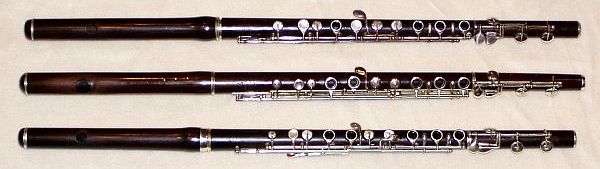
or these (currently available to buy on Tony Bingham’s website!):-
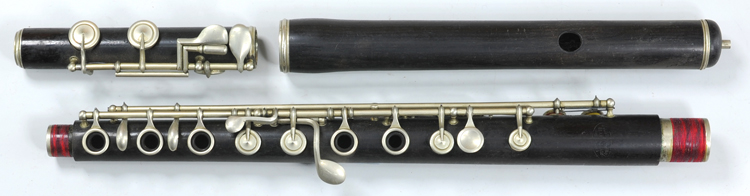
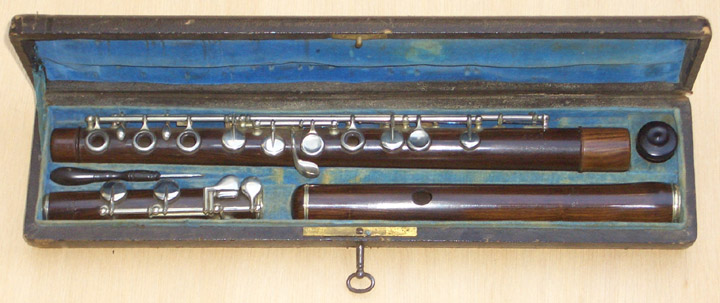

but in flute d’amour format, which in classical terminology would be termed “in Ab”?
I’ve never seen (that I can recall) any mention of such, let alone pictures, even in the antique sector. I am quite certain no-one is making such now, though the occasional standard modern style cylindrical Bohm flute d’amour (in any of the tonalities we folkies would call “low C, B or Bb” - “Bb, A and Ab” to orchestral types) may get made on commission. Almost no-one makes replicas of the concert flute later conoid Bohm type, let alone lower pitched ones. However, French maker Claire Soubeyran does offer replicas of concert flutes in this form.
The only other possibility would be from the field of band flutes - they certainly use(d) low Bb flutes - most of those I remember seeing pictures of were either plain simple system types or hybrids using rod-axle mechanisms and partial or all platter keys borrowing Bohm mechanical advances but essentially retaining simple system fingering. However, there are pictures of a couple with Bohm systems here (as well as some others - top one is “simple system” on a cylinder body, 2nd & 3rd are the Bohm system ones, bottom two are simple system on conoid bodies), but they are cylindrical bodied, not conoid - and almost certainly HP too. Again, I don’t recall hearing of anyone making anything like this in recent times.
Do this conical flutes with Bohm system keys sound just like our SS?
I’ve never played one, Lorenzo, nor that I recall have I heard recordings using them - but you can find written descriptions of their sound/playing character on the sites I linked. My impression from such descriptions is that they keep the part of the tone character that is to do with the bore, but have the greater even-ness of tone between notes that Bohm’s hole schema offers - and probably a slightly “bigger” sound overall due to the larger tone-holes.
Yes, the washout after jem’s very informative post, is a reworking of my OP to say exactly what I already said (directly and impliedly):-
Does anyone make conical bore Boehm system wooden flute in Bb which would be called Ab flute in orchestral music circles?
Possible answer pending.
Thanks.
Claire Soubeyan (spelling?) in France makes these in D (conical Boehm). She might make them in Bb.
I’ve wanted to. Someday.When I get a trust fund…
Casey
thanks Casey, I’ll look her up.
The very simple reason that I want Boehm key system is because in the last year I have self taught the first keyed flute I have ever owned being a Boehm system C. I want that to be template for other keyed flutes.
This reduces the fingering templates to 2 for me:-
- simple hole - (tinwhistle), Irish flute, bansuri and dizi
- Boehm system
for those that do not understand me there are IMO 4 “regular” (to us) fingering templates in the world of flutes and fipple flutes:-
a. as in tin whistle/bansuri etc(which I describe as “simple hole”)
b. recorder
c. simple system (as in keyed pre Boehm classical flutes)
d. Boehm.
@ Casey & talasiga - what I said in my 1st post. Soubeyran (I gave her link!) and a lot of dosh looks the only vague possibility. The short, direct answer to the OP Q (implied above) appears to be ‘no’ but it would be worth contacting Soubeyran to see if she would contemplate such a commission.
As she would presumably not have an original to copy but would have to work up a hybrid and experimental design which would then likely require making a significant amount of dedicated tooling, I’d guess at a straight refusal, but if she (or any maker) would contemplate it, the price would be astronomical. The sheer size of the piece of timber needed for the necessarily one-piece main body and the risks in working it would be a major stumbling block. When Rudall Carte were making those Bohm system band flutes a century ago, they had the sources and large stocks-in-hand of timber to support such projects: modern one-man-band makers probably don’t, and such things have to be planned for in these days of reduced resources.
jem thanks for your reality check comments on availability possibility.
Still, I’d like to see if anyone out there knows about such a maker.
also, am I right when I think of you as someone who plays both simple system and Boehm system reasonably well? Remind me.
I learnt Bohm originally and apart from whistles and recorders played it for 5+ years before switching to 8-key, but mostly self-taught - never got fluent in the 3rd 8ve. I’ve hardly played it for 20+ years and struggle if I pick one up casually, though it comes back a bit if I stick at it.
thanks for that background jem.
BtW, for those not familiar with the term flute d’amore or flute d’amour here is s concise
article
Actually I have been thinking of contacting Claire about this myself. It wouldn’t be that hard to do something, perhaps using my acoustics and her key knowledge. Figuring out where Boehm tone holes would go is a relatively easy process. Then one just has to make keywork that fits that schema. A D flute key setup simply could be modified by longer axles, and wider key cups. I am almost convinced I could do something like this myself, using off the shelf replacement keys for an alto flute or D flute or maybe a mix. Contact me offline in a month - this is a possibility worth exploring, since nobody is making this. I could do both Bb and A. Easy if I don’t have to sweat the keywork myself!
Another lovely day in southern CA on this research trip. Except today is our day off. Going to the Yanks Museum in Chino, then dinner with my daughter Lila over at CalArts.
Casey
I LOVE the Böhm fingering system (good ole silver typewriter is my primary flute), and have always dreamed of getting a wooden one, one day. I had no idea they came in conoid form! I had assumed that when Theobald concocted his fingering system, he did it with the cylindrical body in mind.
If it weren’t for the astronomical price factor I’d start saving up for one of these babies (I’d love one in D @ A=415hz). Wooden modern Böhm flutes tend to range around $11,000 and up that I’ve seen. Though there are those $600 pakistani/chinese ones floating around on eBay, haha.
Keep us posted on any developments you make in the field, Casey! (both your trip and this potential flute venture!)
Edit: checked out Soubeyran’s site, her prices aren’t that bad actually;
Student Traverso (in D, A=415) is only 700euros.
Rottenburgh Traverso (in D, A=415) is only 1300euros
Conical Böhm is only 6100euros (~$8500)
Haha, all those prices are way out of my budget for a long time. Though if I ever do decide to grab a traverso, that student model is mighty appealing!
I suppose if one already has reamers for a Rudall style low Bb bore, that’s a good step on the way to the necessary tooling… but you’d still have to make dedicated hole-cutters. I agree the actual tone-hole schema wouldn’t be that big a deal. What about the timber, though, Casey? That’d need to be a pretty substantial and flawless baulk for the main body - and I presume a Bohm body, even a conoid one, would be turned down rather thinner than one for a simple system flute.
@ sigurthr - the history is readily available - see relevant parts of Rick Wilson’s site, read Bohm’s own book, etc… Bohm’s first, 1832 design was on a conoid bore. After the later re-design that introduced the cylinder bore with “parabolic” head, some makers (viz the pictures I linked above) chose to adapt the new mechanism to fit on a conoid bore.
Not necessarily so. Since what you are looking for is the acoustical sound of one of my low Bb or A flutes, you would use the same wall thickness. Just the tone holes would be locate differently compared to my 6 hole.
As to wood, I can get backwood that is flawless for such things.
Casey
I’m surprised Casey, you said you won’t be making fully keyed footjoints anymore but you’re willing to make a Bohm system keywork…
Its not surprising if one is aware that most makers are often dogged (according to my readings and converstaions with various makers) by simple system keyed footjoints.
It is a matter of recorded history that Boehm footjoints are not rabious.
Which leads me to wonder - by no means for the first time - why on earth they didn’t do the Boehm style foojoint much earlier, and, as soon as they knew about it, incorporate it into the design of the simple system flutes. I mean, the Boehm footjoint is clearly better, isn’t it? And does the same job … so why?
Is this worthy of a new thread, does anyone think? Or has it been done to death hereabouts before and someone can point me in the right direction? 
well I like to see your point in this topic ben because it goes toward the whole issue of why someone (like me) would consider a Boehm key version when there are umpteen makers of simple system Bb flutes with keyed footjoint down to Ab.
I have given my personal reasons in the previous page but there are probably a raft of other reasons that could promote the thing.
Without watering down the point about mechanical advantages of the rod-axle foot mechanism in any way, just to point out there are not “umpteen” current simple system makers offering full 8-keyed simple system low Bb flutes. There are quite a few offering keyless ones now, some of whom might add a few keys on commission, but hell, there aren’t all that many makers offering 8-key D concert flutes routinely! Wilkes, Grinter, Burns that I can think of offhand “offer”/have been known to make 8-key low Bbs. I haven’t gone to The List to check, but I can’t casually think of (m)any more.
As for Ben’s point, there are qute a lot of later C19th and early C20th simple system English flutes with the Bohm style foot mechanism - both Hawkes and Boosey took to it, and so did Rudall Carte. However, doubtless among the persistent users of 8-key flutes there was a degree of conservatism of taste. Even pewter plugs for old-style foot-joints often persisted after card backed pads that would have worked better were developed - and were used by some makers (routinely on non-English SS flutes).