The topic of square tone holes came up on the sax forum and someone posted this.
https://squareoneflutes.com/flutes/
I can wait to hear Terry McGee’s analysis of this.  I’m think that the cost of a re-pad is going to be a real drag.
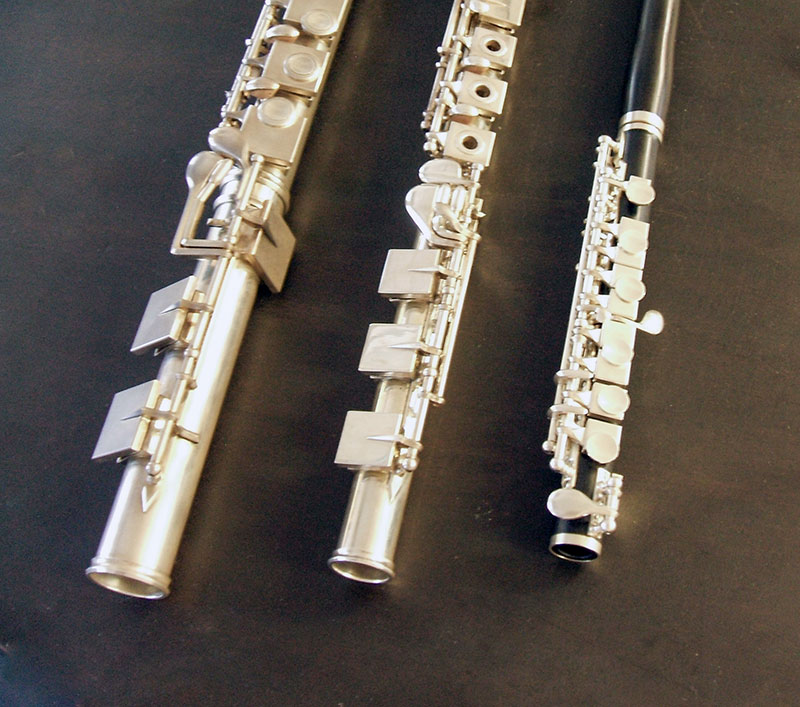
The topic of square tone holes came up on the sax forum and someone posted this.
https://squareoneflutes.com/flutes/
I can wait to hear Terry McGee’s analysis of this. I’m think that the cost of a re-pad is going to be a real drag.
Considering that the open-hole keys have round holes, I have difficulty seeing the point.
And that the fingertips operating the said keys tend to be round as well.
The holes underneath do indeed appear to be square as well. It likely makes little difference to the sound produced and will be about visual aesthetics, but if I wanted something of that kind I’d prefer one with hexagonal holes and keys.
If I’m not mistaken, given a fixed perimeter a circle will have the maximum area. So I don’t see the point in this either. Unless they’re saying that a square tone hole will provide some other benefit than a circle with the same area.
And yeah, what Nano said about the open holes. That too.
Apparently the design does indeed incorporate square toneholes. Mr. Lopatin confirms this:
… but hasn’t told us what difference, if any, it makes.
Spoke too soon; here we go:

https://squareoneflutes.com/pan-article-june-2007/

I leave it to the makers to make heads and tails of it. Way beyond my pay grade.Same here. What he’s saying sounds like it could make sense but I’m no acoustic engineer.
It does actually make sense, except that rectangular holes could be better still, with the ideal hole being a ring opening right round the entire tube. However, the bell note often seems to be the weakest one, even though it has what should be a perfect opening at the end, so there must be more to it. A good test for this though might be to make a flute/whistle with diamond shaped holes and an otherwise identical one with rectangular holes to maximise the differences, and I suspect it would prove him right, but there may be issues with the way sharp corners affect the air flow.
This has fed into another idea I was thinking about though where rectangular holes with the longer dimension running round the tube could be advantageous, but I’ve started a new thread about that called tuning slide revolution, and I’ve put that in the whistle subforum (even though it applies equally to flutes).
If it allows him the engineer a bigger hole - with a key that seals and unseals as effectively as on a circular hole - I can see that ought to be an advantage. As for the rest “seems to make sense” is not enough for me. I’d need an analysis by a wind instrument acoustician. The effective length at the hole is well beyond the ‘top’ edge.
Do we know if James Galway has bought one yet?